Dark matter visualization
1344×768 · AVIF · CC BY 4.0
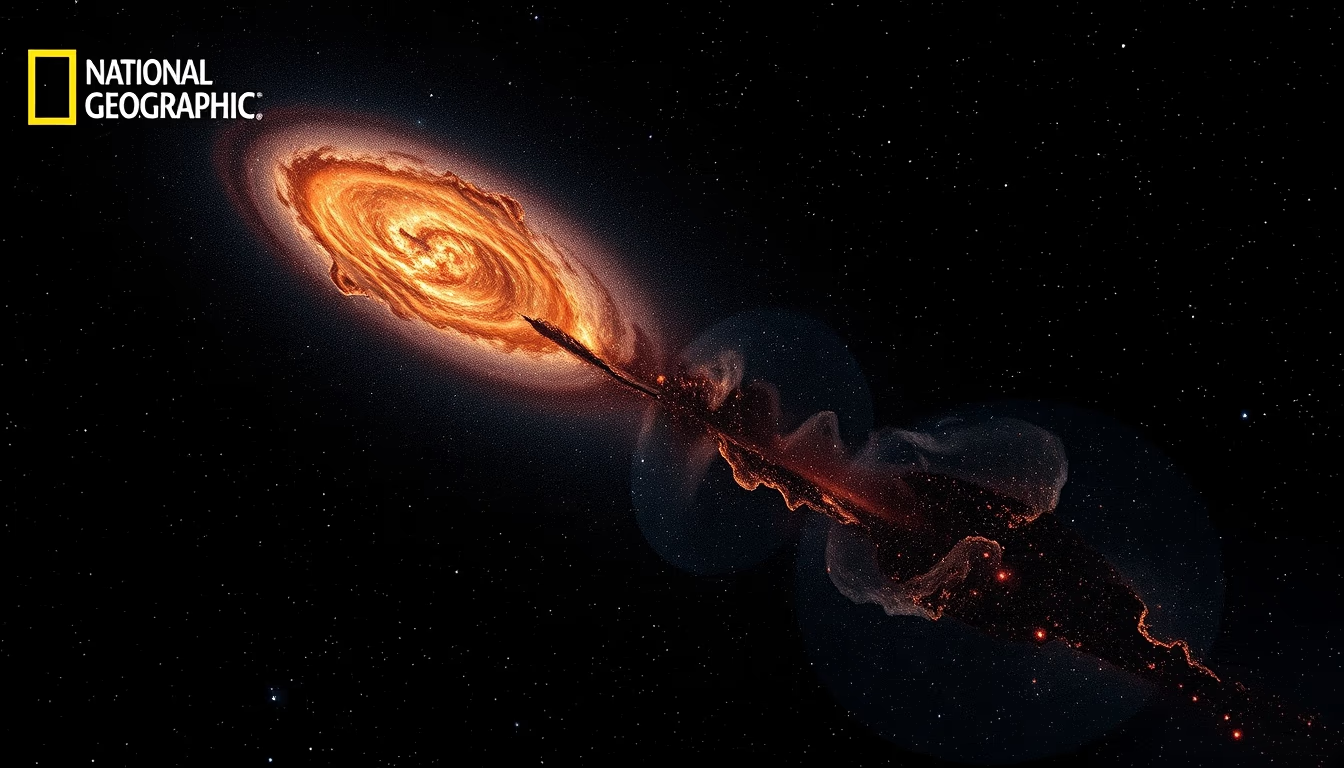
Dark matter makes up 85% of the universe's matter and is revealed through gravitational lensing and cosmological simulations.
About this subject
Dark matter is a form of matter that does not interact with light but exerts gravitational influence. It makes up about 85% of all matter in the universe and roughly 27% of its total energy density. Its existence was first proposed by astrophysicist Fritz Zwicky in the 1930s, when he observed that galaxies in the Coma Cluster moved faster than visible matter could account for. Later, in the 1970s, Vera Rubin confirmed these clues by studying spiral galaxy rotation curves, showing that stars at the edges orbited as fast as those near the center, indicating invisible mass.
Visualizing dark matter is challenging because it does not emit, absorb, or reflect light. Scientists use indirect techniques such as mapping gravitational lensing: dark matter warps spacetime, bending light from distant galaxies. Computer simulations, like the Illustris project, recreate the distribution of dark matter on cosmic scales, revealing filamentary structures known as the cosmic web. The Hubble Space Telescope and ESA's Euclid observatory also contribute detailed maps of dark matter distribution across the universe.
The importance of dark matter extends beyond cosmology: it is crucial for the formation of galaxies and large-scale structures. Without it, baryonic matter (protons and neutrons) would not have clumped together to form stars and galaxies. Despite decades of research, its exact nature remains unknown. Candidates include weakly interacting massive particles (WIMPs) and axions. Experiments such as LUX-ZEPLIN and XENONnT aim to directly detect these particles, while observatories like Fermi-LAT search for indirect signals of dark matter annihilation.
Frequently Asked Questions
What is dark matter?
Dark matter is a hypothetical form of matter that does not interact with electromagnetic radiation, making it invisible. Its presence is inferred through gravitational effects, such as galaxy rotation and light distortion via gravitational lensing.
How do we know dark matter exists?
Evidence includes galaxy rotation curves showing constant speeds at the edges, mass distribution in galaxy clusters measured by gravitational lensing, and the cosmic microwave background pattern that indicates its abundance.
Why can't we see dark matter?
It does not interact with light or other particles except through gravity. Therefore, it does not emit, absorb, or reflect electromagnetic radiation, making it invisible to conventional telescopes.
Direct URL
https://pub-c7d6a6ea828543ac903a74a341ccb2e1.r2.dev/imagens/dark-matter-visualization-national-geographic-style-p8.avifHow to credit
Include a visible link back to UtilizAí. Copy one of the snippets below:
<a href="https://xn--utiliza-eza.com/en/midia/imagens/dark-matter-visualization-national-geographic-style-p8">Dark matter visualization</a> by <a href="https://xn--utiliza-eza.com">UtilizAí</a>, licensed under <a href="https://creativecommons.org/licenses/by/4.0/">CC BY 4.0</a>.
[Dark matter visualization](https://xn--utiliza-eza.com/en/midia/imagens/dark-matter-visualization-national-geographic-style-p8) by [UtilizAí](https://xn--utiliza-eza.com), CC BY 4.0
License: CC-BY-4.0