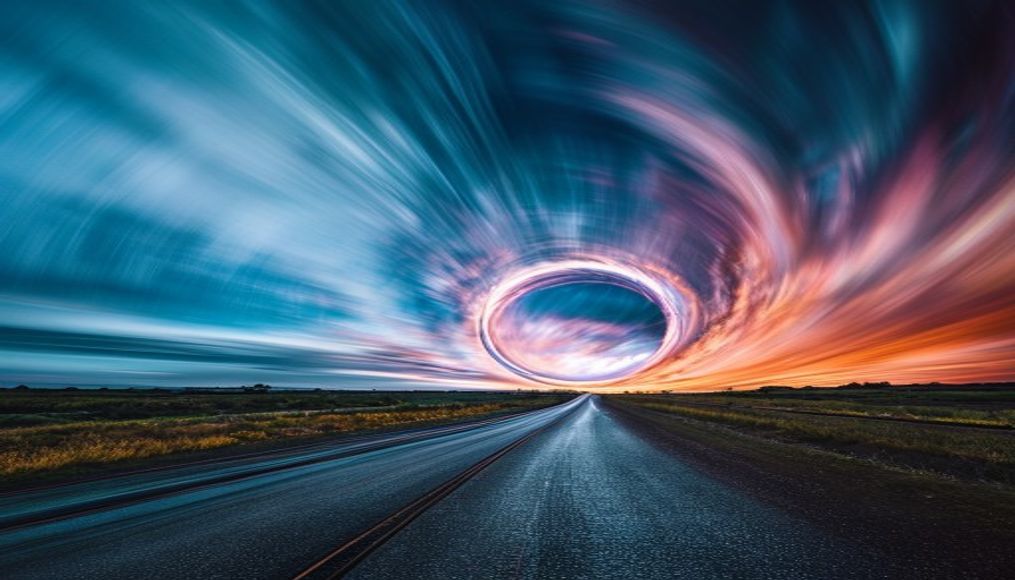
Dark matter visualization
1344×768 · AVIF · CC BY 4.0

Dark matter is an invisible form of matter that makes up about 85% of the universe's total mass, detectable only through its gravitational effects.
About this subject
Dark matter is one of the greatest puzzles in modern cosmology. Unlike ordinary matter, it does not emit, absorb, or reflect light, making it invisible to telescopes. Its existence was inferred from astronomical observations showing that the visible mass of galaxies and clusters is insufficient to explain the observed motions. The first evidence came in the 1930s when astronomer Fritz Zwicky studied the Coma Cluster and noted that galaxies moved so fast they should fly apart unless invisible matter was present. Decades later, in the 1970s, Vera Rubin confirmed the phenomenon by measuring rotation curves of spiral galaxies.
The distribution of dark matter is modeled through computer simulations that reproduce large-scale structure formation. It forms spherical halos around galaxies, acting as gravitational 'glue.' Effects such as weak and strong gravitational lensing allow mapping its presence. In the cosmic microwave background, tiny temperature fluctuations reveal the seeds of cosmic structures, whose amplitude is consistent with a model including cold dark matter and dark energy.
Despite decades of search, the nature of dark matter remains unknown. Leading candidates include particles such as WIMPs (Weakly Interactive Massive Particles), axions, and sterile neutrinos. Underground experiments like LUX-ZEPLIN and XENONnT attempt to detect them directly, while accelerators like the LHC seek to produce them. Space missions such as the Euclid telescope and the Vera Rubin Observatory will map dark matter on a cosmic scale. Understanding it is key to answering questions about the evolution and fate of the universe.
Frequently Asked Questions
What is dark matter?
It is a hypothetical form of matter that does not interact with light, detectable only through its gravitational effects. It makes up about 85% of the universe's total matter.
How do we know dark matter exists?
Evidence comes from observations such as galaxy rotation curves, gravitational lensing, and fluctuations in the cosmic microwave background. Visible matter alone cannot explain the observed gravity.
Why is it called 'dark'?
Because it does not emit, absorb, or reflect light, making it invisible to electromagnetic detectors. It is effectively invisible, but its presence is inferred from gravitational attraction.
Direct URL
https://pub-c7d6a6ea828543ac903a74a341ccb2e1.r2.dev/imagens/dark-matter-visualization-high-fashion-editorial-p9.avifHow to credit
Include a visible link back to UtilizAí. Copy one of the snippets below:
<a href="https://xn--utiliza-eza.com/en/midia/imagens/dark-matter-visualization-high-fashion-editorial-p9">Dark matter visualization</a> by <a href="https://xn--utiliza-eza.com">UtilizAí</a>, licensed under <a href="https://creativecommons.org/licenses/by/4.0/">CC BY 4.0</a>.
[Dark matter visualization](https://xn--utiliza-eza.com/en/midia/imagens/dark-matter-visualization-high-fashion-editorial-p9) by [UtilizAí](https://xn--utiliza-eza.com), CC BY 4.0
License: CC-BY-4.0