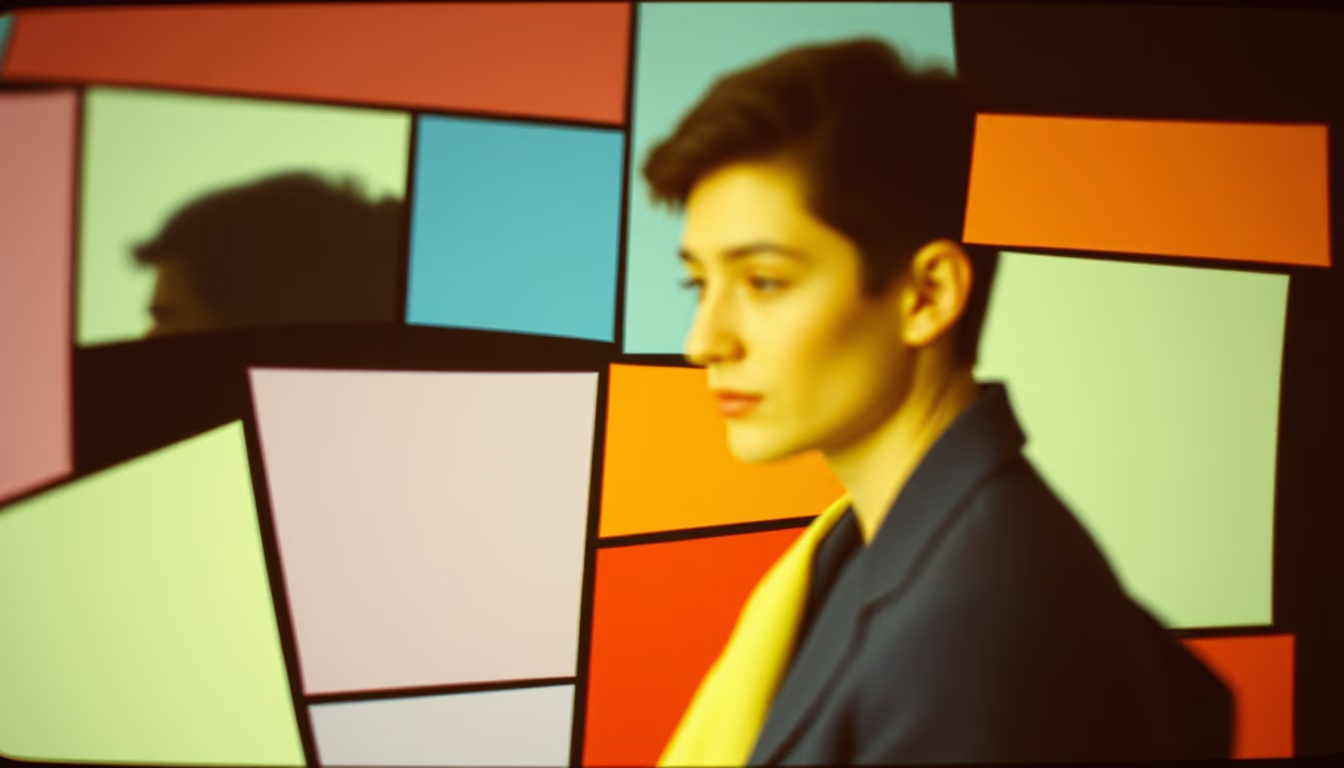
Cubist abstract picasso style
1344×768 · AVIF · CC BY 4.0

Cubism, revolutionized by Picasso and Braque, fragments forms into geometric planes to depict multiple perspectives simultaneously.
About this subject
Cubism was a radical art movement that emerged between 1907 and 1914, led by Pablo Picasso and Georges Braque. Inspired by African and Iberian art, as well as Cézanne's theories, cubism broke with naturalistic representation. Instead of a single viewpoint, figures are decomposed into geometric shapes, cubes, cones, and cylinders, rearranged on a flat surface. This allows the viewer to see the object from multiple angles simultaneously, as if the canvas were a mosaic of temporal and spatial fragments.
Although Picasso never adhered strictly to complete abstraction, cubism paved the way for modern geometric abstraction. Phases such as analytic cubism (1909-1912) and synthetic cubism (1912 onward) explored extreme fragmentation and collage techniques using materials like newspapers and sheet music. The style influenced not only painting but also sculpture, architecture, and design, leaving a lasting legacy on 20th-century art.
In the context of portraiture, cubism challenges the traditional notion of fixed identity. A face can be seen in profile and frontally at once, with displaced eyes and broken noses into planes. This approach is not merely aesthetic but philosophical: it questions human perception and objective reality. Artists like Juan Gris and Fernand Léger expanded these ideas, creating vibrant compositions that prioritize structure over illusion.
Today, the cubist abstract style continues to inspire contemporary artists and illustrators, often used in editorial portraits and magazine covers. Its ability to condense visual complexity into simple, dynamic forms makes it timeless, especially in representations seeking to convey energy, movement, and multiple dimensions of personality.
Frequently Asked Questions
What defines an abstract cubist portrait?
An abstract cubist portrait fragments the face into geometric shapes, showing multiple angles (front, profile, etc.) simultaneously. Colors are often reduced or contrasting, and structural lines dominate over realistic modeling.
Why is Picasso so associated with cubism?
Picasso, along with Braque, pioneered cubism. Works such as 'Les Demoiselles d'Avignon' (1907) and 'Portrait of Ambroise Vollard' (1910) exemplify the break from Renaissance perspective, inspiring an entire generation of artists.
Is abstract cubism still relevant in contemporary art?
Yes. Cubism influenced movements like futurism, constructivism, and geometric abstraction. Today, it is revisited in digital illustration, graphic design, and street art, maintaining its visual and conceptual power.
Direct URL
https://pub-c7d6a6ea828543ac903a74a341ccb2e1.r2.dev/imagens/cubist-abstract-picasso-style-studio-editorial-portrait-fresh6.avifHow to credit
Include a visible link back to UtilizAí. Copy one of the snippets below:
<a href="https://xn--utiliza-eza.com/en/midia/imagens/cubist-abstract-picasso-style-studio-editorial-portrait-fresh6">Cubist abstract picasso style</a> by <a href="https://xn--utiliza-eza.com">UtilizAí</a>, licensed under <a href="https://creativecommons.org/licenses/by/4.0/">CC BY 4.0</a>.
[Cubist abstract picasso style](https://xn--utiliza-eza.com/en/midia/imagens/cubist-abstract-picasso-style-studio-editorial-portrait-fresh6) by [UtilizAí](https://xn--utiliza-eza.com), CC BY 4.0
License: CC-BY-4.0