Cpu chip pin grid
1344×768 · AVIF · CC BY 4.0
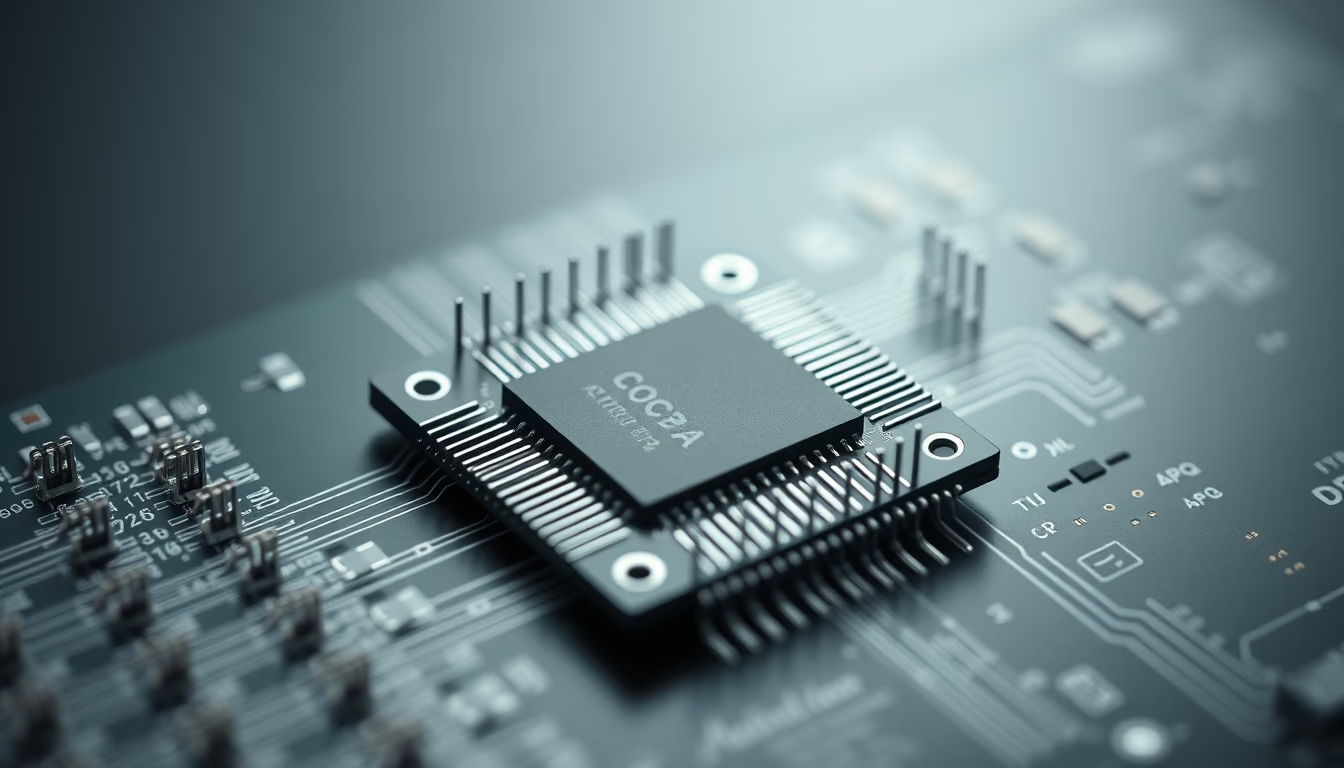
A CPU chip with a pin grid array (PGA) features hundreds of metallic pins that connect the chip to the motherboard, crucial for data and power transfer.
About this subject
The pin grid array (PGA) is a packaging technology for processors where the underside of the chip is covered with rows of conductive pins. These pins fit into corresponding sockets on the motherboard, establishing electrical connections for data, addresses, and power. Unlike the land grid array (LGA), which has flat contacts on the chip and pins in the socket, PGA places pins on the chip itself, making them more prone to damage but simplifying socket design.
Intel used PGA for many of its processors, such as the Pentium 4 and early Core 2 Duo CPUs, before switching to LGA starting with socket LGA 775. AMD, however, adopted PGA for most of its desktop processors, including Ryzen chips with sockets AM4 and AM5, though the AM5 actually uses LGA. Pin counts have increased dramatically: the Intel 8086 (1978) had 40 pins; the AMD Ryzen 9 7950X (AM5 socket) has 1718 pins.
Manufacturing PGA requires precision to avoid bent or broken pins. Pins made of copper alloy are soldered or pressed into the chip substrate. The grid arrangement allows high connection density without increasing package size. This technology was critical for increasing CPU-to-memory bandwidth, especially with 64-bit buses and multiple channels.
Interestingly, PGA has also been used in other integrated circuits, such as FPGAs and memory chips, but its most iconic use is in processors. As CPUs integrate more cores and memory controllers, pin counts will continue to grow in future generations.
Frequently Asked Questions
What is a pin grid array (PGA)?
It is a chip packaging type where the underside has rows of metallic pins that fit into a socket on the motherboard, establishing electrical connections.
What is the difference between PGA and LGA?
In PGA, the pins are on the chip; in LGA, the pins are on the socket. PGA is common in AMD processors (e.g., AM4), while LGA is used by Intel and AMD's AM5 socket.
How many pins does a modern CPU have?
Modern CPUs can have 1000 to over 1700 pins. For example, an AMD Ryzen AM4 has 1331 pins, and an Intel LGA1700 has 1700 pins.
Direct URL
https://pub-c7d6a6ea828543ac903a74a341ccb2e1.r2.dev/imagens/cpu-chip-pin-grid-studio-still-life-p8.avifHow to credit
Include a visible link back to UtilizAí. Copy one of the snippets below:
<a href="https://xn--utiliza-eza.com/en/midia/imagens/cpu-chip-pin-grid-studio-still-life-p8">Cpu chip pin grid</a> by <a href="https://xn--utiliza-eza.com">UtilizAí</a>, licensed under <a href="https://creativecommons.org/licenses/by/4.0/">CC BY 4.0</a>.
[Cpu chip pin grid](https://xn--utiliza-eza.com/en/midia/imagens/cpu-chip-pin-grid-studio-still-life-p8) by [UtilizAí](https://xn--utiliza-eza.com), CC BY 4.0
License: CC-BY-4.0