Cosmic microwave background
1344×768 · AVIF · CC BY 4.0
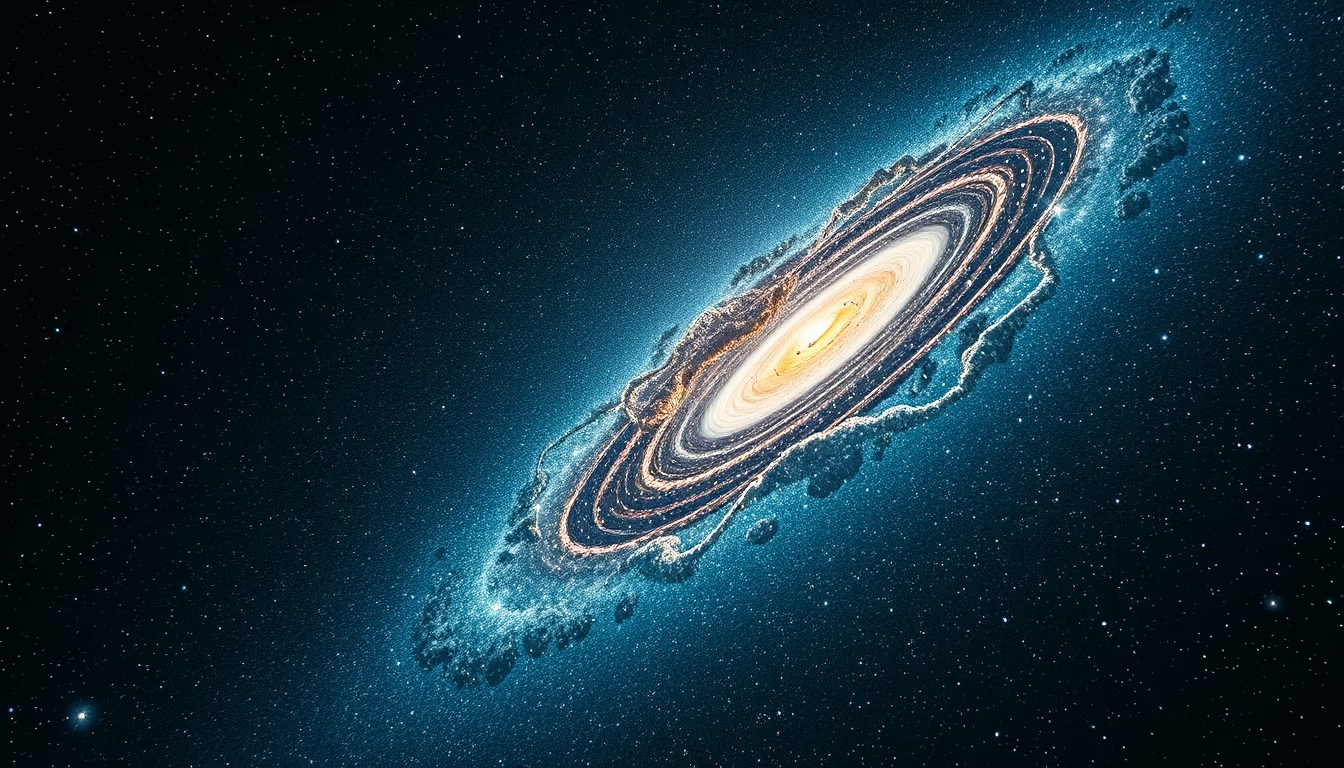
The cosmic microwave background is the afterglow of the Big Bang, a relic from the early universe that reveals its origins and evolution.
About this subject
The cosmic microwave background (CMB) is the oldest light in the universe, emitted about 380,000 years after the Big Bang. At that time, the universe had cooled enough for protons and electrons to combine into neutral atoms, allowing photons to travel freely. This radiation fills the entire cosmos almost uniformly, with an average temperature of 2.725 kelvins, and was accidentally discovered in 1965 by Arno Penzias and Robert Wilson in the United States while working with a radio antenna. The discovery earned them the Nobel Prize in Physics in 1978 and provided the strongest evidence for the Big Bang theory.
The CMB is not perfectly uniform. Tiny temperature fluctuations, on the order of one part in 100,000, have been mapped by space missions such as COBE (1989-1993), WMAP (2001-2010), and Planck (2009-2013). These anisotropies are the seeds of current cosmic structures, such as galaxies and galaxy clusters. The CMB map produced by the Planck satellite, launched by the European Space Agency, is the most detailed ever obtained, showing patterns that confirm the standard cosmological model, known as Lambda-CDM.
The study of the CMB has allowed precise determination of the universe's age at 13.8 billion years, its composition (roughly 5% ordinary matter, 27% dark matter, and 68% dark energy), and the Hubble constant. Additionally, the polarization of the CMB, measured by experiments such as BICEP and the Keck Array, seeks evidence of cosmic inflation, a rapid exponential expansion in the first moments after the Big Bang. Any signal of primordial gravitational waves in polarization would be direct confirmation of inflation.
Frequently Asked Questions
What is the cosmic microwave background?
It is the electromagnetic radiation left over from the Big Bang, emitted when the universe first became transparent. It fills all space and has a temperature of about 2.7 kelvins.
Who discovered the cosmic microwave background?
It was accidentally discovered in 1965 by radio astronomers Arno Penzias and Robert Wilson in the United States. They noticed a persistent background noise coming from all directions, later identified as the CMB.
Why is the cosmic microwave background important for cosmology?
It provides direct evidence for the Big Bang and contains information about the early universe's conditions. The tiny temperature fluctuations in the CMB are the seeds of galaxies and help determine the age, composition, and geometry of the cosmos.
Direct URL
https://pub-c7d6a6ea828543ac903a74a341ccb2e1.r2.dev/imagens/cosmic-microwave-background-national-geographic-style-p7.avifHow to credit
Include a visible link back to UtilizAí. Copy one of the snippets below:
<a href="https://xn--utiliza-eza.com/en/midia/imagens/cosmic-microwave-background-national-geographic-style-p7">Cosmic microwave background</a> by <a href="https://xn--utiliza-eza.com">UtilizAí</a>, licensed under <a href="https://creativecommons.org/licenses/by/4.0/">CC BY 4.0</a>.
[Cosmic microwave background](https://xn--utiliza-eza.com/en/midia/imagens/cosmic-microwave-background-national-geographic-style-p7) by [UtilizAí](https://xn--utiliza-eza.com), CC BY 4.0
License: CC-BY-4.0