Cosmic microwave background
1344×768 · AVIF · CC BY 4.0
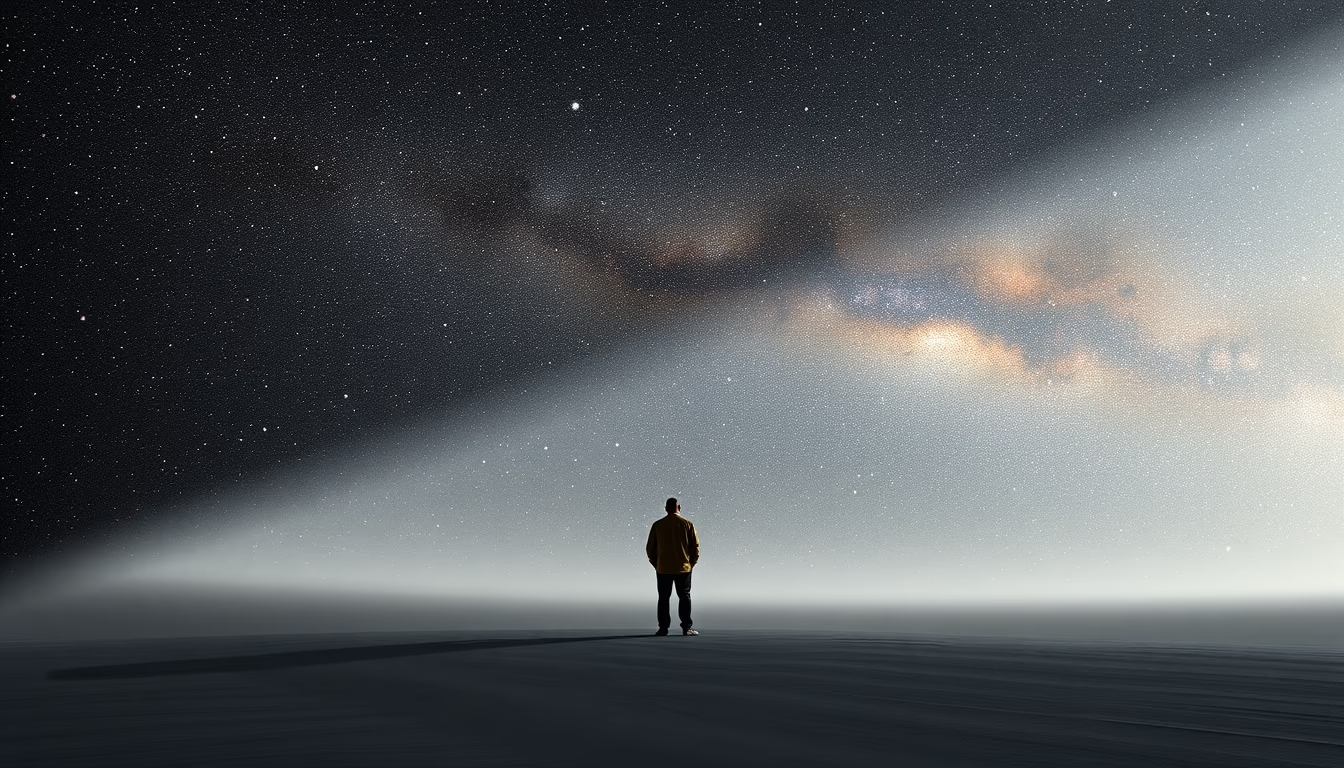
The cosmic microwave background is the oldest light in the universe, an echo of the Big Bang that reveals the infancy of the cosmos.
About this subject
The cosmic microwave background (CMB) is the electromagnetic radiation that fills the entire universe, a remnant of the Big Bang that occurred about 13.8 billion years ago. Accidentally discovered in 1965 by Arno Penzias and Robert Wilson, who later won the Nobel Prize for this detection, the CMB is a nearly uniform thermal signature with an average temperature of 2.725 Kelvin (about -270 °C). This radiation was emitted when the universe was only 380,000 years old, during the so-called recombination epoch, when protons and electrons combined to form neutral atoms, allowing photons to travel freely through space.
The CMB exhibits tiny temperature fluctuations, on the order of one part in 100,000, mapped as anisotropies. These variations correspond to slightly denser or rarer regions in the early universe, which later gave rise to galaxies and large-scale structures observed today. Missions such as COBE (1989), WMAP (2001), and Planck (2009) have measured these fluctuations with increasing precision, confirming the standard cosmological model and providing parameters like the composition of the universe (about 5% ordinary matter, 27% dark matter, and 68% dark energy).
The study of the CMB is fundamental to modern cosmology, as its properties allow testing theories about cosmic inflation, the geometry of the universe, and the evolution of large-scale structures. Moreover, the polarization of the CMB, known as B-mode, may contain imprints of primordial gravitational waves, offering a direct window into the first moments after the Big Bang. The minimalist image accompanying this text seeks to visually represent the isotropy and subtle temperature variations that characterize this primordial signal.
Frequently Asked Questions
Why is the cosmic microwave background called 'microwave'?
Because its peak emission lies in the microwave region of the electromagnetic spectrum, with wavelengths around 1 mm. This results from the cooling of the original (visible) radiation due to the universe's expansion over 13.8 billion years.
What do CMB anisotropies reveal about the universe?
The anisotropies (tiny temperature variations) map density fluctuations in the early universe. They are the seeds of current structures: galaxies, clusters, and cosmic voids. Their angular pattern allows measuring cosmological parameters such as the expansion rate and the curvature of the universe.
How was the CMB discovered?
It was discovered accidentally in 1965 by engineers Arno Penzias and Robert Wilson at Bell Labs while testing a microwave antenna. They detected a constant noise coming from all directions that they could not eliminate. After consulting theorists, they identified it as the radiation predicted by the Big Bang model.
Direct URL
https://pub-c7d6a6ea828543ac903a74a341ccb2e1.r2.dev/imagens/cosmic-microwave-background-minimalist-composition-p2.avifHow to credit
Include a visible link back to UtilizAí. Copy one of the snippets below:
<a href="https://xn--utiliza-eza.com/en/midia/imagens/cosmic-microwave-background-minimalist-composition-p2">Cosmic microwave background</a> by <a href="https://xn--utiliza-eza.com">UtilizAí</a>, licensed under <a href="https://creativecommons.org/licenses/by/4.0/">CC BY 4.0</a>.
[Cosmic microwave background](https://xn--utiliza-eza.com/en/midia/imagens/cosmic-microwave-background-minimalist-composition-p2) by [UtilizAí](https://xn--utiliza-eza.com), CC BY 4.0
License: CC-BY-4.0