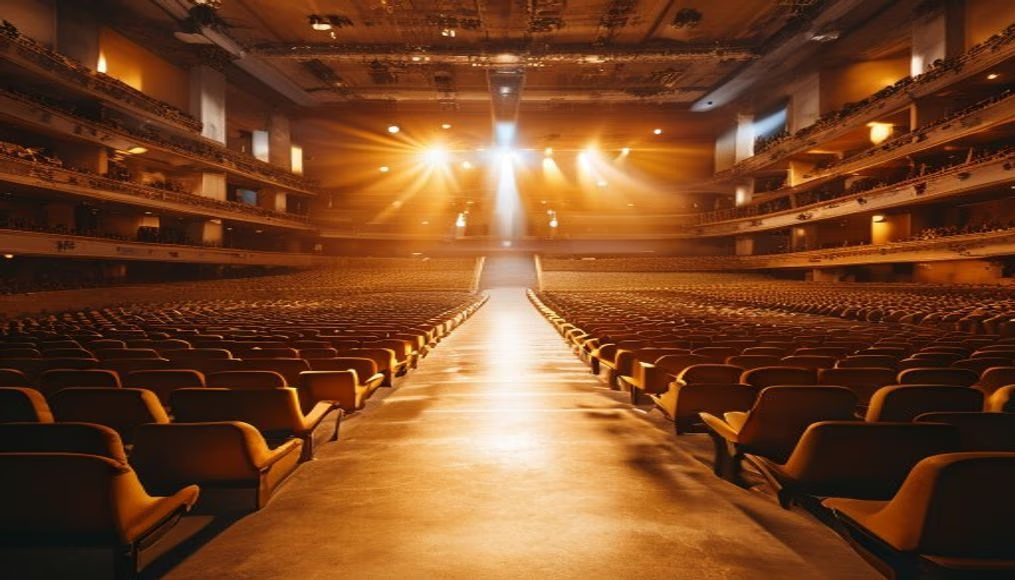
Concert hall empty seats
1344×768 · AVIF · CC BY 4.0

Empty concert halls represent a global phenomenon blending acoustic architecture, cultural management, and economic challenges.
About this subject
Concert halls are spaces meticulously designed for musical performance, with acoustics that can take years to perfect. The Teatro Colón in Buenos Aires, for instance, underwent a seven-year acoustic renovation before reopening in 2010. When empty, these halls reveal architectural details unnoticed during packed performances: the design of seats, the wooden panels reflecting sound, the chandeliers hanging from the ceiling. Each element serves both acoustic and aesthetic functions.
The phenomenon of empty audiences gained prominence during the COVID-19 pandemic, when theaters like the Municipal do Rio de Janeiro and Theatro São Pedro in São Paulo streamed live performances without an audience. This sparked reflections on the sustainability of the cultural sector. Data from Funarte shows that 70% of Brazilian concert halls rely on public subsidies to keep their doors open.
Beyond the economic aspect, there is a symbolic dimension. The silence in an empty concert hall is different from silence anywhere else, it is a silence charged with expectation, where every sound, even a door creak, echoes with clarity. This environment inspired composers like John Cage, who in his piece 4'33" explored silence as music.
Interestingly, empty halls also serve for acoustic tests and orchestra rehearsals. The Berlin Philharmonic, for example, holds open rehearsals, but at specific times the seats remain empty for technical adjustments. These moments are recorded by architects and sound engineers to calibrate reverberation and ensure every note reaches the listener perfectly.
Frequently Asked Questions
Why are empty concert halls used for acoustic tests?
Sound behaves differently in empty spaces because there are no bodies to absorb sound waves. Audio engineers take advantage to measure pure reverberation and adjust panels and diffusers before events.
What is the largest concert hall in Brazil?
Sala São Paulo, home to the São Paulo State Symphony Orchestra (OSESP), is considered the largest in the country, with a capacity of 1,498 people. Its acoustics are internationally recognized.
How did the pandemic affect concert halls in Brazil?
Many halls closed temporarily and migrated to online streaming. A study by Funarte indicated that 40% of Brazilian theaters had revenue drops of over 80% in 2020.
Direct URL
https://pub-c7d6a6ea828543ac903a74a341ccb2e1.r2.dev/imagens/concert-hall-empty-seats-cinematic-wide-shot-v2.avifHow to credit
Include a visible link back to UtilizAí. Copy one of the snippets below:
<a href="https://xn--utiliza-eza.com/en/midia/imagens/concert-hall-empty-seats-cinematic-wide-shot-v2">Concert hall empty seats</a> by <a href="https://xn--utiliza-eza.com">UtilizAí</a>, licensed under <a href="https://creativecommons.org/licenses/by/4.0/">CC BY 4.0</a>.
[Concert hall empty seats](https://xn--utiliza-eza.com/en/midia/imagens/concert-hall-empty-seats-cinematic-wide-shot-v2) by [UtilizAí](https://xn--utiliza-eza.com), CC BY 4.0
License: CC-BY-4.0