Comet trail bright
1344×768 · AVIF · CC BY 4.0
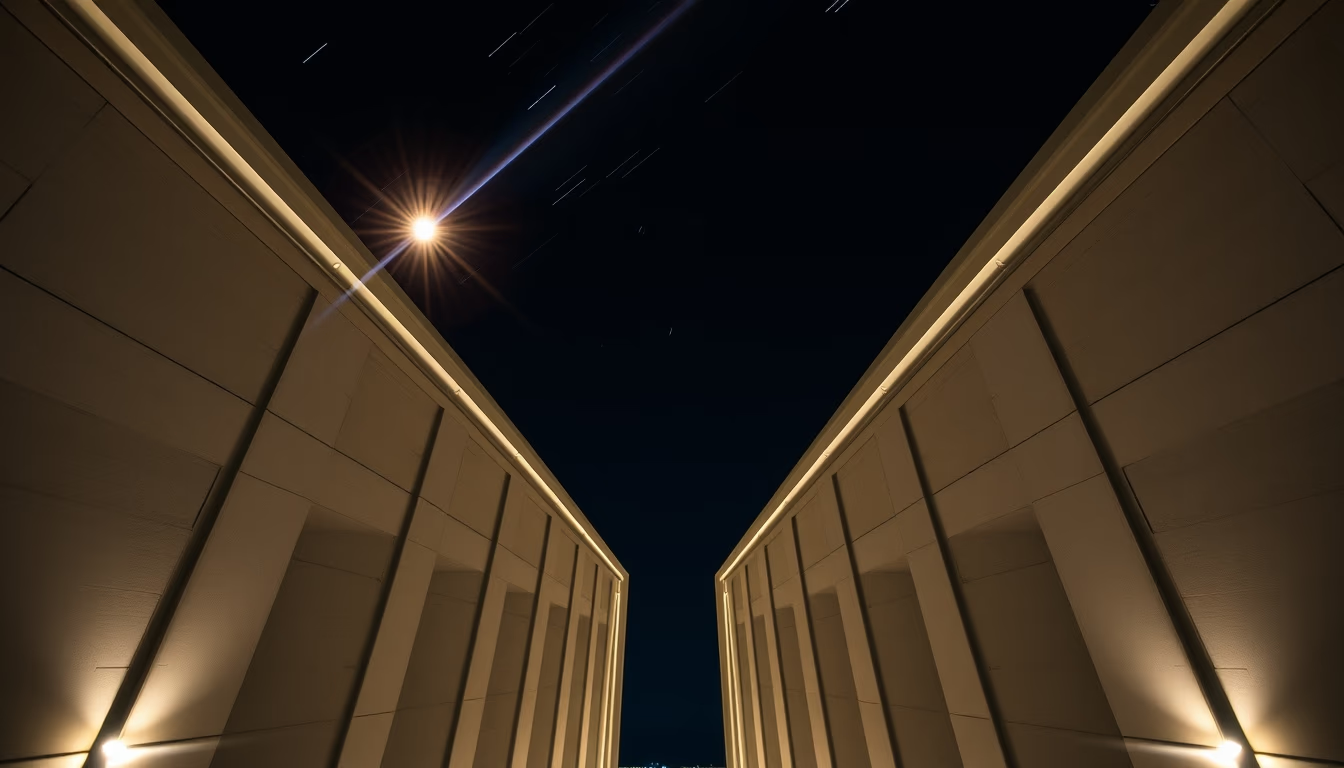
Comets leave bright trails across the night sky, a phenomenon that has fascinated observers for millennia and can be captured in long-exposure photographs.
About this subject
Comets are celestial bodies made of ice, dust, and rock that orbit the Sun in elliptical paths. As they approach the Sun, solar heat vaporizes some of their material, forming a coma (diffuse cloud) and a tail that can extend millions of kilometers. The tail is usually double: one ion tail (straight and bluish) and one dust tail (curved and yellowish), both pointing away from the Sun due to radiation pressure and solar wind.
A comet's brightness depends on its size, composition, and distance from the Sun. Some comets become visible to the naked eye, such as Hale-Bopp (1997) and NEOWISE (2020). Hale-Bopp was one of the brightest of the 20th century, with a tail that remained visible for 18 months. NEOWISE was discovered by the eponymous space probe and provided a spectacle for Northern Hemisphere photographers, with its greenish coma and bright nucleus.
Capturing a comet in photography requires specific techniques: a camera on a tripod, wide-angle lenses, long exposures (seconds to minutes), and a location with little light pollution. Photos of comets over landscapes or human structures combine astronomy and architecture, creating striking images that show the vastness of the cosmos against earthly elements. This type of photography, known as landscape astrophotography, has gained popularity with the advancement of digital cameras and sensitive sensors.
Culturally, comets have been seen as omens, both good and bad, across various civilizations. In ancient China, records of comets date back thousands of years. In the West, the Bayeux Tapestry depicts Halley's Comet in 1066, interpreted as a bad omen for King Harold II of England. Today, science explains these phenomena, but the fascination remains: every few years, a new visible comet appears, renewing wonder and encouraging sky observation.
Frequently Asked Questions
What is the difference between a comet and an asteroid?
Comets are rich in ice and dust, forming tails when near the Sun. Asteroids are rocky or metallic, usually without visible activity. Both are small Solar System bodies.
Can we predict when a bright comet will appear?
Yes, for periodic comets like Halley (period 75-76 years). However, many comets are discovered only months or weeks before their closest approach, such as NEOWISE in 2020.
What is the best equipment to photograph a comet?
A DSLR or mirrorless camera with a wide-angle lens (14-24mm), aperture f/2.8 or faster, sturdy tripod, and remote shutter release to avoid vibrations. Exposures of 10-30 seconds at high ISO (1600-3200) are common.
Direct URL
https://pub-c7d6a6ea828543ac903a74a341ccb2e1.r2.dev/imagens/comet-trail-bright-architectural-photography-p5.avifHow to credit
Include a visible link back to UtilizAí. Copy one of the snippets below:
<a href="https://xn--utiliza-eza.com/en/midia/imagens/comet-trail-bright-architectural-photography-p5">Comet trail bright</a> by <a href="https://xn--utiliza-eza.com">UtilizAí</a>, licensed under <a href="https://creativecommons.org/licenses/by/4.0/">CC BY 4.0</a>.
[Comet trail bright](https://xn--utiliza-eza.com/en/midia/imagens/comet-trail-bright-architectural-photography-p5) by [UtilizAí](https://xn--utiliza-eza.com), CC BY 4.0
License: CC-BY-4.0