Cassini saturn rings
1344×768 · AVIF · CC BY 4.0
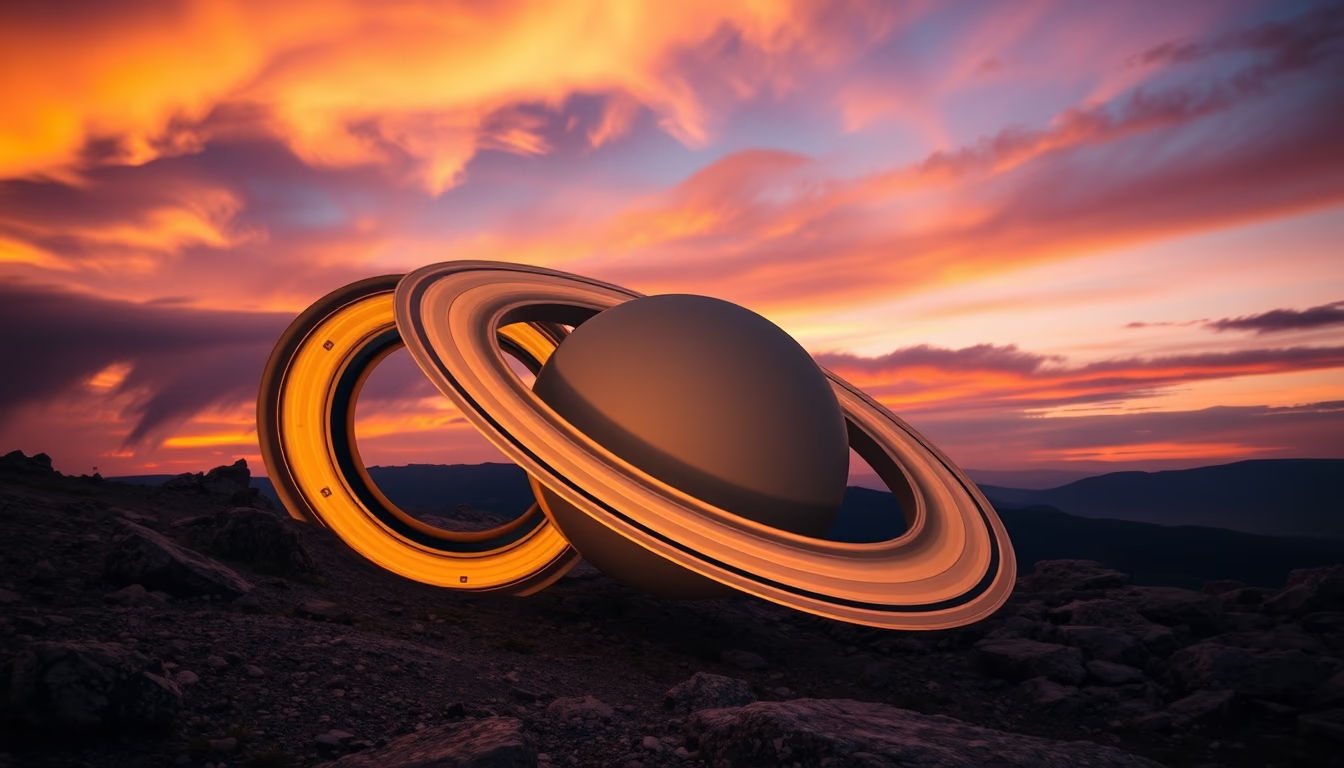
The Cassini spacecraft revealed unprecedented details about Saturn's rings, including their composition, structure, and orbital dynamics.
About this subject
Saturn's rings are among the most iconic features of the Solar System, and the Cassini-Huygens mission, a collaboration between NASA, ESA, and ASI, revolutionized our understanding of them. Between 2004 and 2017, the Cassini spacecraft orbited Saturn, completing 294 orbits and 162 flybys of its moons. During that time, it captured images and data that allowed scientists to analyze the rings' composition, primarily water ice particles with smaller amounts of rocky dust and organic compounds. Particles range in size from micrometers to meters, and the ring structure is maintained by gravitational interactions with shepherd moons like Prometheus and Pandora. One of the most surprising discoveries was the existence of vertical structures, such as waves and 'hills' up to 2.5 km tall, caused by perturbations from embedded moons. Additionally, Cassini detected that the rings are losing mass rapidly, raining particles onto Saturn's atmosphere, suggesting they may be relatively young, only 100 to 200 million years old. The spacecraft's final plunge in September 2017, known as the 'Grand Finale,' passed between the rings and the planet, providing the closest measurements ever of the rings' gravity and composition. This scientific legacy continues to be analyzed by researchers worldwide, deepening knowledge about the formation and evolution of planetary ring systems.
Frequently Asked Questions
What are Saturn's rings made of?
Saturn's rings are primarily composed of water ice particles, with small amounts of rocky dust and organic compounds. The particles range in size from micrometers to meters.
How many rings does Saturn have?
Saturn has a main ring system divided into seven groups named D through F (in order of distance from the planet), plus fainter rings and structures like diffuse rings and arcs.
Why are Saturn's rings disappearing?
The rings are losing mass because ice particles are pulled by Saturn's gravity and fall into its atmosphere, a process called 'ring rain'. It is estimated that the rings may disappear in 100 to 300 million years.
Direct URL
https://pub-c7d6a6ea828543ac903a74a341ccb2e1.r2.dev/imagens/cassini-saturn-rings-long-exposure-fresh10.avifHow to credit
Include a visible link back to UtilizAí. Copy one of the snippets below:
<a href="https://xn--utiliza-eza.com/en/midia/imagens/cassini-saturn-rings-long-exposure-fresh10">Cassini saturn rings</a> by <a href="https://xn--utiliza-eza.com">UtilizAí</a>, licensed under <a href="https://creativecommons.org/licenses/by/4.0/">CC BY 4.0</a>.
[Cassini saturn rings](https://xn--utiliza-eza.com/en/midia/imagens/cassini-saturn-rings-long-exposure-fresh10) by [UtilizAí](https://xn--utiliza-eza.com), CC BY 4.0
License: CC-BY-4.0