Cassini saturn rings
1344×768 · AVIF · CC BY 4.0

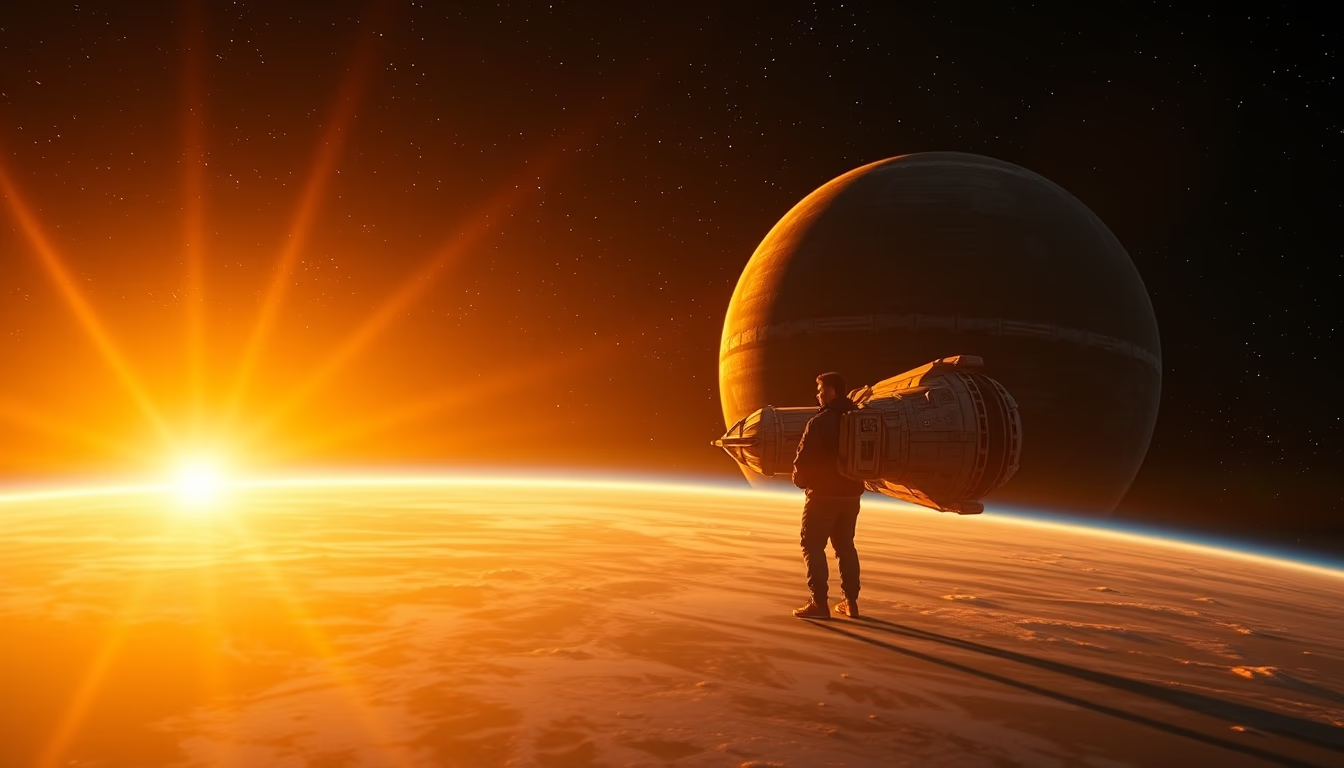
The Cassini-Huygens spacecraft revolutionized our knowledge of Saturn, its rings, and its moons during its 13-year mission.
About this subject
Launched in 1997 as a collaboration between NASA, ESA, and ASI, the Cassini-Huygens mission reached Saturn in 2004 after a nearly seven-year journey. Comprising the Cassini orbiter and the Huygens probe, which landed on Titan, the mission provided unprecedented data on the gas giant, its rings, and moons. Cassini ended its journey in September 2017 by deliberately plunging into Saturn's atmosphere to avoid contaminating potentially habitable environments on Enceladus and Titan.
Saturn's rings, mainly composed of water ice and rocky particles, were revealed in stunning detail by Cassini. The mission discovered complex structures such as waves, tiny moons, and faint rings caused by shepherd satellites. The rings are relatively young, estimated at a few million years old, and may have formed from the destruction of an icy moon. Cassini also observed ring particles raining onto Saturn's atmosphere, a phenomenon known as ring rain.
Among Saturn's moons, Enceladus stood out: plumes of salty water and organic compounds were detected at its south pole, indicating a subsurface ocean with potential for life. Titan, the largest moon, revealed liquid methane lakes and a thick nitrogen-rich atmosphere. The mission also studied other moons like Mimas, Iapetus, and Rhea, each with unique features that expanded understanding of icy body geology.
Cassini's legacy includes over 4,000 scientific papers and a profound reassessment of Saturn's ring and moon systems. Data continues to be analyzed, and the mission paved the way for future exploration, such as the Dragonfly mission to Titan. The final dive ensured no terrestrial microbes would contaminate potentially habitable moons.
Frequently Asked Questions
What did Cassini discover about Saturn's rings?
Cassini revealed complex structures including waves, tiny shepherd moons, and tenuous rings. It found that the rings are young, only a few million years old, and that particles rain onto Saturn, creating ring rain.
How did the Cassini mission end?
Cassini ended on September 15, 2017, with a controlled dive into Saturn's atmosphere, disintegrating to avoid contamination of moons like Enceladus and Titan, which may harbor conditions for life.
Which Saturn moons were most important studied by Cassini?
Enceladus and Titan were the most important. Enceladus has a subsurface ocean with salty water plumes. Titan has methane lakes and a thick atmosphere; the Huygens probe landed on its surface.
Direct URL
https://pub-c7d6a6ea828543ac903a74a341ccb2e1.r2.dev/imagens/cassini-saturn-rings-documentary-nature-style-fresh4.avifHow to credit
Include a visible link back to UtilizAí. Copy one of the snippets below:
<a href="https://xn--utiliza-eza.com/en/midia/imagens/cassini-saturn-rings-documentary-nature-style-fresh4">Cassini saturn rings</a> by <a href="https://xn--utiliza-eza.com">UtilizAí</a>, licensed under <a href="https://creativecommons.org/licenses/by/4.0/">CC BY 4.0</a>.
[Cassini saturn rings](https://xn--utiliza-eza.com/en/midia/imagens/cassini-saturn-rings-documentary-nature-style-fresh4) by [UtilizAí](https://xn--utiliza-eza.com), CC BY 4.0
License: CC-BY-4.0