Bubble chamber tracks
1344×768 · AVIF · CC BY 4.0
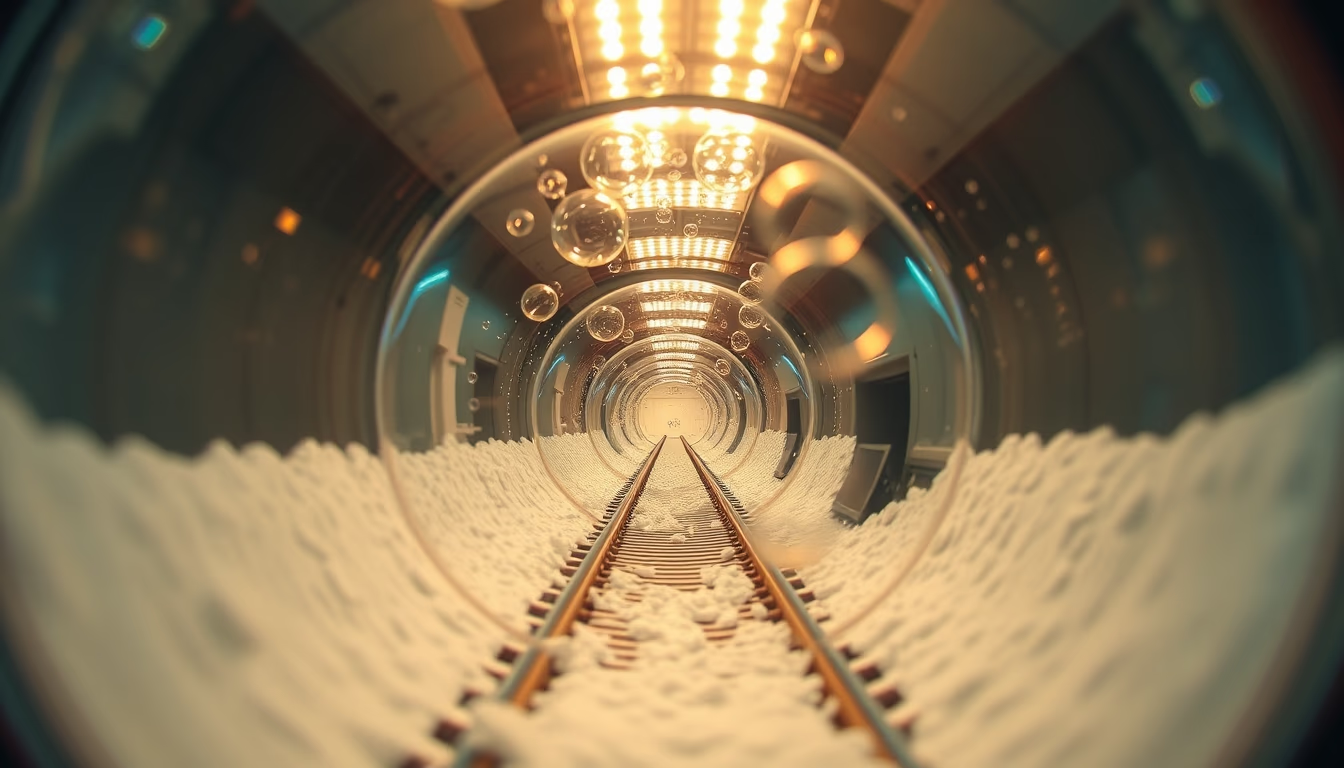
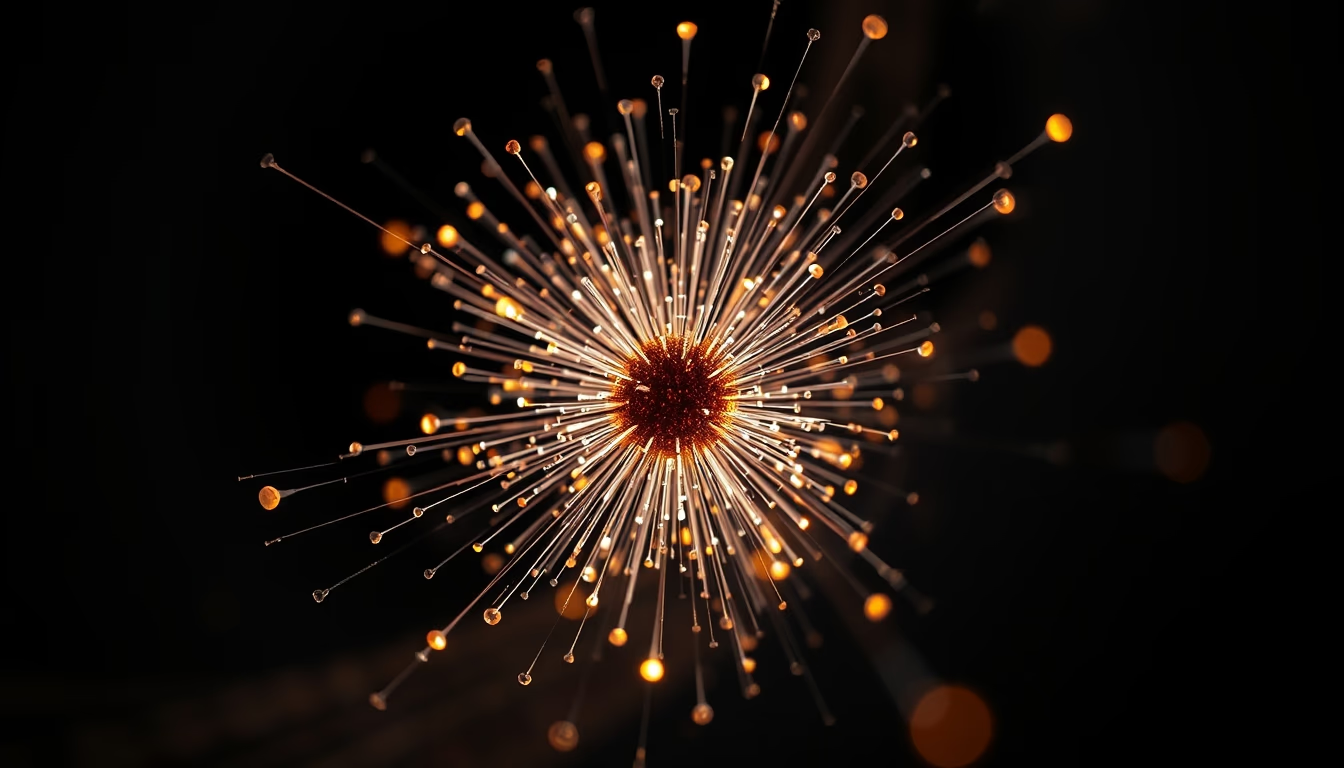
Bubble chamber: essential device for detecting subatomic particles, revealing their tracks in superheated liquid.
About this subject
The bubble chamber is a particle detector that revolutionized high-energy physics from the 1950s to the 1980s. Invented by Donald Glaser in 1952, it uses a superheated liquid, typically liquid hydrogen, which becomes sensitive to the passage of charged particles. When a particle traverses the liquid, it ionizes the medium, creating vapor nuclei that grow into visible bubbles. Stereoscopic photographs of these tracks allow measurement of the curvature induced by a magnetic field, revealing the particle's momentum and charge.
Historically, bubble chambers were crucial for discoveries such as the weak neutral current (1973) in the Gargamelle experiment at CERN, and the observation of the charmed baryon (1975) at Fermilab. Large chambers like the Big European Bubble Chamber (BEBC) and Fermilab's 15-foot chamber generated millions of images manually analyzed by scientists. The method enabled identification of exotic particles like kaons and hyperons, contributing to the development of the Standard Model.
Each track has distinct characteristics: higher momentum particles show larger curvature radii, while slower particles produce thicker tracks due to higher ionization rates. Bubble chambers can also be filled with heavy liquid mixtures, such as freon or propane, to study neutrino interactions. Although superseded by faster electronic detectors, bubble chambers remain celebrated for the visual beauty of their tracks and their pivotal role in shaping modern particle physics.
Frequently Asked Questions
How does a bubble chamber work?
A bubble chamber contains a superheated liquid (e.g., liquid hydrogen) in a metastable state. When a charged particle traverses, it ionizes molecules along its path, creating small bubbles that grow rapidly. These bubbles are photographed, revealing the particle's trajectory. A magnetic field curves the path, allowing calculation of the particle's charge-to-mass ratio.
What is the importance of bubble chambers in particle physics?
Bubble chambers were essential for fundamental discoveries, such as the confirmation of the weak neutral current in the Gargamelle experiment (1973) and the discovery of the charmed baryon (1975). They enabled identification of new particles and study of neutrino interactions, directly contributing to the formulation of the Standard Model.
Why were bubble chambers replaced by other detectors?
Bubble chambers have low event rates (only a few photos per second) and require manual film analysis. Modern electronic detectors like drift chambers and calorimeters are faster, allow automated data collection, and can handle the high collision rates of modern accelerators such as the LHC.
Direct URL
https://pub-c7d6a6ea828543ac903a74a341ccb2e1.r2.dev/imagens/bubble-chamber-tracks-fish-eye-wide-angle-p12.avifHow to credit
Include a visible link back to UtilizAí. Copy one of the snippets below:
<a href="https://xn--utiliza-eza.com/en/midia/imagens/bubble-chamber-tracks-fish-eye-wide-angle-p12">Bubble chamber tracks</a> by <a href="https://xn--utiliza-eza.com">UtilizAí</a>, licensed under <a href="https://creativecommons.org/licenses/by/4.0/">CC BY 4.0</a>.
[Bubble chamber tracks](https://xn--utiliza-eza.com/en/midia/imagens/bubble-chamber-tracks-fish-eye-wide-angle-p12) by [UtilizAí](https://xn--utiliza-eza.com), CC BY 4.0
License: CC-BY-4.0