Bubble chamber tracks
1344×768 · AVIF · CC BY 4.0
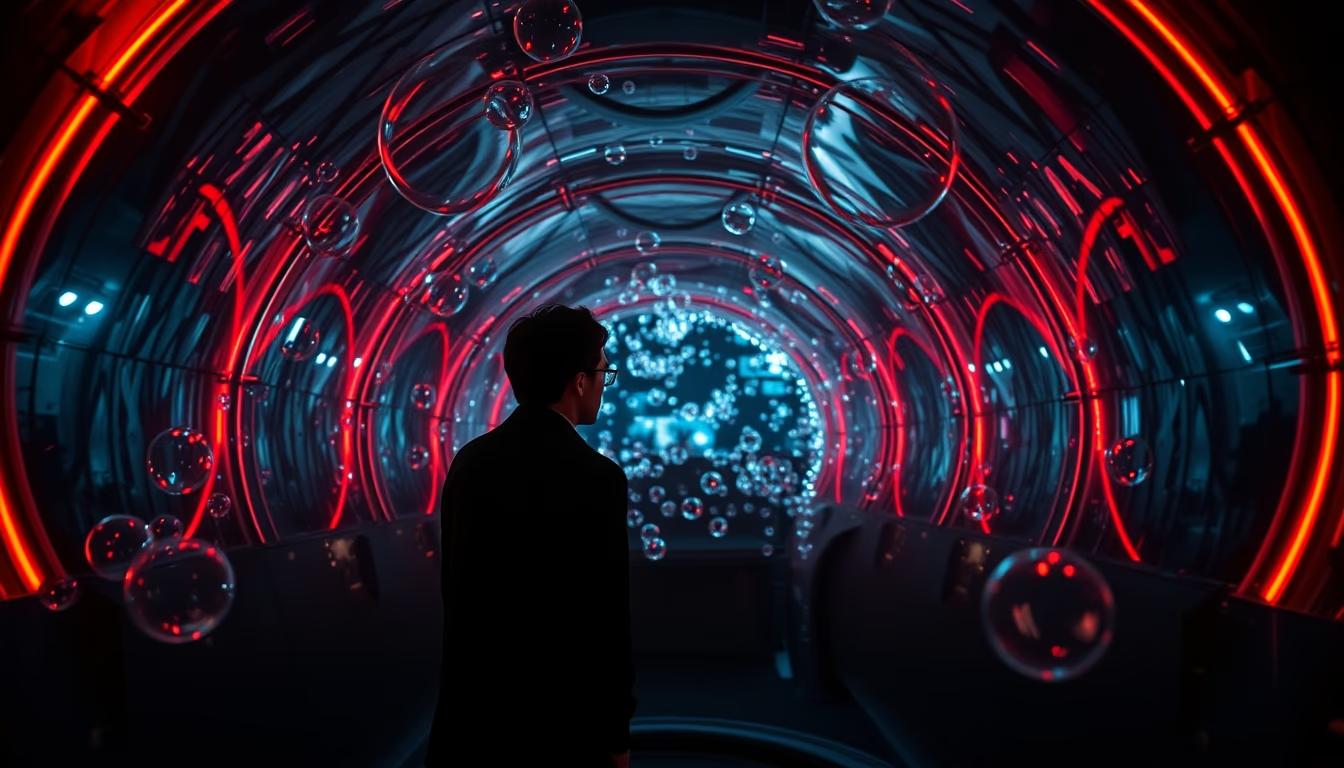
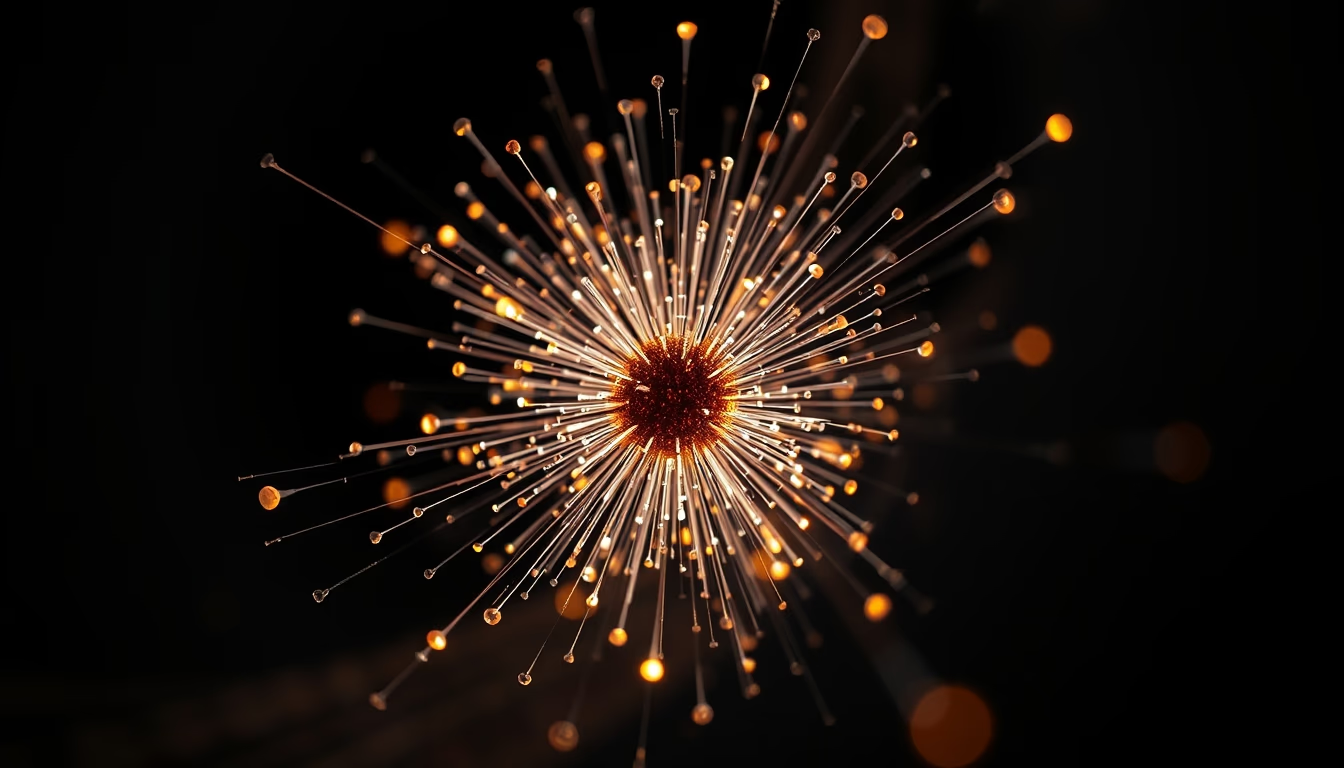
Tracks of subatomic particles in a bubble chamber reveal high-energy physics phenomena, with historical and aesthetic applications.
About this subject
The bubble chamber is a particle detector invented by Donald Glaser in 1952, for which he received the 1960 Nobel Prize in Physics. It operates on the principle of a superheated liquid, usually liquid hydrogen, kept under high pressure and at a temperature just below its boiling point. When a charged particle passes through the liquid, it ionizes molecules along its path, creating vapor nucleation sites that form visible bubbles. These bubbles are photographed by cameras surrounding the chamber, producing three-dimensional images of the particle tracks.
Bubble chambers were instrumental in discovering many elementary particles, such as pions, kaons, and strange baryons, during the golden age of particle physics in the 1950s and 1960s. The curved tracks visible in the photographs allowed scientists to identify the charge, mass, and momentum of particles, as the chamber was placed in a uniform magnetic field. Each type of particle leaves a characteristic pattern of curvature and bubble density, enabling identification.
Beyond their scientific value, bubble chamber images are considered abstract art, with sweeping curves and intricate patterns. Many have been published in books and exhibited, blending science and aesthetics. The technique has largely been replaced by more efficient electronic detectors, such as spark chambers and wire chambers, but its legacy remains as a milestone in visualizing subatomic phenomena.
Interestingly, the liquid hydrogen used in these chambers is highly flammable and requires special safety precautions. The largest bubble chamber ever built, the BEBC (Big European Bubble Chamber), was 3.7 meters in diameter and contained 35 cubic meters of liquid hydrogen. It operated at CERN from 1973 to 1984, recording millions of particle collision events.
Frequently Asked Questions
How does a bubble chamber work?
A bubble chamber contains a superheated liquid, usually liquid hydrogen. When a charged particle passes through, it ionizes the liquid, creating bubbles along its path. These bubbles are photographed and analyzed to determine the particle's properties.
Who invented the bubble chamber?
American physicist Donald Glaser invented the bubble chamber in 1952. He was awarded the Nobel Prize in Physics in 1960 for this invention.
What particles were discovered with bubble chambers?
Many particles including pions, kaons, strange baryons, and resonances were discovered or confirmed using bubble chambers. They were essential for developing the Standard Model of particle physics.
Direct URL
https://pub-c7d6a6ea828543ac903a74a341ccb2e1.r2.dev/imagens/bubble-chamber-tracks-fine-art-photography-p0.avifHow to credit
Include a visible link back to UtilizAí. Copy one of the snippets below:
<a href="https://xn--utiliza-eza.com/en/midia/imagens/bubble-chamber-tracks-fine-art-photography-p0">Bubble chamber tracks</a> by <a href="https://xn--utiliza-eza.com">UtilizAí</a>, licensed under <a href="https://creativecommons.org/licenses/by/4.0/">CC BY 4.0</a>.
[Bubble chamber tracks](https://xn--utiliza-eza.com/en/midia/imagens/bubble-chamber-tracks-fine-art-photography-p0) by [UtilizAí](https://xn--utiliza-eza.com), CC BY 4.0
License: CC-BY-4.0