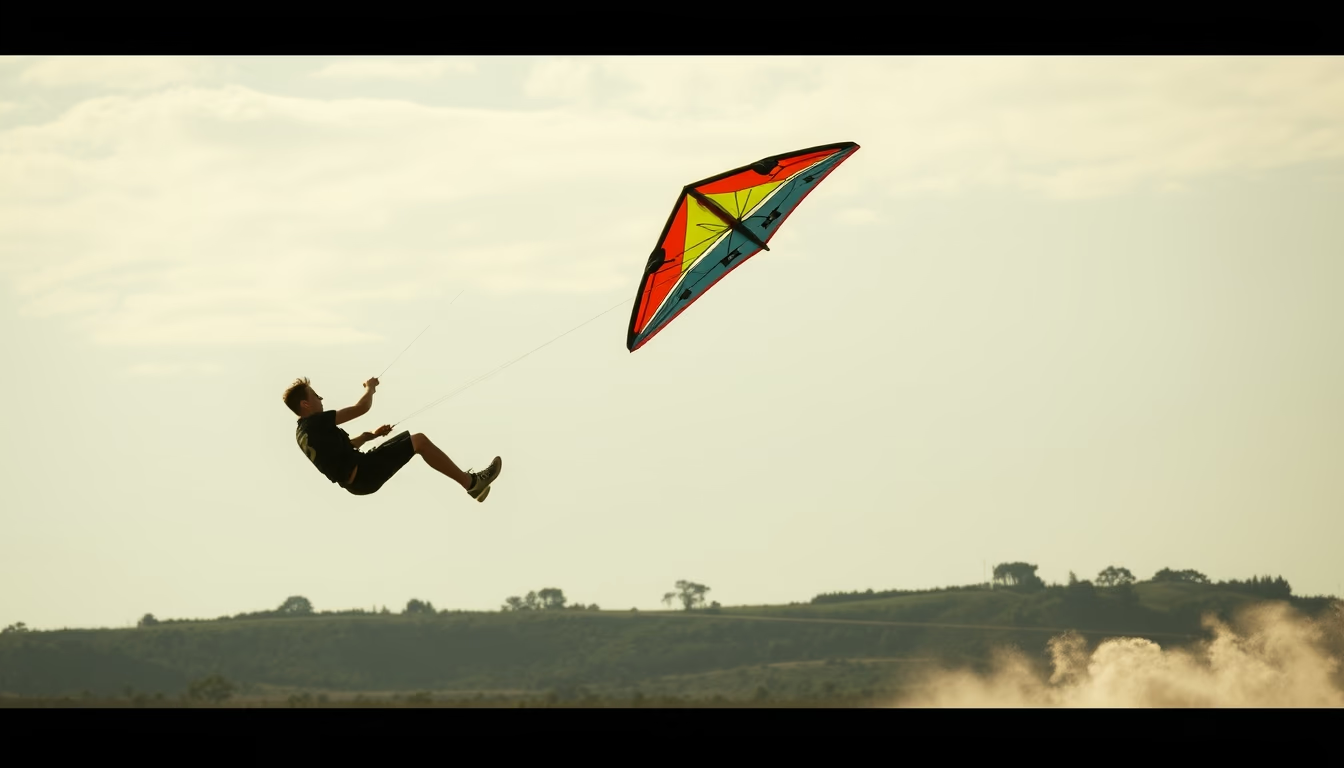
Box kite vintage
1344×768 · AVIF · CC BY 4.0

The vintage box kite, invented by Lawrence Hargrave in 1893, revolutionized aviation with its three-dimensional kite structure.
About this subject
The box kite was invented by Australian Lawrence Hargrave in 1893. Hargrave, an engineer and explorer, sought a stable design for lifting loads. His innovation consisted of two parallel rectangular cells connected by spars, creating a three-dimensional structure that provided superior lift. This design was crucial for early flight experiments, directly influencing the Wright brothers and other aviation pioneers. Before the box kite, kites were essentially flat; adding depth and rigidity allowed flight in stronger winds and greater load capacity.
Historically, the box kite was used for meteorological research, collecting atmospheric data via attached instruments. In the early 20th century, it was employed in radio communications, lifting antennas for long-distance transmissions. During World War I, it served as a training target for artillery gunners. Culturally, the box kite became an icon of aeronautical design, often associated with the golden age of aviation. Its geometric form and simplicity inspire kite enthusiasts today, who build vintage replicas or modern versions with lightweight materials.
Trivia: Hargrave designed the box kite without ever flying himself; he tested prototypes on Australian beaches. The name "box kite" derives from the box-like shape of the cells. While variations exist, the classic two-compartment design is the most recognized. The altitude record for a box kite is about 10,000 meters, achieved in 1919 in Germany. In Brazil, the box kite also had scientific use: in 1910, the National Observatory of Rio de Janeiro used box kites for upper wind studies.
Frequently Asked Questions
Who invented the box kite and in what year?
The box kite was invented by Australian Lawrence Hargrave in 1893 during his experiments with kite structures for aviation.
What was the main innovation of the box kite over traditional kites?
Its main innovation was the three-dimensional structure with two rectangular cells, providing greater stability and load capacity, allowing flight in stronger winds.
How was the box kite used historically in meteorology?
It was used to lift meteorological instruments, such as thermometers and barometers, to high altitudes, collecting essential atmospheric data for weather forecasting and climate studies.
Direct URL
https://pub-c7d6a6ea828543ac903a74a341ccb2e1.r2.dev/imagens/box-kite-vintage-minimalist-composition-fresh3.avifHow to credit
Include a visible link back to UtilizAí. Copy one of the snippets below:
<a href="https://xn--utiliza-eza.com/en/midia/imagens/box-kite-vintage-minimalist-composition-fresh3">Box kite vintage</a> by <a href="https://xn--utiliza-eza.com">UtilizAí</a>, licensed under <a href="https://creativecommons.org/licenses/by/4.0/">CC BY 4.0</a>.
[Box kite vintage](https://xn--utiliza-eza.com/en/midia/imagens/box-kite-vintage-minimalist-composition-fresh3) by [UtilizAí](https://xn--utiliza-eza.com), CC BY 4.0
License: CC-BY-4.0