Black hole event horizon
1344×768 · AVIF · CC BY 4.0
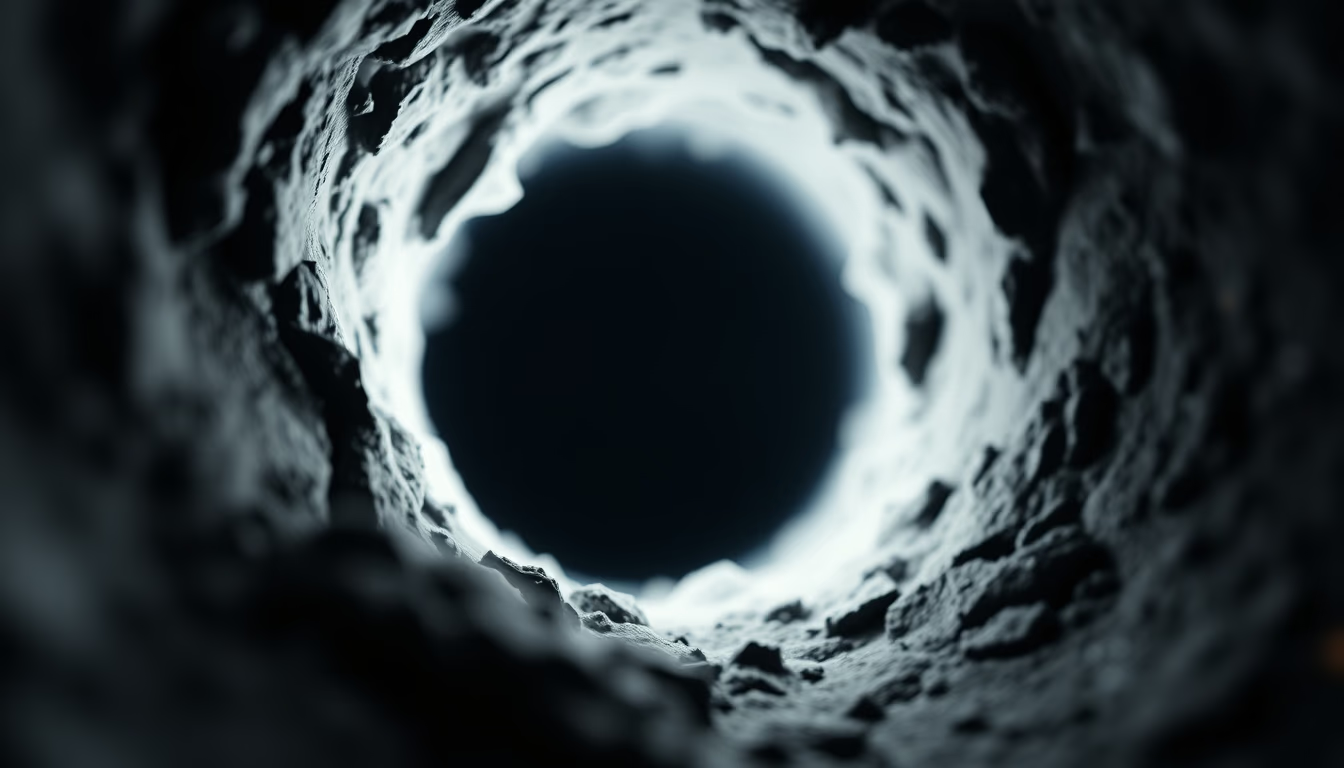
The event horizon of a black hole is the point of no return where gravity is so intense that even light cannot escape.
About this subject
Black holes are regions of spacetime where gravity is so strong that nothing, not even light, can escape. The event horizon is the boundary that defines this region: once crossed, any object or radiation is inevitably doomed to be pulled toward the central singularity. This boundary is not a physical surface but a mathematical limit defined by Einstein's general theory of relativity.
The formation of a black hole occurs when a massive star collapses under its own weight at the end of its life cycle. If the remaining mass is large enough, gravity overcomes all other forces, creating a singularity. The event horizon emerges in this process, and its size is proportional to the black hole's mass: for an object with the mass of the Sun, the horizon would be about 3 km in radius. The supermassive black hole at the center of the M87 galaxy, photographed by the Event Horizon Telescope in 2019, has a horizon with a diameter nearly three times the size of the Solar System.
Although we cannot directly see the event horizon, its existence is inferred through indirect observations. Gas and dust heated as they fall toward the black hole emit intense radiation, revealing the dark central region. Additionally, phenomena such as gravitational lensing and gravitational waves confirm the presence of these extreme objects. The study of event horizons remains one of the most fascinating frontiers in astrophysics, challenging our understanding of space, time, and the very nature of reality.
Frequently Asked Questions
What is the event horizon of a black hole?
It is the boundary around a black hole from which nothing, not even light, can escape. Inside it, gravity is so intense that any object is inevitably pulled toward the central singularity.
What happens if something crosses the event horizon?
Upon crossing the event horizon, an object cannot return. It is dragged toward the singularity, where matter is compressed to infinite density. From an outside observer's perspective, the object appears to freeze in time and gradually fade away.
How do scientists know black holes exist if they can't be seen?
They detect indirect effects such as stars orbiting an invisible center, X-ray emission from heated gas falling into the black hole, and more recently, gravitational waves from black hole mergers. The direct image of the M87 event horizon provided visual confirmation.
Direct URL
https://pub-c7d6a6ea828543ac903a74a341ccb2e1.r2.dev/imagens/black-hole-event-horizon-tilt-shift-miniature-p4.avifHow to credit
Include a visible link back to UtilizAí. Copy one of the snippets below:
<a href="https://xn--utiliza-eza.com/en/midia/imagens/black-hole-event-horizon-tilt-shift-miniature-p4">Black hole event horizon</a> by <a href="https://xn--utiliza-eza.com">UtilizAí</a>, licensed under <a href="https://creativecommons.org/licenses/by/4.0/">CC BY 4.0</a>.
[Black hole event horizon](https://xn--utiliza-eza.com/en/midia/imagens/black-hole-event-horizon-tilt-shift-miniature-p4) by [UtilizAí](https://xn--utiliza-eza.com), CC BY 4.0
License: CC-BY-4.0