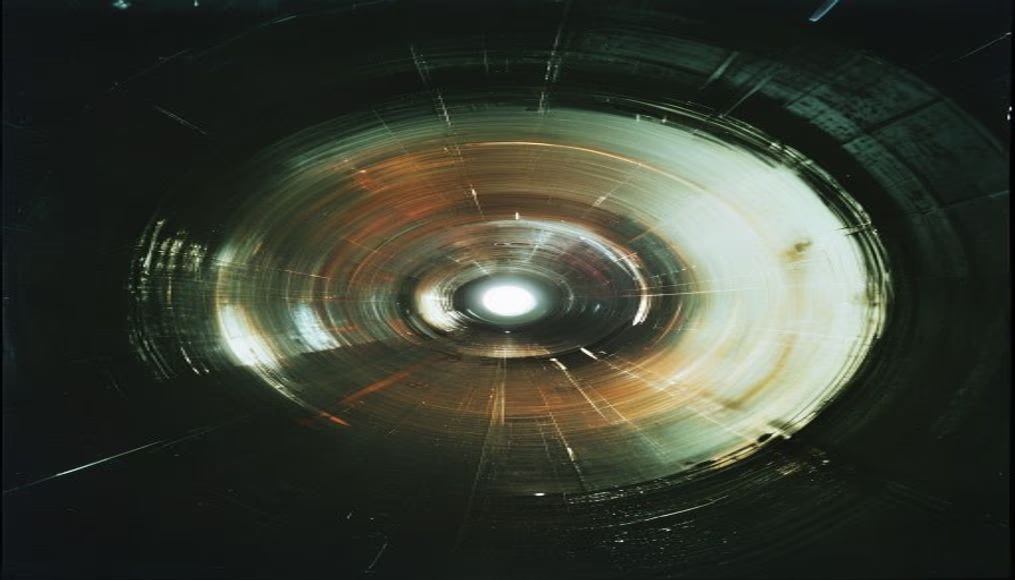
Black hole event horizon
1344×768 · AVIF · CC BY 4.0

The event horizon of a black hole is the boundary beyond which nothing, not even light, can escape the gravitational pull.
About this subject
The event horizon is a fundamental feature of black holes, defining the point of no return. Theoretically first proposed by John Michell in 1783 as "dark stars", the concept was refined by Einstein's general relativity in 1915. Karl Schwarzschild solved Einstein's equations in 1916, predicting a critical radius (Schwarzschild radius) where spacetime curvature becomes infinite. For a non-rotating black hole, the event horizon is spherical and its size is directly proportional to the black hole's mass: a solar-mass black hole would have a radius of about 3 kilometers.
Direct observational evidence of an event horizon came with the first image of the supermassive black hole at the center of galaxy M87, captured by the Event Horizon Telescope (EHT) in 2019. The image shows a dark shadow at the center of a ring of light, corresponding to the event horizon. In 2022, the EHT released the image of Sagittarius A*, the Milky Way's central black hole, with a mass of about 4 million solar masses and an event horizon diameter of approximately 44 million kilometers.
Theoretical studies indicate that the event horizon is not a physical surface but a region of spacetime where known physics breaks down. Objects crossing the horizon undergo spaghettification due to extreme tidal forces. Moreover, information falling inside is lost to the exterior universe, leading to the black hole information paradox. Recent gravitational wave observations and simulations have provided new insights into dynamics near the horizon.
In 2023, studies using the James Webb Telescope and international collaborations began investigating X-ray emission variability from accretion disks near the event horizons of active black holes. These studies help test general relativity under extreme conditions and enhance our understanding of matter behavior in high-gravity environments.
Frequently Asked Questions
What happens if something crosses the event horizon?
Once an object crosses the event horizon, it is inevitably pulled toward the central singularity. Tidal forces stretch and compress it in a process called spaghettification. No signal or information can escape from inside the horizon to the outside.
How do scientists observe event horizons if they are invisible?
Although the event horizon itself is invisible, scientists observe its effects. The Event Horizon Telescope (EHT) captured images of supermassive black hole shadows, formed by background light distorted by extreme gravity, revealing the horizon's size and shape.
What is the typical size of a black hole's event horizon?
Size depends on mass. For a stellar-mass black hole (about 10 solar masses), the radius is roughly 30 km. The supermassive black hole at the Milky Way's center, Sagittarius A*, has a radius of about 22 million km, while M87's extends around 120 billion km.
Direct URL
https://pub-c7d6a6ea828543ac903a74a341ccb2e1.r2.dev/imagens/black-hole-event-horizon-minimalist-composition-p10.avifHow to credit
Include a visible link back to UtilizAí. Copy one of the snippets below:
<a href="https://xn--utiliza-eza.com/en/midia/imagens/black-hole-event-horizon-minimalist-composition-p10">Black hole event horizon</a> by <a href="https://xn--utiliza-eza.com">UtilizAí</a>, licensed under <a href="https://creativecommons.org/licenses/by/4.0/">CC BY 4.0</a>.
[Black hole event horizon](https://xn--utiliza-eza.com/en/midia/imagens/black-hole-event-horizon-minimalist-composition-p10) by [UtilizAí](https://xn--utiliza-eza.com), CC BY 4.0
License: CC-BY-4.0