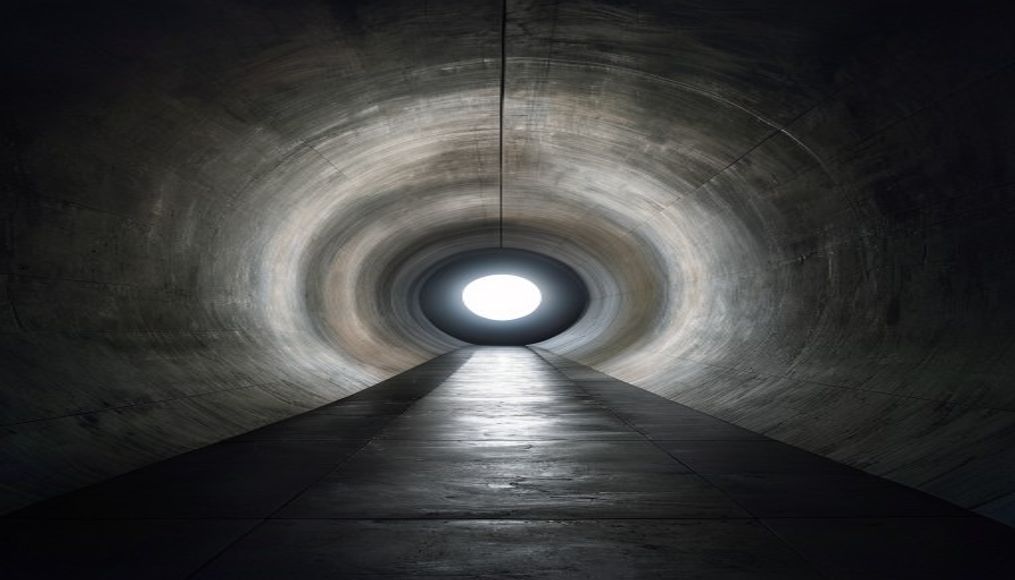
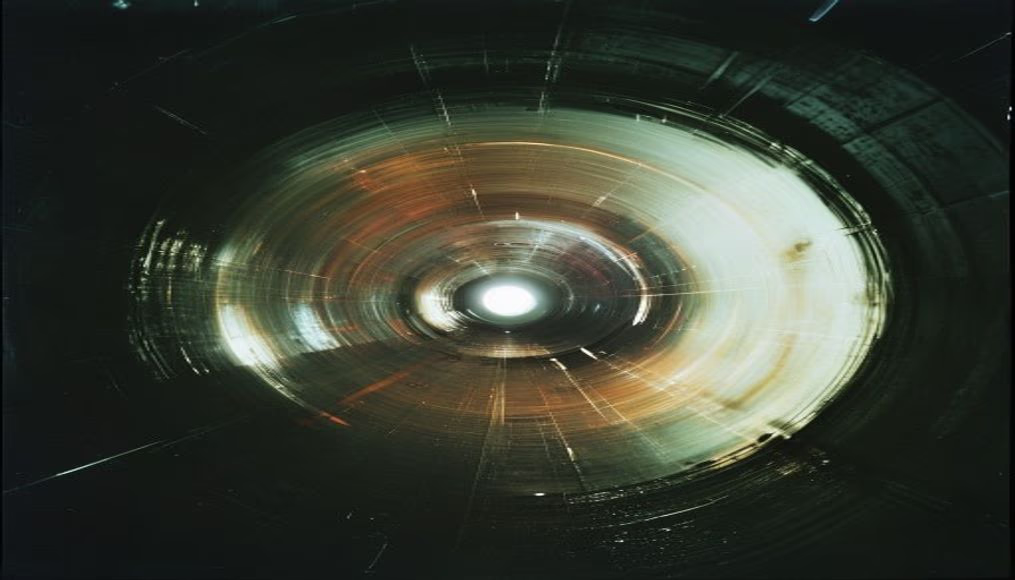
Black hole event horizon
1344×768 · AVIF · CC BY 4.0

The event horizon of a black hole is the point of no return where gravity prevents any light or matter from escaping.
About this subject
The event horizon is the theoretical boundary defining a black hole. Beyond this limit, escape velocity exceeds the speed of light, making it impossible for any object or radiation to escape. The concept was formalized by Karl Schwarzschild in 1916, shortly after Einstein's publication of general relativity. The radius of the event horizon, known as the Schwarzschild radius, is directly proportional to the black hole's mass. For instance, a black hole with the mass of the Sun would have a radius of about 3 kilometers.
Direct observational evidence of an event horizon first came in 2019, when the Event Horizon Telescope (EHT) captured the image of the supermassive black hole at the center of galaxy M87. That image showed a dark shadow surrounded by a ring of light, corresponding to the event horizon and the accretion disk. The shadow is larger than the actual horizon due to gravitational lensing, but its inner edge coincides with the Schwarzschild radius.
The event horizon is not a solid physical surface but a region of spacetime where the laws of physics as we know them break down. Inside, spacetime curvature becomes infinite at the singularity, a point of infinite density. Nonetheless, the exact nature of what occurs at the horizon is debated, especially concerning the information paradox and Hawking radiation, predicted by Stephen Hawking in 1974. Hawking radiation suggests black holes can slowly evaporate by emitting virtual particles near the horizon, raising questions about the conservation of quantum information.
Frequently Asked Questions
What happens if something crosses the event horizon?
Any matter or radiation that crosses the event horizon is irreversibly pulled toward the black hole's center. From a distant observer's perspective, the object appears to freeze and fade, never actually crossing the horizon due to gravitational time dilation.
Can we see a black hole directly?
No, because light cannot escape the event horizon. However, we can observe the black hole's shadow against background radiation, as done by the Event Horizon Telescope (EHT) in 2019 with the black hole in M87.
What is Hawking radiation and how does it relate to the event horizon?
Hawking radiation is a theoretical emission of particles that occurs at the edge of the event horizon due to quantum effects. It causes black holes to slowly lose mass and eventually evaporate, challenging the notion that nothing can escape.
Direct URL
https://pub-c7d6a6ea828543ac903a74a341ccb2e1.r2.dev/imagens/black-hole-event-horizon-macro-closeup-p9.avifHow to credit
Include a visible link back to UtilizAí. Copy one of the snippets below:
<a href="https://xn--utiliza-eza.com/en/midia/imagens/black-hole-event-horizon-macro-closeup-p9">Black hole event horizon</a> by <a href="https://xn--utiliza-eza.com">UtilizAí</a>, licensed under <a href="https://creativecommons.org/licenses/by/4.0/">CC BY 4.0</a>.
[Black hole event horizon](https://xn--utiliza-eza.com/en/midia/imagens/black-hole-event-horizon-macro-closeup-p9) by [UtilizAí](https://xn--utiliza-eza.com), CC BY 4.0
License: CC-BY-4.0