Black hole event horizon
1344×768 · AVIF · CC BY 4.0

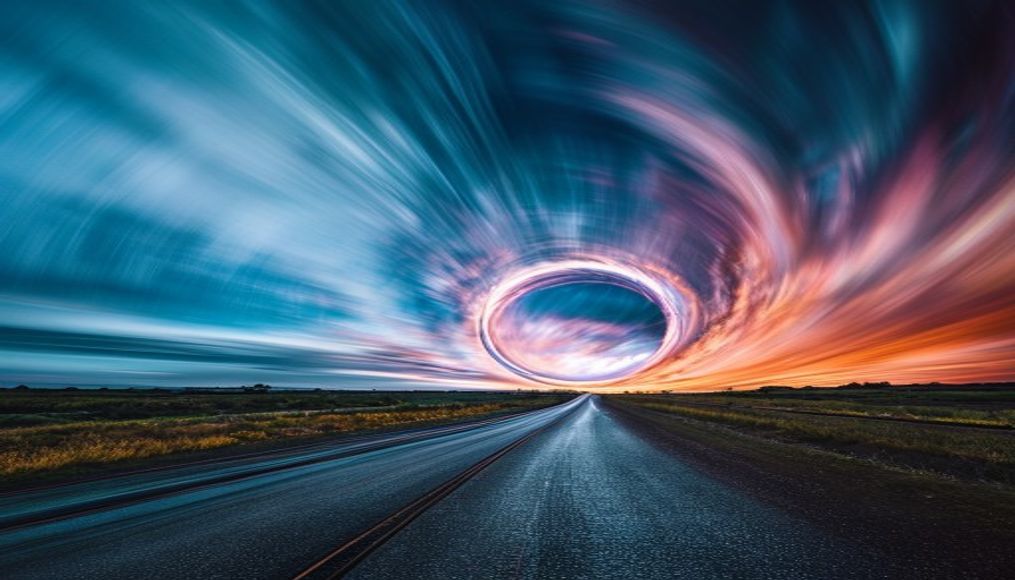
The event horizon of a black hole is the point of no return where gravity is so intense that not even light can escape, a cosmic frontier challenging physics.
About this subject
The event horizon is a theoretical region surrounding a black hole, marking the boundary beyond which nothing, not even light, can escape its gravitational pull. First conceptualized by physicist Karl Schwarzschild in 1916 as a solution to Einstein’s equations of general relativity, the term was popularized by John Archibald Wheeler and David Finkelstein, who showed that this surface acts as a one-way barrier: any matter or energy that crosses it is inexorably drawn toward the singularity at the black hole’s center.
At the center of the Milky Way, the supermassive black hole Sagittarius A has an event horizon with an estimated diameter of about 24 million kilometers. In 2019, the Event Horizon Telescope (EHT) produced the first direct image of an event horizon, that of the black hole M87, located 55 million light-years away in the galaxy M87. The image revealed a dark shadow surrounded by a bright ring of light, confirming predictions of general relativity.
Culturally, the event horizon captivates popular imagination, appearing in films like “Interstellar” (2014), where the black hole Gargantua was depicted with scientific accuracy advised by physicist Kip Thorne. The term is also used metaphorically to describe situations beyond which no information can be obtained.
Technically, the event horizon is not a solid physical surface but a mathematical boundary defined by space-time geometry. Objects crossing this limit are stretched by tidal gravitational forces, a process known as spaghettification. Ongoing debates center on the information paradox: whether information that falls into a black hole is lost forever or preserved in some form.
Frequently Asked Questions
What happens if something crosses the event horizon?
Once crossing the event horizon, any object or radiation is inevitably pulled toward the central singularity. Time and space become drastically distorted, and intense tidal forces stretch the material in a process called spaghettification.
How do scientists detect black holes if they emit no light?
Black holes are detected indirectly through their gravitational effects on nearby stars and gas, via X-ray emissions from accretion disks, and most recently by direct imaging of their shadows using the Event Horizon Telescope.
Is the event horizon a physical object?
No, the event horizon is not a material surface but a mathematical boundary in spacetime. It has no mass or thickness; it is simply the point where the escape velocity equals the speed of light.
Direct URL
https://pub-c7d6a6ea828543ac903a74a341ccb2e1.r2.dev/imagens/black-hole-event-horizon-isometric-flat-lay-p2.avifHow to credit
Include a visible link back to UtilizAí. Copy one of the snippets below:
<a href="https://xn--utiliza-eza.com/en/midia/imagens/black-hole-event-horizon-isometric-flat-lay-p2">Black hole event horizon</a> by <a href="https://xn--utiliza-eza.com">UtilizAí</a>, licensed under <a href="https://creativecommons.org/licenses/by/4.0/">CC BY 4.0</a>.
[Black hole event horizon](https://xn--utiliza-eza.com/en/midia/imagens/black-hole-event-horizon-isometric-flat-lay-p2) by [UtilizAí](https://xn--utiliza-eza.com), CC BY 4.0
License: CC-BY-4.0