Black hole event horizon
1344×768 · AVIF · CC BY 4.0
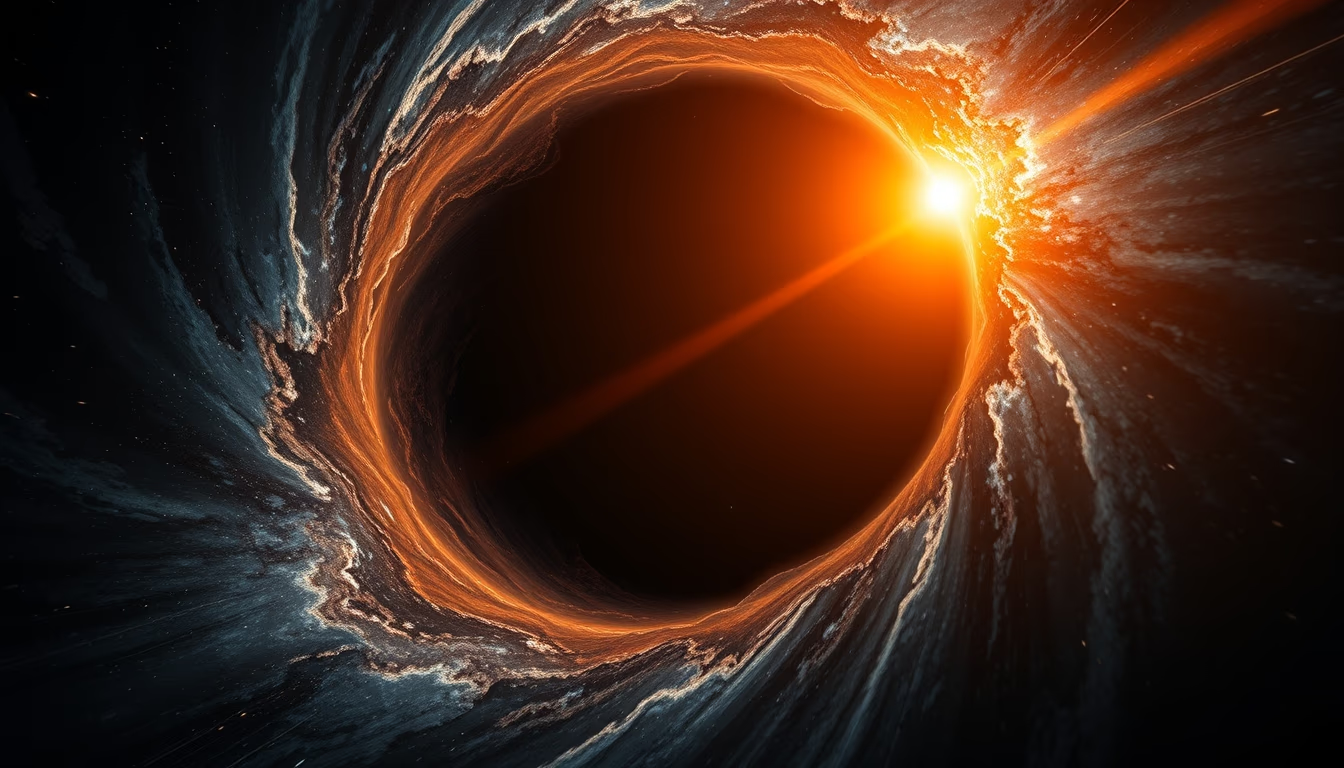
The event horizon of a black hole is the boundary beyond which nothing can escape, not even light. Learn how scientists study it.
About this subject
The event horizon is the imaginary surface that defines the point of no return around a black hole. Any object or radiation that crosses this boundary is inexorably pulled toward the singularity, a region of infinite density where the laws of physics as we know them break down. The first direct image of an event horizon was obtained in 2019 by the Event Horizon Telescope (EHT), which captured the supermassive black hole at the center of galaxy M87, 55 million light-years from Earth. This achievement confirmed predictions of Einstein's general relativity and opened a new window into the study of these extreme objects.
The size of the event horizon is given by the Schwarzschild radius, which is directly proportional to the black hole's mass. For a black hole with the mass of the Sun, the radius would be about 3 kilometers. The supermassive black hole Sagittarius A*, at the center of the Milky Way, has a mass equivalent to 4 million suns, and its event horizon extends for roughly 12 million kilometers. These numbers illustrate how extreme gravity compresses matter into a tiny volume, generating a gravitational field so intense that it warps spacetime to trap light.
Beyond its central role in astrophysics, the event horizon raises fundamental questions about the nature of reality. Hawking radiation, predicted by Stephen Hawking in 1974, suggests that black holes can slowly evaporate by emitting quantum particles near the horizon, implying information loss and challenging the unitarity principle of quantum mechanics. Recent studies also investigate the temporal and spatial distortions that occur near the horizon, such as time dilation predicted by relativity.
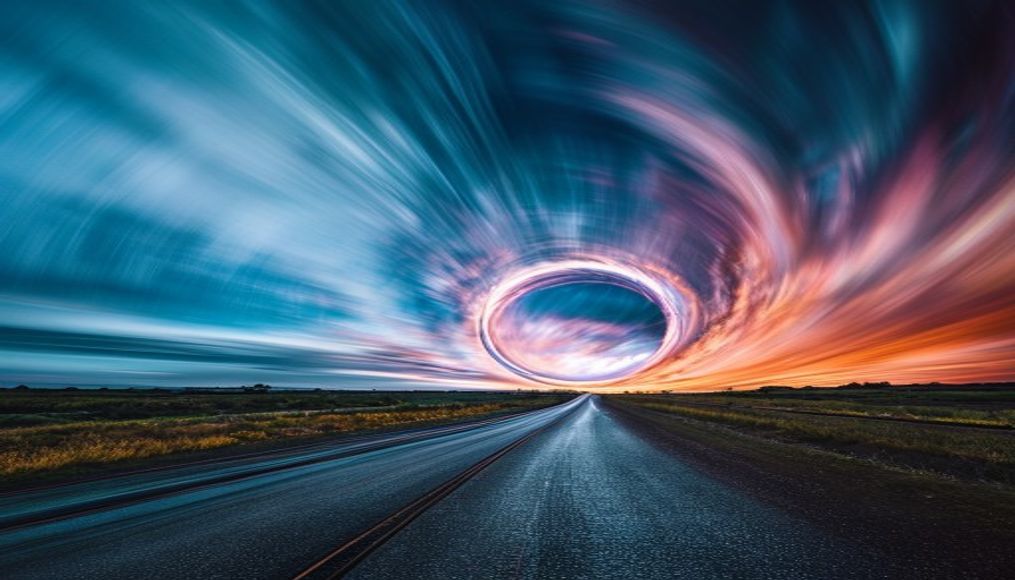
In popular culture, the event horizon is often depicted as a dark, devouring vortex, but its true appearance is more subtle: a dark sphere against a background of stars distorted by gravitational lensing. In films like "Interstellar", the visual representation of the event horizon, including the photon ring and the black hole's shadow, was inspired by scientific simulations. The ongoing study of the event horizon not only deepens our understanding of the cosmos but also tests the limits of theoretical physics.
Frequently Asked Questions
What is the event horizon of a black hole?
It is the boundary around a black hole beyond which nothing, not even light, can escape. Inside the event horizon, gravity is so intense that every path inevitably leads to the central singularity.
What happens if something crosses the event horizon?
Any object or radiation that crosses the event horizon is pulled toward the black hole's interior, heading to the singularity. To an outside observer, the object appears to freeze at the horizon and slowly fade away due to time dilation.
How did astronomers photograph a black hole?
In 2019, the Event Horizon Telescope (EHT), a global network of radio telescopes, captured the first image of the event horizon of the M87* black hole. The technique used very-long-baseline interferometry to combine data from multiple telescopes, creating a virtual telescope the size of Earth.
Direct URL
https://pub-c7d6a6ea828543ac903a74a341ccb2e1.r2.dev/imagens/black-hole-event-horizon-fine-art-photography-p11.avifHow to credit
Include a visible link back to UtilizAí. Copy one of the snippets below:
<a href="https://xn--utiliza-eza.com/en/midia/imagens/black-hole-event-horizon-fine-art-photography-p11">Black hole event horizon</a> by <a href="https://xn--utiliza-eza.com">UtilizAí</a>, licensed under <a href="https://creativecommons.org/licenses/by/4.0/">CC BY 4.0</a>.
[Black hole event horizon](https://xn--utiliza-eza.com/en/midia/imagens/black-hole-event-horizon-fine-art-photography-p11) by [UtilizAí](https://xn--utiliza-eza.com), CC BY 4.0
License: CC-BY-4.0