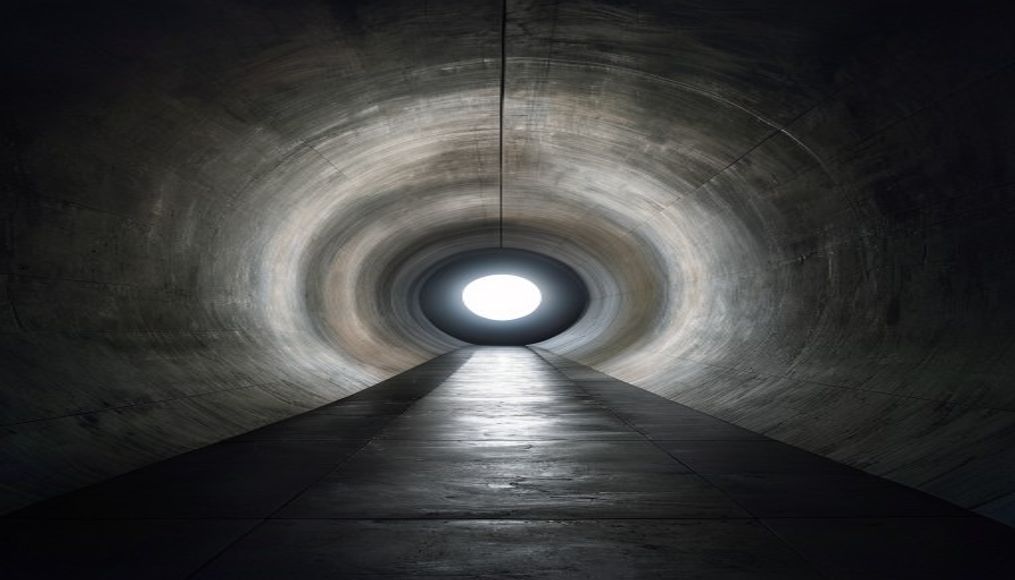
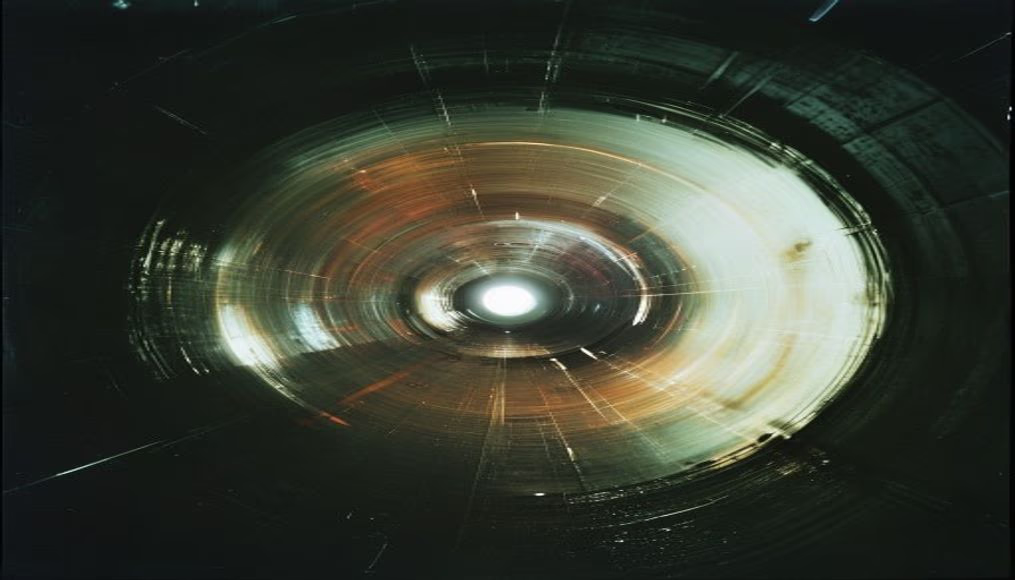
Black hole event horizon
1344×768 · AVIF · CC BY 4.0

The event horizon of a black hole is the point of no return where gravity is so intense that even light cannot escape, a landmark of modern astrophysics.
About this subject
The event horizon is the theoretical boundary around a black hole beyond which nothing, not even light, can escape. This region defines the black hole's apparent size and is directly proportional to its mass. For instance, a black hole with the mass of the Sun would have an event horizon radius of about 6 kilometers, while the supermassive black hole at the center of the Milky Way, Sagittarius A*, has a radius of approximately 12 million kilometers.
The first direct image of an event horizon was obtained in 2019 by the Event Horizon Telescope (EHT), a global network of radio telescopes. The image showed the black hole M87*, located 55 million light-years from Earth, with a bright ring of hot matter orbiting the event horizon. This achievement confirmed predictions of Einstein's General Theory of Relativity and opened new avenues for studying extreme gravity.
Interestingly, the event horizon is not a physical surface but a region of spacetime where the trajectories of light particles in a vacuum become so curved that they point inward. Any object crossing this boundary is stretched and compressed by enormous tidal forces, a process known as spaghettification. Moreover, the event horizon is one of the few places where quantum effects of gravity become relevant, connecting general relativity with quantum mechanics.
Despite its invisible nature, the event horizon can be detected indirectly through radiation emitted by matter falling toward it, forming accretion disks and relativistic jets. Recent studies suggest that black holes might host naked singularities, but the validity of cosmic censorship is still debated. The study of event horizons continues to challenge our understanding of the cosmos.
Frequently Asked Questions
What happens if something crosses the event horizon?
Once something crosses the event horizon, it becomes permanently trapped inside the black hole. From an external perspective, the object appears to freeze in time and gradually fade away, but in reality it is stretched and compressed by intense gravity in a process called spaghettification.
Can we see an event horizon?
Yes, indirectly. In 2019, the Event Horizon Telescope (EHT) produced the first image of a black hole's shadow, corresponding to the event horizon of M87*. The image shows a bright ring surrounding a dark region, which is the projection of the event horizon against the hot matter.
How large is the event horizon of a supermassive black hole?
The size of the event horizon is directly proportional to the black hole's mass. For example, Sagittarius A*, with about 4 million solar masses, has an event horizon radius of approximately 12 million kilometers, about 17 times the Sun's radius.
Direct URL
https://pub-c7d6a6ea828543ac903a74a341ccb2e1.r2.dev/imagens/black-hole-event-horizon-cinematic-wide-shot-p6.avifHow to credit
Include a visible link back to UtilizAí. Copy one of the snippets below:
<a href="https://xn--utiliza-eza.com/en/midia/imagens/black-hole-event-horizon-cinematic-wide-shot-p6">Black hole event horizon</a> by <a href="https://xn--utiliza-eza.com">UtilizAí</a>, licensed under <a href="https://creativecommons.org/licenses/by/4.0/">CC BY 4.0</a>.
[Black hole event horizon](https://xn--utiliza-eza.com/en/midia/imagens/black-hole-event-horizon-cinematic-wide-shot-p6) by [UtilizAí](https://xn--utiliza-eza.com), CC BY 4.0
License: CC-BY-4.0