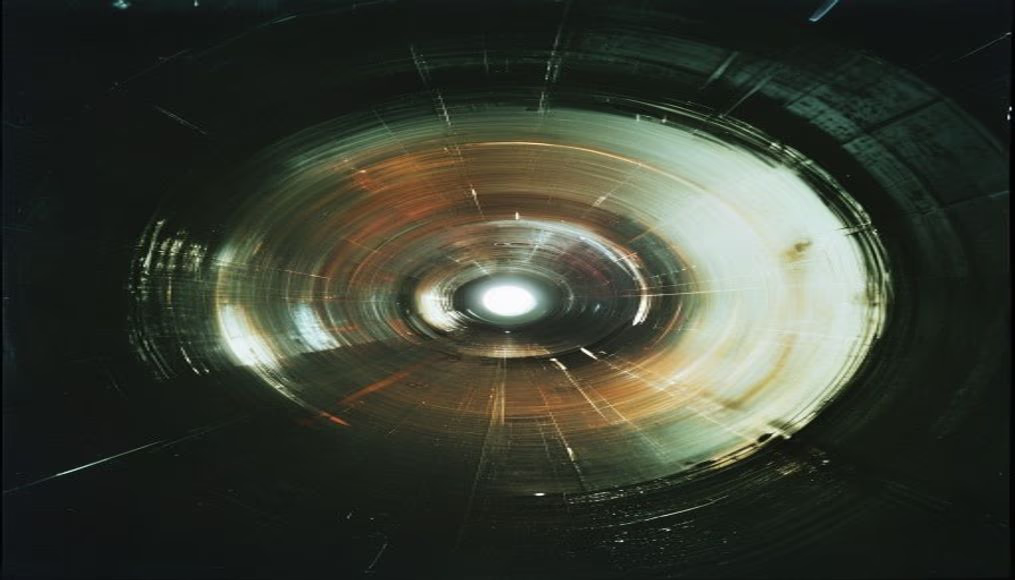
Black hole accretion disk
1344×768 · AVIF · CC BY 4.0

Discos de acreção são estruturas de gás e poeira que giram em torno de buracos negros, emitindo intensa radiação antes de serem consumidos.
Sobre o tema
Um disco de acreção é formado quando matéria interestelar, como gás e poeira, é atraída pela imensa gravidade de um buraco negro. Esse material não cai diretamente no horizonte de eventos, mas se acumula em um disco rotativo, aquecendo-se a temperaturas extremas devido ao atrito e à compressão gravitacional. Esse aquecimento faz com que o disco emita radiação em todo o espectro eletromagnético, desde ondas de rádio até raios X, sendo esta a principal forma de detectar buracos negros no universo.
Os discos de acreção podem ter tamanhos variados, desde alguns quilômetros até centenas de anos-luz de diâmetro, dependendo da massa do buraco negro. Em buracos negros supermassivos, como aqueles no centro de galáxias, o disco pode ser tão brilhante quanto milhares de galáxias, originando os núcleos ativos de galáxias e quasares. Já em buracos negros de massa estelar, formados pelo colapso de estrelas massivas, os discos são menores e mais tênues, frequentemente associados a sistemas binários onde o buraco negro 'rouba' matéria de sua estrela companheira.
A estrutura de um disco de acreção é influenciada pela rotação do buraco negro e pelo campo magnético presente. Próximo ao horizonte de eventos, os efeitos relativísticos se tornam significativos, fazendo com que partículas orbitem a velocidades próximas à da luz. Isso gera fenômenos como a sombra do buraco negro, observada pela primeira vez em 2019 pelo Event Horizon Telescope na galáxia M87. O estudo de discos de acreção ajuda a entender a evolução galáctica, a formação de jatos relativísticos e as propriedades fundamentais da gravidade em regimes extremos.
Perguntas frequentes
O que é um buraco negro?
Um buraco negro é uma região do espaço onde a gravidade é tão intensa que nada, nem mesmo a luz, consegue escapar. Ele se forma quando uma grande quantidade de massa é comprimida em um volume extremamente pequeno.
Como os discos de acreção emitem radiação?
O material no disco é aquecido a milhões de graus pela fricção e pela compressão gravitacional, emitindo radiação eletromagnética, especialmente raios X e luz visível, que podem ser detectados por telescópios.
Qual a importância dos discos de acreção para a astronomia?
Eles permitem a detecção indireta de buracos negros e fornecem informações sobre sua massa, rotação e ambiente, além de ajudar a estudar processos de acreção e formação de jatos relativísticos.
URL direta
https://pub-c7d6a6ea828543ac903a74a341ccb2e1.r2.dev/imagens/black-hole-accretion-disk-minimalist-composition-p1.avifComo creditar
Inclua um link visível de volta pro UtilizAí. Copie um dos snippets abaixo:
<a href="https://xn--utiliza-eza.com/midia/imagens/black-hole-accretion-disk-minimalist-composition-p1">Black hole accretion disk</a> by <a href="https://xn--utiliza-eza.com">UtilizAí</a>, licensed under <a href="https://creativecommons.org/licenses/by/4.0/">CC BY 4.0</a>.
[Black hole accretion disk](https://xn--utiliza-eza.com/midia/imagens/black-hole-accretion-disk-minimalist-composition-p1) by [UtilizAí](https://xn--utiliza-eza.com), CC BY 4.0
Licença: CC-BY-4.0