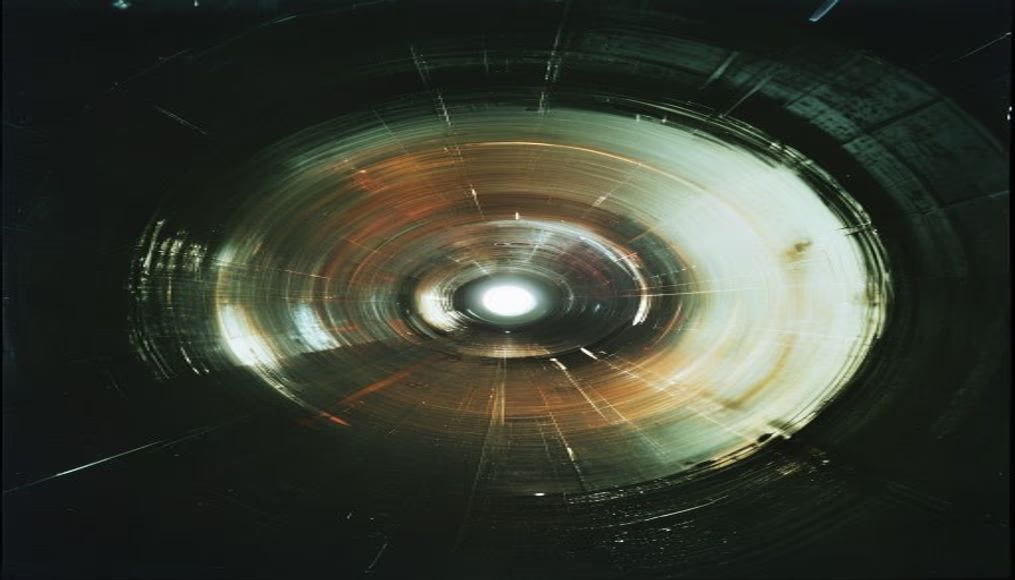
Black hole accretion disk
1344×768 · AVIF · CC BY 4.0

An accretion disk is a rotating structure of superheated matter around a black hole, emitting intense X-ray and visible light radiation.
About this subject
An accretion disk forms when gas, dust, and stars are captured by the extreme gravity of a black hole. The matter spirals toward the event horizon, gaining speed and heating up through viscous friction to millions of degrees. This process converts gravitational potential energy into electromagnetic radiation, mainly X-rays, making active black holes detectable by telescopes. The first accretion disk ever directly imaged was that of the supermassive black hole M87 in 2019 by the Event Horizon Telescope. The image revealed a bright ring around the black hole's shadow, confirming predictions of Einstein's general relativity. Accretion disks are common in X-ray binary systems and active galactic nuclei such as quasars. The matter in the disk does not fall directly; it orbits at relativistic speeds, sometimes reaching 50% the speed of light. Turbulence and magnetic fields in the disk produce instabilities that cause periodic brightness variations. These objects also serve as natural laboratories for studying high-energy physics and galaxy evolution, as the accretion process can trigger relativistic jets extending thousands of light-years.
Frequently Asked Questions
What happens to matter falling into an accretion disk?
Matter in the accretion disk gradually loses energy and angular momentum, spiraling toward the black hole. Some is swallowed by the event horizon, while other parts may be ejected in relativistic jets along the black hole's poles.
How do scientists observe accretion disks?
Accretion disks are mainly observed with X-ray telescopes like Chandra and XMM-Newton, as well as radio observatories such as ALMA. The direct image of M87 required a global network of radio telescopes, the Event Horizon Telescope.
What is the temperature of an accretion disk?
Temperatures range from a few thousand Kelvin in the outer regions to tens of millions of Kelvin in the inner parts near the black hole, emitting mainly X-rays. In stellar-mass black holes, inner regions can exceed 100 million Kelvin.
Direct URL
https://pub-c7d6a6ea828543ac903a74a341ccb2e1.r2.dev/imagens/black-hole-accretion-disk-macro-closeup-p0.avifHow to credit
Include a visible link back to UtilizAí. Copy one of the snippets below:
<a href="https://xn--utiliza-eza.com/en/midia/imagens/black-hole-accretion-disk-macro-closeup-p0">Black hole accretion disk</a> by <a href="https://xn--utiliza-eza.com">UtilizAí</a>, licensed under <a href="https://creativecommons.org/licenses/by/4.0/">CC BY 4.0</a>.
[Black hole accretion disk](https://xn--utiliza-eza.com/en/midia/imagens/black-hole-accretion-disk-macro-closeup-p0) by [UtilizAí](https://xn--utiliza-eza.com), CC BY 4.0
License: CC-BY-4.0