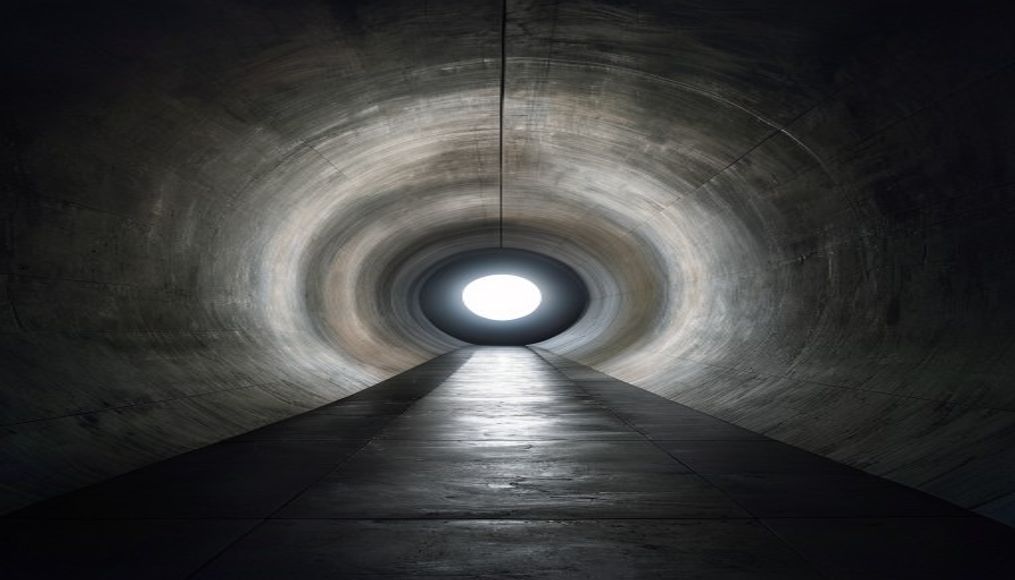
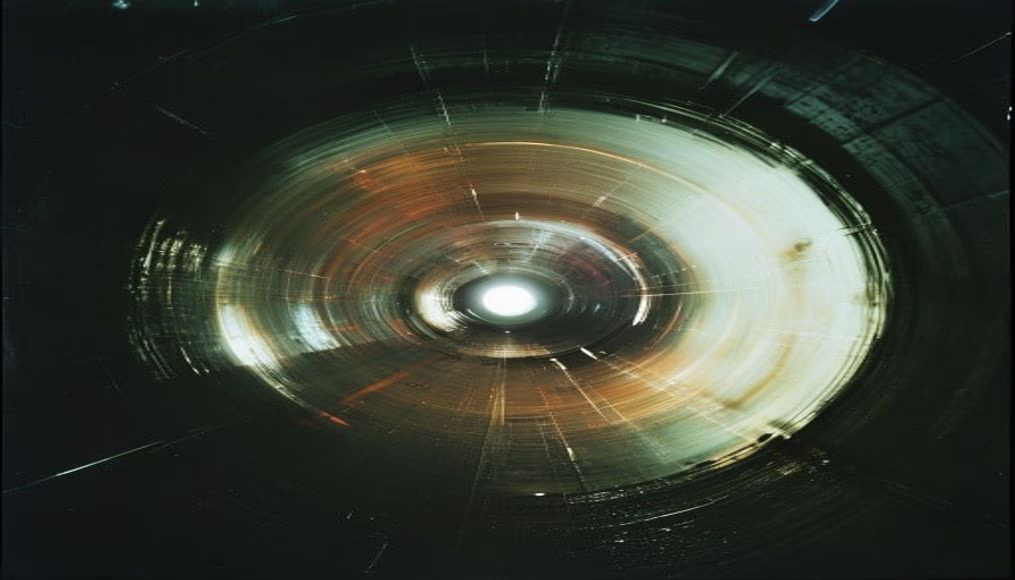
Big bang tunnel cern
1344×768 · AVIF · CC BY 4.0
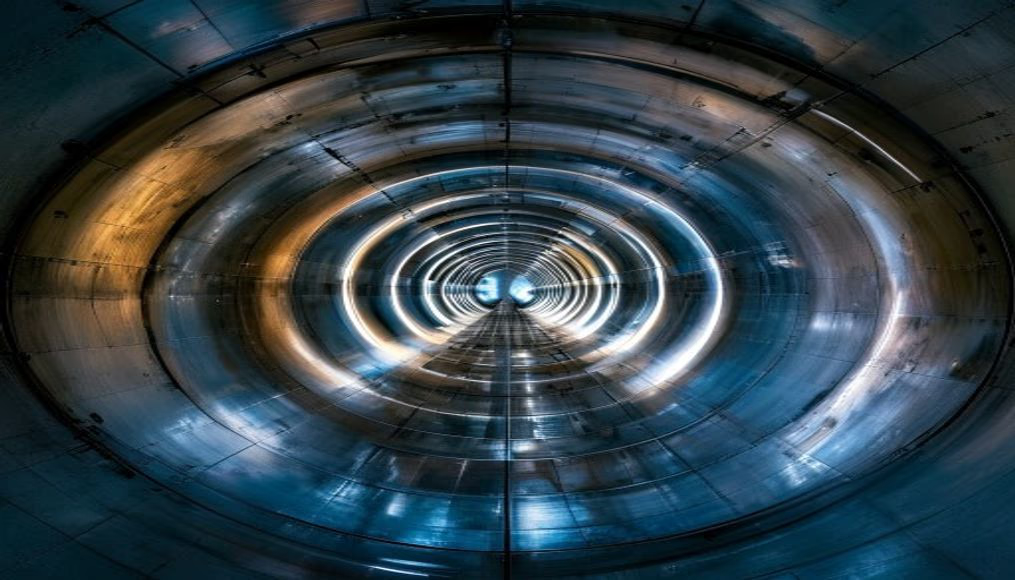
The Large Hadron Collider (LHC) at CERN, a 27 km tunnel recreating Big Bang conditions to study fundamental particles.
About this subject
The Large Hadron Collider (LHC) is the world's largest and most powerful particle accelerator, located on the border between France and Switzerland near Geneva. Built by the European Organization for Nuclear Research (CERN), its circular tunnel is 27 kilometers in circumference and buried about 100 meters underground. The LHC is designed to collide proton beams at speeds close to light, generating unprecedented energies that recreate conditions just after the Big Bang.
Inside the tunnel, four major detectors (ATLAS, CMS, ALICE, and LHCb) record debris from collisions, allowing physicists to study subatomic particles and fundamental forces. In 2012, the LHC confirmed the existence of the Higgs boson, a discovery that earned Peter Higgs and François Englert the Nobel Prize in Physics. The tunnel is lined with superconducting magnets that guide the beams, maintaining precise trajectories with cryogenics at temperatures near absolute zero.
The LHC not only validates the Standard Model of particle physics but also seeks explanations for mysteries like dark matter, antimatter, and extra dimensions. Operations occur in cycles, with collision periods called Runs followed by technical shutdowns for upgrades. The tunnel itself is a masterpiece of civil and mechanical engineering, requiring meticulous geodetic adjustments due to Earth's curvature. Its construction involved excavating over 1.2 million cubic meters of rock and concrete, and its cooling system uses liquid helium to cool magnets to -271.3 degrees Celsius.
In popular culture, the LHC is often associated with experiments simulating the Big Bang, sparking fascination and sometimes conspiracy theories about black holes. However, CERN assures no risks exist, and the tunnel remains a symbol of global scientific collaboration, involving over 10,000 scientists from 100 countries. Images of the tunnel, with its cables and metallic structures, are iconic in architectural and scientific photography, representing the frontier of human knowledge.
Frequently Asked Questions
What is the Big Bang tunnel at CERN?
It is the tunnel of the Large Hadron Collider (LHC), a 27 km particle accelerator that collides protons at extremely high energies to recreate conditions similar to the Big Bang, enabling the study of elementary particles.
What experiments are conducted at the CERN LHC?
The main experiments are ATLAS, CMS, ALICE, and LHCb, which analyze collisions to investigate the Higgs boson, dark matter, quark-gluon plasma, and matter-antimatter asymmetry.
What is the importance of the LHC for science?
The LHC is crucial for testing the Standard Model of particle physics, discovering new particles (like the Higgs boson), and seeking answers to fundamental questions about the universe's origin and the nature of dark matter.
Direct URL
https://pub-c7d6a6ea828543ac903a74a341ccb2e1.r2.dev/imagens/big-bang-tunnel-cern-architectural-photography-p0.avifHow to credit
Include a visible link back to UtilizAí. Copy one of the snippets below:
<a href="https://xn--utiliza-eza.com/en/midia/imagens/big-bang-tunnel-cern-architectural-photography-p0">Big bang tunnel cern</a> by <a href="https://xn--utiliza-eza.com">UtilizAí</a>, licensed under <a href="https://creativecommons.org/licenses/by/4.0/">CC BY 4.0</a>.
[Big bang tunnel cern](https://xn--utiliza-eza.com/en/midia/imagens/big-bang-tunnel-cern-architectural-photography-p0) by [UtilizAí](https://xn--utiliza-eza.com), CC BY 4.0
License: CC-BY-4.0