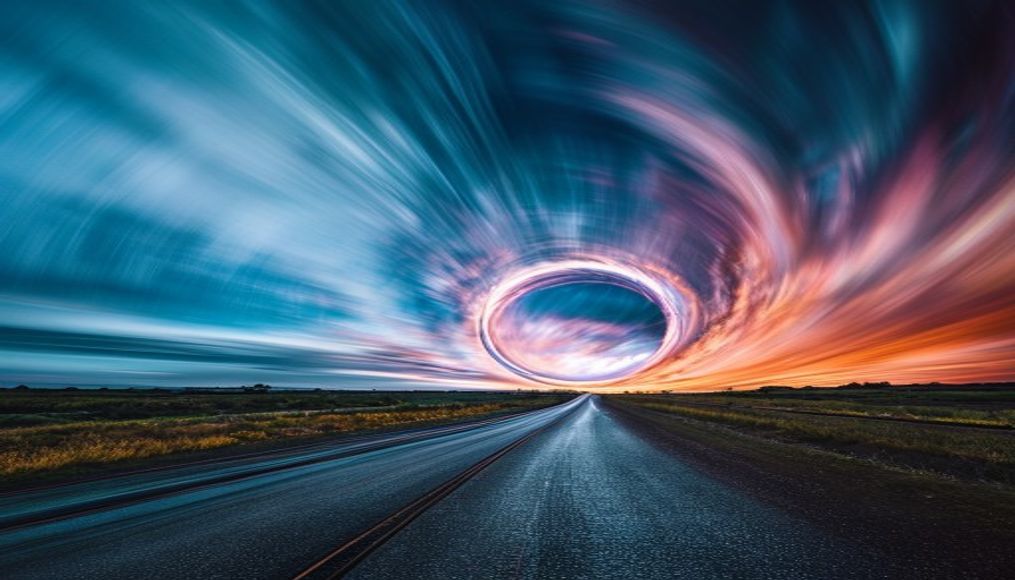
Big bang artistic concept
1344×768 · AVIF · CC BY 4.0

The Big Bang is the scientific theory describing the origin of the universe from a rapid expansion of an extremely hot and dense initial state about 13.8 billion years ago.
About this subject
The Big Bang theory is the prevailing cosmological model for the origin and evolution of the universe. It posits that all space, time, matter, and energy emerged from an infinitely hot and dense singularity that began expanding rapidly. This expansion was not an explosion in space but an expansion of space itself. The term 'Big Bang' was popularized by astrophysicist Fred Hoyle, who ironically was a critic of the theory. Key evidence includes the cosmic microwave background radiation, discovered in 1965, which is an 'echo' of the early universe, and Hubble's Law, which shows galaxies receding from each other, indicating expansion.
In the first instants, the universe was a soup of elementary particles and radiation. As it expanded and cooled, protons and neutrons formed, and later the first atomic nuclei (such as helium and lithium) emerged in primordial nucleosynthesis. After about 380,000 years, electrons combined with nuclei, allowing light to travel freely, this is the origin of the cosmic microwave background. Over time, small density fluctuations grew under gravity, forming stars, galaxies, and large-scale structures.
Interestingly, the Big Bang does not explain what happened before time zero, as the laws of physics as we know them break down at that point. Models such as cosmic inflation attempt to describe the earliest moments. The James Webb Space Telescope and other observatories continue to test and refine the theory, investigating the first galaxies and the composition of the universe. Mysteries remain, such as the nature of dark matter and dark energy, which make up most of the cosmos.
Frequently Asked Questions
What happened right after the Big Bang?
Just after the Big Bang, the universe underwent a rapid expansion called cosmic inflation. Then elementary particles formed, and primordial nucleosynthesis produced the first light elements like helium and lithium.
What is the strongest evidence for the Big Bang?
The cosmic microwave background radiation is considered the strongest evidence. Discovered in 1965, it fills the entire universe and is a remnant of the Big Bang's heat.
Was the Big Bang an explosion?
No, the Big Bang was not an explosion in the conventional sense. It was the expansion of space itself from an extremely dense and hot state, not the dispersal of matter into preexisting space.
Direct URL
https://pub-c7d6a6ea828543ac903a74a341ccb2e1.r2.dev/imagens/big-bang-artistic-concept-travel-photography-p5.avifHow to credit
Include a visible link back to UtilizAí. Copy one of the snippets below:
<a href="https://xn--utiliza-eza.com/en/midia/imagens/big-bang-artistic-concept-travel-photography-p5">Big bang artistic concept</a> by <a href="https://xn--utiliza-eza.com">UtilizAí</a>, licensed under <a href="https://creativecommons.org/licenses/by/4.0/">CC BY 4.0</a>.
[Big bang artistic concept](https://xn--utiliza-eza.com/en/midia/imagens/big-bang-artistic-concept-travel-photography-p5) by [UtilizAí](https://xn--utiliza-eza.com), CC BY 4.0
License: CC-BY-4.0