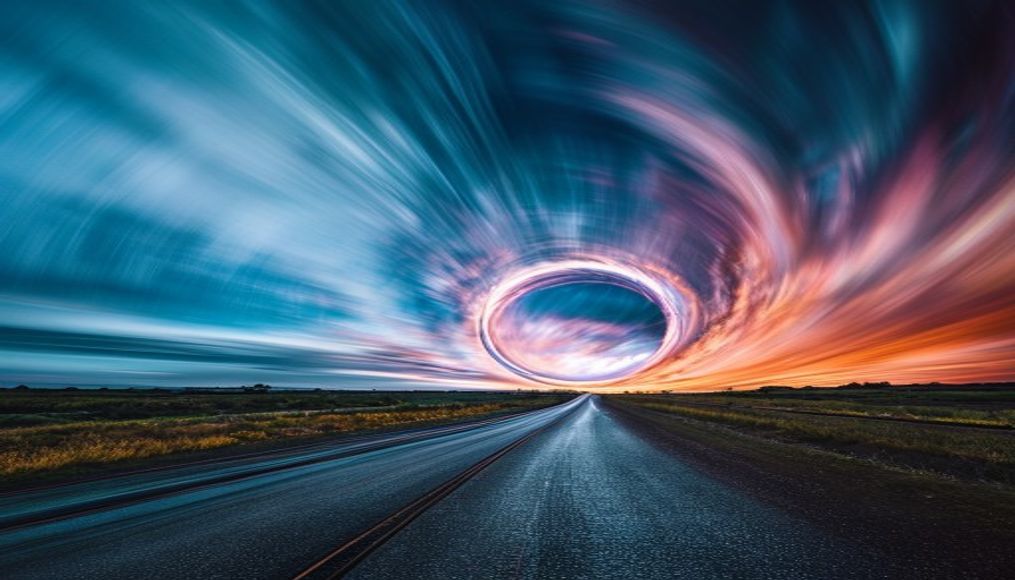
Big bang artistic concept
1344×768 · AVIF · CC BY 4.0

The Big Bang is the scientific theory explaining the origin of the universe from an accelerated expansion about 13.8 billion years ago.
About this subject
The Big Bang was not an explosion in space but an expansion of spacetime itself. The theory was first proposed by Georges Lemaître, a Belgian priest and astronomer, in 1927, and later strengthened by Edwin Hubble's observation of the redshift of galaxies. This phenomenon indicates that galaxies are moving away from each other, implying the universe was once much smaller and denser.
In the first moments after the Big Bang, the universe was a soup of elementary particles at extremely high temperatures. About 380,000 years later, electrons and protons combined to form the first hydrogen atoms, allowing light to travel freely. This cosmic microwave background radiation, discovered in 1965 by Penzias and Wilson, is one of the strongest pieces of evidence for the theory.
The standard Big Bang model is supported by observations such as the abundance of light elements (helium, deuterium) and the large-scale structure of the universe. However, questions like what existed before the Big Bang or what caused the initial expansion remain subjects of research in cosmology, involving concepts like cosmic inflation and dark energy.
Interestingly, the term "Big Bang" was coined by physicist Fred Hoyle in 1949 during a radio broadcast, in a pejorative sense, as he advocated the steady-state theory. Today, the name is widely accepted and represents the leading scientific explanation for the origin of the cosmos.
Frequently Asked Questions
What is the cosmic microwave background?
It is the afterglow of the Big Bang, discovered in 1965. It fills the entire universe and has a temperature of about 2.7 Kelvin, considered one of the strongest pieces of evidence for the theory.
What existed before the Big Bang?
This question has no definitive answer in current science. Some theories suggest that time and space began with the Big Bang, so there would be no 'before' in the conventional sense. Other proposals include cyclic universes or quantum fluctuations.
How does the Big Bang explain galaxy formation?
After the Big Bang, tiny fluctuations in matter density grew due to gravity, forming larger structures. Over time, these clumps gave rise to the first stars and galaxies about 13 billion years ago.
Direct URL
https://pub-c7d6a6ea828543ac903a74a341ccb2e1.r2.dev/imagens/big-bang-artistic-concept-magazine-editorial-p3.avifHow to credit
Include a visible link back to UtilizAí. Copy one of the snippets below:
<a href="https://xn--utiliza-eza.com/en/midia/imagens/big-bang-artistic-concept-magazine-editorial-p3">Big bang artistic concept</a> by <a href="https://xn--utiliza-eza.com">UtilizAí</a>, licensed under <a href="https://creativecommons.org/licenses/by/4.0/">CC BY 4.0</a>.
[Big bang artistic concept](https://xn--utiliza-eza.com/en/midia/imagens/big-bang-artistic-concept-magazine-editorial-p3) by [UtilizAí](https://xn--utiliza-eza.com), CC BY 4.0
License: CC-BY-4.0