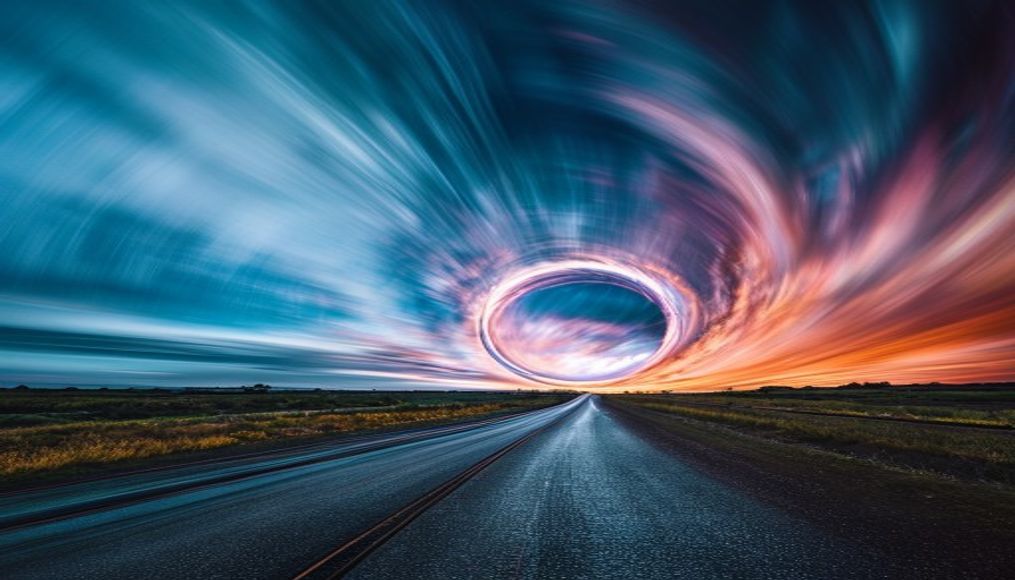
Big bang artistic concept
1344×768 · AVIF · CC BY 4.0

The Big Bang is the scientific theory explaining the origin of the universe about 13.8 billion years ago, from a rapid expansion of an extremely dense and hot point.
About this subject
The Big Bang is the prevailing cosmological model for the origin of the universe. According to this theory, all space, time, matter, and energy emerged from a singularity, an infinitely dense and hot point, that began to expand rapidly approximately 13.8 billion years ago. This expansion was not an explosion in space, but rather the expansion of space itself, which continues to this day.
Key evidence supporting the Big Bang includes the cosmic microwave background radiation, discovered in 1965, which is the residual heat from the early universe. Another piece of evidence is Hubble's law, which shows that galaxies are moving away from each other, indicating that the universe is expanding. Additionally, the abundance of light elements such as hydrogen and helium matches precisely the predictions of Big Bang nucleosynthesis.
In the first moments after the Big Bang, the universe was incredibly hot and dense, and it underwent a period of cosmic inflation, an exponential expansion lasting fractions of a second. As the universe cooled, subatomic particles formed, and later atoms. About 400,000 years after the Big Bang, radiation decoupled from matter, allowing light to travel freely, this is the origin of the cosmic microwave background.
The Big Bang is often misunderstood: it was not an explosion occurring at a point in empty space, but the expansion of spacetime itself from an extremely compact state. The theory does not describe what happened before the Big Bang, as time as we know it began with this event. The study of the Big Bang continues, with research on dark energy, dark matter, and the earliest moments of the universe, using telescopes and gravitational wave detectors.
Frequently Asked Questions
What happened before the Big Bang?
The Big Bang theory does not describe what happened before the event, as time as we know it began with the Big Bang. Some cosmological hypotheses suggest a cyclic universe or a quantum fluctuation, but there is no scientific consensus.
Was the Big Bang an explosion?
No, the Big Bang was not an explosion in ordinary space. It was an expansion of spacetime itself from an extremely dense and hot state. There is no center of the explosion; the expansion occurs throughout the universe.
How do we know the Big Bang actually happened?
The main evidence includes the cosmic microwave background radiation, the expansion of the universe observed by Hubble, and the abundance of light elements. These combined observations confirm the Big Bang model.
Direct URL
https://pub-c7d6a6ea828543ac903a74a341ccb2e1.r2.dev/imagens/big-bang-artistic-concept-long-exposure-p12.avifHow to credit
Include a visible link back to UtilizAí. Copy one of the snippets below:
<a href="https://xn--utiliza-eza.com/en/midia/imagens/big-bang-artistic-concept-long-exposure-p12">Big bang artistic concept</a> by <a href="https://xn--utiliza-eza.com">UtilizAí</a>, licensed under <a href="https://creativecommons.org/licenses/by/4.0/">CC BY 4.0</a>.
[Big bang artistic concept](https://xn--utiliza-eza.com/en/midia/imagens/big-bang-artistic-concept-long-exposure-p12) by [UtilizAí](https://xn--utiliza-eza.com), CC BY 4.0
License: CC-BY-4.0