Voyager 1 deep space
1344×768 · AVIF · CC BY 4.0
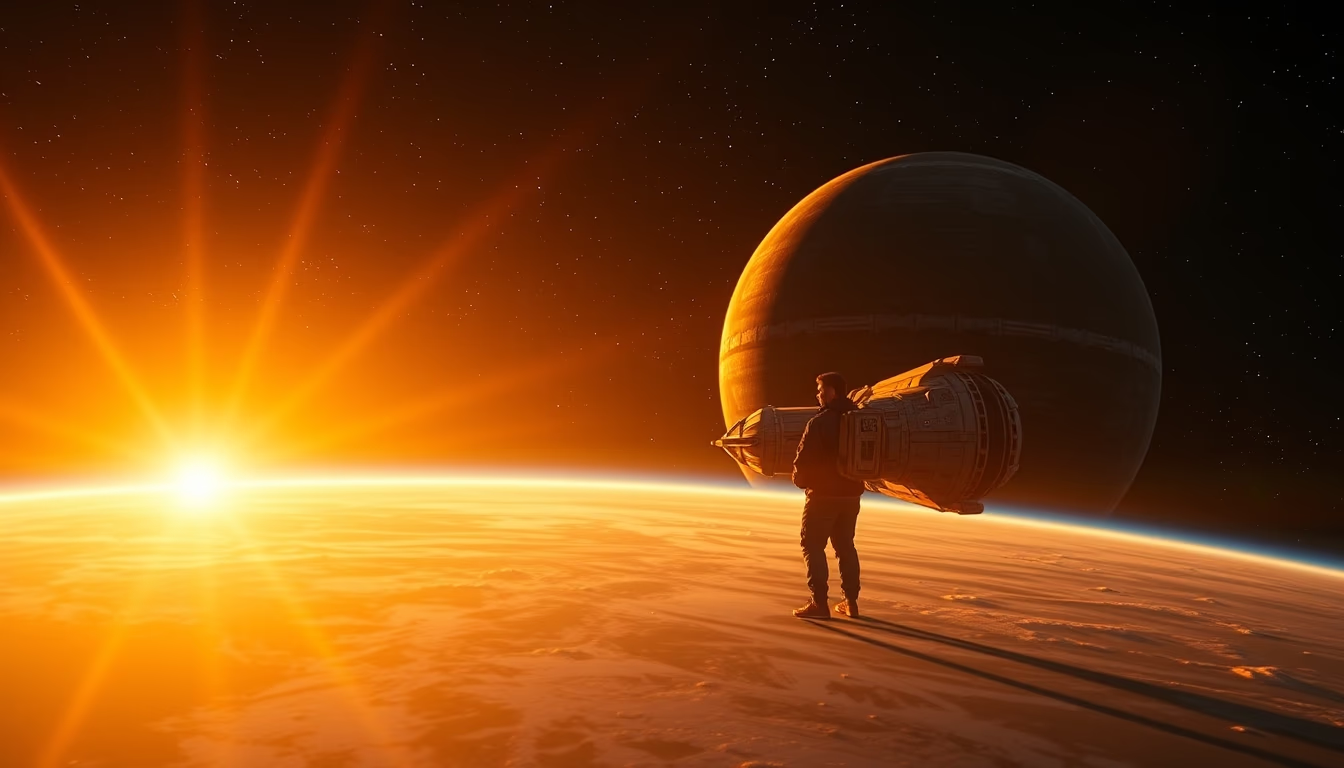
Launched in 1977, Voyager 1 is the farthest human-made object from Earth, now traveling through interstellar space.
About this subject
Voyager 1 is a spacecraft launched by NASA on September 5, 1977, with the primary mission to explore Jupiter and Saturn. After completing its planetary objectives, it continued its journey and on August 25, 2012, became the first human-made object to enter interstellar space, crossing the heliopause, the boundary where the solar wind meets the interstellar medium. As of today, Voyager 1 is over 24 billion kilometers from the Sun, sending back faint but valuable data about particles and magnetic fields beyond our solar system.
The spacecraft carries the famous Golden Record, a phonograph recording containing sounds and images of life on Earth, conceived by a team led by Carl Sagan. The record includes music from various cultures, greetings in 55 languages, and pulsar maps to indicate the spacecraft's origin, intended for potential extraterrestrial discovery. This artifact makes Voyager 1 a time capsule of humanity, representing our culture and science on an interstellar scale.
Despite its advanced age, Voyager 1 remains operational, with NASA managing its scientific instruments and communication systems. However, the power from its radioisotope thermoelectric generators is gradually declining, and all instruments are expected to be shut down by 2030. Even after falling silent, Voyager 1 will continue its trajectory, orbiting the center of the Milky Way every 225 million years, carrying humanity's legacy for eons.
Frequently Asked Questions
What is the current distance of Voyager 1 from Earth?
Voyager 1 is over 24 billion kilometers from Earth, making it the most distant human-made object. This distance increases by about 17 kilometers per second.
What is the Golden Record on Voyager?
It is a phonograph record containing greetings in 55 languages, music from various cultures, and images of life on Earth, designed to communicate our existence to any potential extraterrestrial civilizations.
How long will Voyager 1 continue to send data?
NASA estimates that Voyager 1 will keep at least one scientific instrument operating until around 2030, when the power from its radioisotope thermoelectric generators will no longer suffice.
Direct URL
https://pub-c7d6a6ea828543ac903a74a341ccb2e1.r2.dev/imagens/voyager-1-deep-space-cinematic-wide-shot-fresh17.avifHow to credit
Include a visible link back to UtilizAí. Copy one of the snippets below:
<a href="https://xn--utiliza-eza.com/en/midia/imagens/voyager-1-deep-space-cinematic-wide-shot-fresh17">Voyager 1 deep space</a> by <a href="https://xn--utiliza-eza.com">UtilizAí</a>, licensed under <a href="https://creativecommons.org/licenses/by/4.0/">CC BY 4.0</a>.
[Voyager 1 deep space](https://xn--utiliza-eza.com/en/midia/imagens/voyager-1-deep-space-cinematic-wide-shot-fresh17) by [UtilizAí](https://xn--utiliza-eza.com), CC BY 4.0
License: CC-BY-4.0