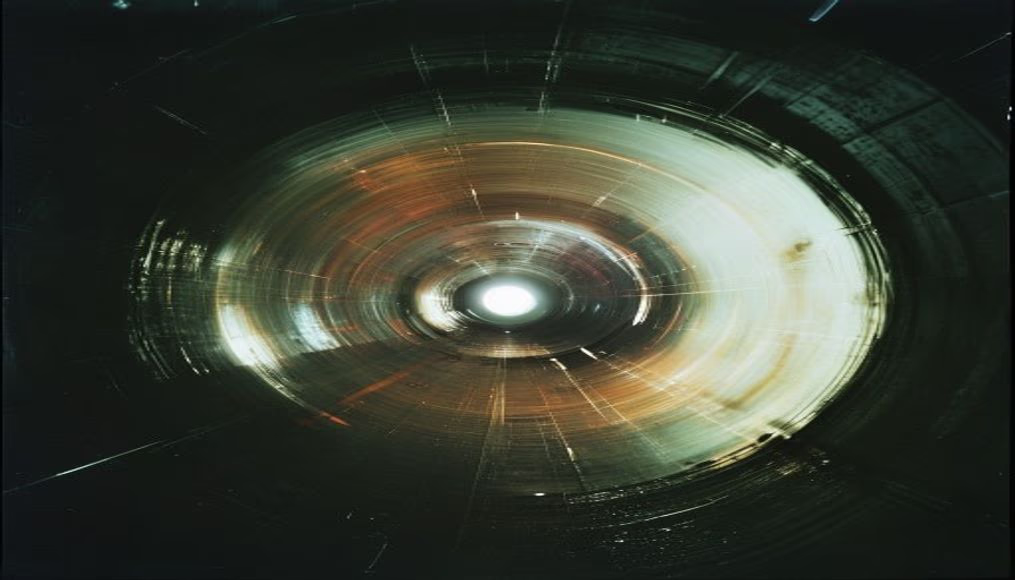
White dwarf star fading
1344×768 · AVIF · CC BY 4.0

White dwarf stars are the leftover cores of Sun-like stars, gradually cooling and fading over billions of years.
About this subject
White dwarfs are the final evolutionary stage of low to intermediate mass stars, like our Sun. After exhausting nuclear fuel, such stars shed their outer layers to form a planetary nebula, leaving behind an extremely dense core: the white dwarf. With masses comparable to the Sun but volumes similar to Earth, these objects have densities on the order of tons per cubic centimeter.
The fading process occurs because white dwarfs have no internal energy source; they shine only from residual heat. Initially with surface temperatures above 100,000 K, they gradually cool over billions of years, becoming fainter until they theoretically become black dwarfs, objects that do not yet exist in the observable universe due to its age. Cooling to 5,000 K is estimated to take about 10 billion years.
Sirius B, the companion to the brightest star in the night sky, is a well-studied white dwarf with a surface temperature around 25,000 K and a much lower apparent magnitude than Sirius A. Another famous example is Van Maanen's Star, an isolated white dwarf about 14 light-years away. Observing the fading of these objects helps astronomers calibrate the ages of star clusters and understand the chemical evolution of the galaxy.
Frequently Asked Questions
How long does it take for a white dwarf to cool completely?
Cooling to about 5,000 K takes roughly 10 billion years. To become a black dwarf (completely cold) would require many trillions of years, but the universe is too young to have produced any.
What is the initial temperature of a white dwarf?
Right after formation, a white dwarf's surface temperature can exceed 100,000 K, but it cools rapidly in the first few million years.
What happens to the material inside a white dwarf as it fades?
The material is mainly carbon and oxygen in a degenerate state. As it cools, it crystallizes, forming a solid core of carbon and oxygen, similar to a giant diamond.
Direct URL
https://pub-c7d6a6ea828543ac903a74a341ccb2e1.r2.dev/imagens/white-dwarf-star-fading-travel-photography-p12.avifHow to credit
Include a visible link back to UtilizAí. Copy one of the snippets below:
<a href="https://xn--utiliza-eza.com/en/midia/imagens/white-dwarf-star-fading-travel-photography-p12">White dwarf star fading</a> by <a href="https://xn--utiliza-eza.com">UtilizAí</a>, licensed under <a href="https://creativecommons.org/licenses/by/4.0/">CC BY 4.0</a>.
[White dwarf star fading](https://xn--utiliza-eza.com/en/midia/imagens/white-dwarf-star-fading-travel-photography-p12) by [UtilizAí](https://xn--utiliza-eza.com), CC BY 4.0
License: CC-BY-4.0