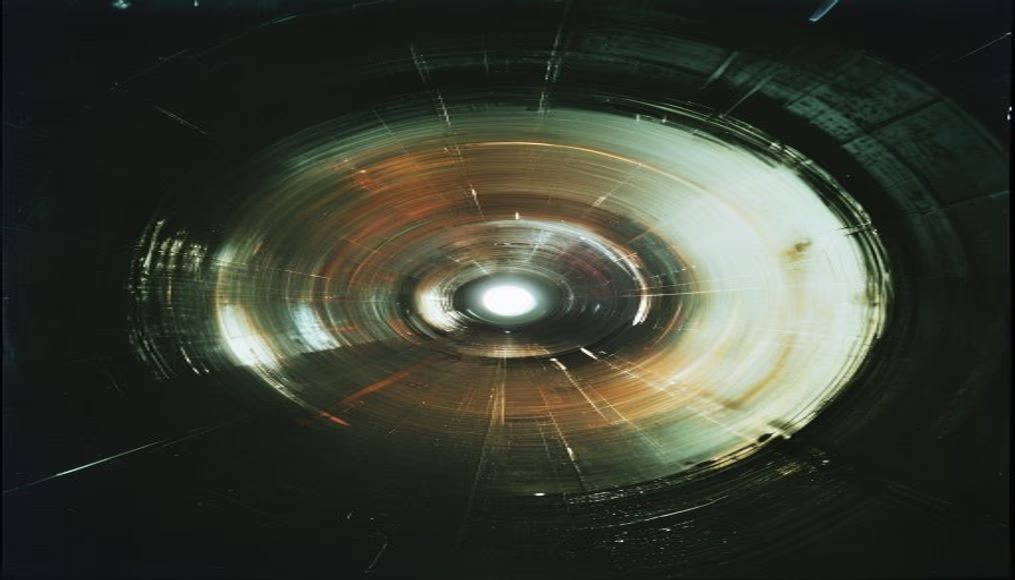
White dwarf star fading
1344×768 · AVIF · CC BY 4.0

White dwarf stars are the remnant cores of Sun-like stars, cooling and fading over billions of years.
About this subject
A white dwarf is the final evolutionary stage of low to medium mass stars, like our Sun. After exhausting all nuclear fuel, the star ejects its outer layers forming a planetary nebula, leaving behind a dense core composed mainly of carbon and oxygen. This core, about the size of Earth but with a mass comparable to the Sun, is a white dwarf. Its extremely high density means a cubic centimeter weighs tons.
The fading process occurs because the white dwarf no longer undergoes nuclear fusion. It shines only from residual heat. Initially, its surface temperature can exceed 100,000 K, but over time it radiates energy into space and gradually cools. This cooling is extremely slow: it takes billions of years for a white dwarf to become a black dwarf, a cold and dark object. The universe is currently too young to contain black dwarfs, as the estimated time required is longer than the current age of the universe (13.8 billion years).
The maximum mass of a white dwarf is limited by the Chandrasekhar limit, about 1.4 solar masses. Above this, electron degeneracy pressure cannot support the star, leading to a type Ia supernova explosion. White dwarfs are fascinating celestial objects because they allow the study of high-density physics and serve as standard candles for measuring cosmic distances. Notable examples include Sirius B, the companion of Sirius, and Van Maanen's star.
Frequently Asked Questions
How long does it take for a white dwarf to cool completely?
Complete cooling to become a black dwarf takes tens to hundreds of billions of years, longer than the current age of the universe. Thus, no black dwarfs exist yet.
What is the temperature of a newly formed white dwarf?
A newly formed white dwarf can have a surface temperature above 100,000 K. Over billions of years, it cools to a few thousand Kelvin.
Why are white dwarfs so dense?
Extreme gravitational compression without nuclear fusion causes matter to be squeezed until electrons form a degenerate gas. A volume the size of Earth can contain up to 1.4 solar masses.
Direct URL
https://pub-c7d6a6ea828543ac903a74a341ccb2e1.r2.dev/imagens/white-dwarf-star-fading-minimalist-composition-p8.avifHow to credit
Include a visible link back to UtilizAí. Copy one of the snippets below:
<a href="https://xn--utiliza-eza.com/en/midia/imagens/white-dwarf-star-fading-minimalist-composition-p8">White dwarf star fading</a> by <a href="https://xn--utiliza-eza.com">UtilizAí</a>, licensed under <a href="https://creativecommons.org/licenses/by/4.0/">CC BY 4.0</a>.
[White dwarf star fading](https://xn--utiliza-eza.com/en/midia/imagens/white-dwarf-star-fading-minimalist-composition-p8) by [UtilizAí](https://xn--utiliza-eza.com), CC BY 4.0
License: CC-BY-4.0