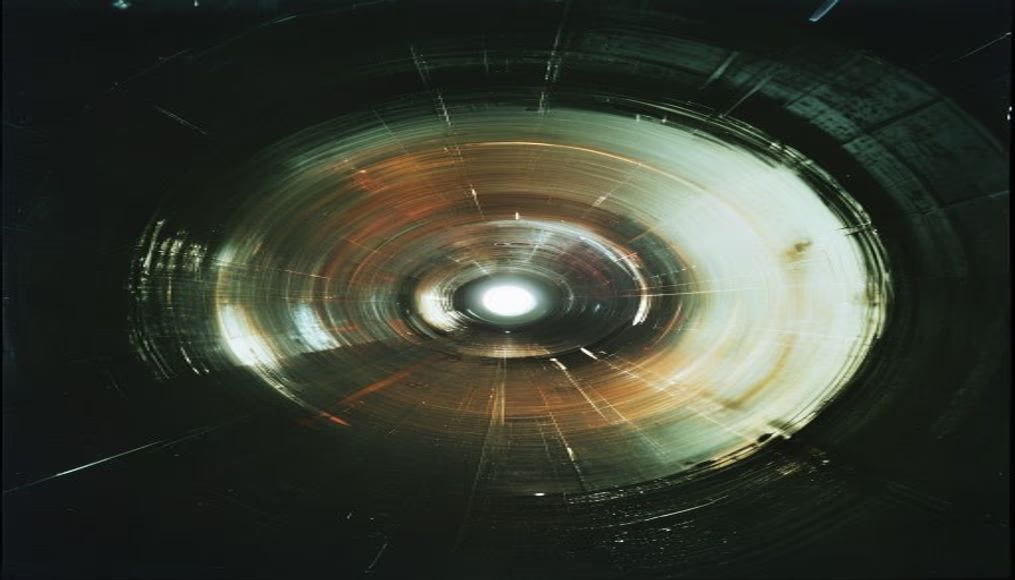
White dwarf star fading
1344×768 · AVIF · CC BY 4.0

White dwarfs are the remnant cores of stars like the Sun, which slowly cool and fade over billions of years.
About this subject
A white dwarf is the final evolutionary stage of low- to intermediate-mass stars, such as our Sun. After exhausting its nuclear fuel, the star expels its outer layers to form a planetary nebula, leaving behind an extremely dense core composed mainly of carbon and oxygen. This core, the white dwarf, no longer undergoes nuclear fusion and shines only from residual heat.
White dwarfs are incredibly compact objects. A mass comparable to the Sun is compressed into a volume the size of Earth, resulting in densities on the order of one ton per cubic centimeter. Their surface gravity is about 100,000 times that of Earth. The interior matter is in a degenerate state, governed by quantum mechanics, which prevents gravitational collapse up to the Chandrasekhar limit of about 1.4 solar masses.
The cooling process is extremely slow. Initially, the surface temperature can be tens of thousands of Kelvin, but the white dwarf generates no new energy and loses heat through radiation. It is estimated that a typical white dwarf takes tens of billions of years to become a black dwarf, a cold and dark object. Since the universe is only 13.8 billion years old, no black dwarfs are expected to exist yet.
Famous examples include Sirius B, the companion of Sirius, and the nearest white dwarf, Van Maanen 2, about 14 light-years away. Studies of white dwarfs provide insights into the ages of star clusters and the evolution of the galactic disk. The discovery of white dwarfs with metal-rich atmospheres suggests the presence of remnant planetary systems, as in the case of WD 1145+017.
Frequently Asked Questions
How long does it take for a white dwarf to cool completely?
A white dwarf takes tens of billions of years to cool and become a black dwarf. Since the universe is about 13.8 billion years old, no black dwarfs have been observed yet.
Can a white dwarf explode?
Yes, if a white dwarf in a binary system accretes matter from its companion and exceeds the Chandrasekhar limit (1.4 solar masses), it can undergo a Type Ia supernova, a thermonuclear explosion that completely destroys it.
What is the difference between a white dwarf and a neutron star?
White dwarfs are formed by low-mass stars and have densities on the order of tons per cm³, while neutron stars are remnants of massive stars, with nuclear densities and masses between 1.4 and 2.16 solar masses compressed into only 20 km in diameter.
Direct URL
https://pub-c7d6a6ea828543ac903a74a341ccb2e1.r2.dev/imagens/white-dwarf-star-fading-isometric-flat-lay-p0.avifHow to credit
Include a visible link back to UtilizAí. Copy one of the snippets below:
<a href="https://xn--utiliza-eza.com/en/midia/imagens/white-dwarf-star-fading-isometric-flat-lay-p0">White dwarf star fading</a> by <a href="https://xn--utiliza-eza.com">UtilizAí</a>, licensed under <a href="https://creativecommons.org/licenses/by/4.0/">CC BY 4.0</a>.
[White dwarf star fading](https://xn--utiliza-eza.com/en/midia/imagens/white-dwarf-star-fading-isometric-flat-lay-p0) by [UtilizAí](https://xn--utiliza-eza.com), CC BY 4.0
License: CC-BY-4.0