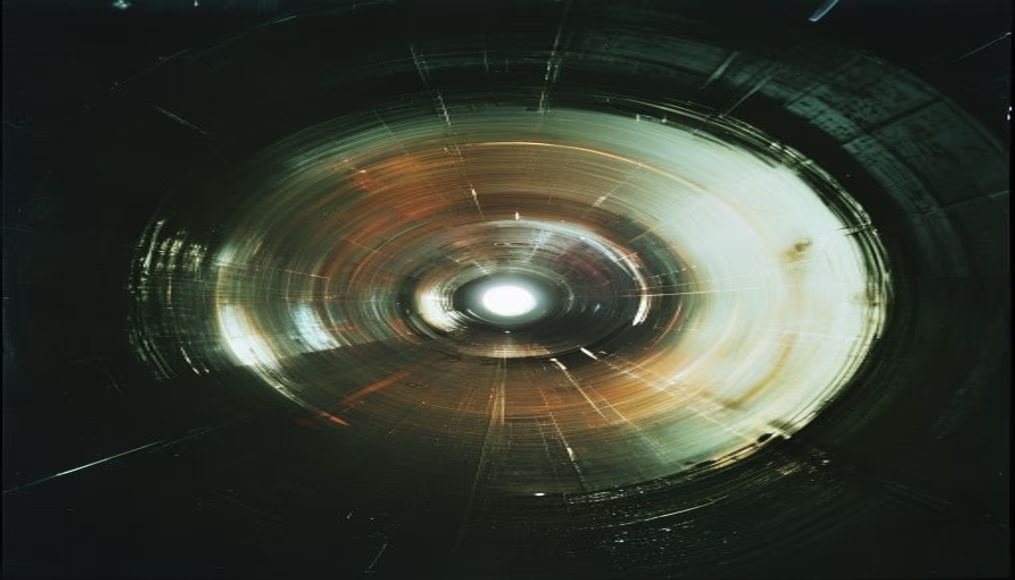
White dwarf star fading
1344×768 · AVIF · CC BY 4.0

White dwarf stars are stellar remnants that gradually cool over billions of years until they become invisible black dwarfs.
About this subject
White dwarfs are the final evolutionary stage of low to intermediate mass stars, such as the Sun. After exhausting nuclear fuel, the star ejects its outer layers forming a planetary nebula, leaving a dense core composed mainly of carbon and oxygen. This core, a white dwarf, no longer undergoes nuclear fusion and shines only from residual thermal energy. The cooling process is extremely slow: a white dwarf can take tens of billions of years to cool completely, becoming a black dwarf, a dark object indistinguishable from the cosmic background.
The term "fading" precisely describes this gradual decrease in luminosity. The cooling rate depends on the dwarf's mass and composition. More massive dwarfs, near the Chandrasekhar limit (about 1.4 solar masses), cool faster because they are smaller and have less surface area. Less massive dwarfs can persist longer. Known white dwarfs, like Sirius B, have surface temperatures around 25,000 K, but over time this temperature drops to thousands of degrees until they reach thermal equilibrium with the universe.
Interestingly, no black dwarfs exist yet in the observable universe. The universe's age, roughly 13.8 billion years, is insufficient for any white dwarf to have cooled completely. The oldest known white dwarfs are estimated to be 10 to 12 billion years old and still emit visible light. Studying these objects provides clues to the age of stellar clusters and the chemical evolution of the galaxy. Furthermore, white dwarfs can explode as Type Ia supernovae if they accrete matter from a binary companion, making them crucial for cosmological measurements.
Frequently Asked Questions
How long does it take for a white dwarf to become a black dwarf?
A white dwarf is estimated to take tens of billions of years to cool completely and become a black dwarf. Since the universe is only 13.8 billion years old, no black dwarfs have formed yet.
What determines the cooling rate of a white dwarf?
The cooling rate primarily depends on the dwarf's mass and composition. More massive dwarfs near the Chandrasekhar limit cool faster because they are smaller and have less surface area.
Can white dwarfs become supernovae?
Yes, white dwarfs in binary systems can explode as Type Ia supernovae if they accrete enough matter from their companion star, exceeding the Chandrasekhar limit. These supernovae are used as standard candles in cosmology.
Direct URL
https://pub-c7d6a6ea828543ac903a74a341ccb2e1.r2.dev/imagens/white-dwarf-star-fading-commercial-product-photography-p11.avifHow to credit
Include a visible link back to UtilizAí. Copy one of the snippets below:
<a href="https://xn--utiliza-eza.com/en/midia/imagens/white-dwarf-star-fading-commercial-product-photography-p11">White dwarf star fading</a> by <a href="https://xn--utiliza-eza.com">UtilizAí</a>, licensed under <a href="https://creativecommons.org/licenses/by/4.0/">CC BY 4.0</a>.
[White dwarf star fading](https://xn--utiliza-eza.com/en/midia/imagens/white-dwarf-star-fading-commercial-product-photography-p11) by [UtilizAí](https://xn--utiliza-eza.com), CC BY 4.0
License: CC-BY-4.0