Watch face macro luxury
1344×768 · AVIF · CC BY 4.0
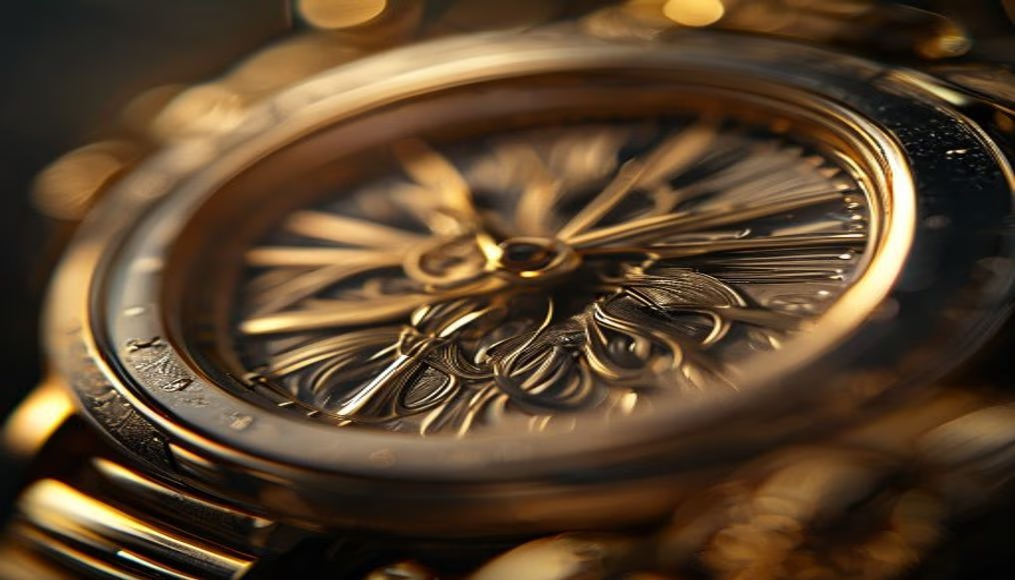
The dial of a luxury watch reveals the precision of haute horlogerie, with details such as skeleton hands and applied indices.
About this subject
The dials of luxury watches are true miniature works of art, combining centuries-old craftsmanship with precision engineering. Every element, from the hands to the indices, is carefully designed and hand-assembled by master watchmakers. The complexity goes beyond aesthetics: many dials include complications such as chronographs, moon phases, and perpetual calendars, requiring hundreds of tiny parts to function perfectly.
The materials used are as noble as the design. 18k gold, platinum, grand feu enamel, mother-of-pearl, and sapphire are common in high-end models. The guilloché technique, which creates raised geometric patterns, is often used to add depth and texture to the dial. These details not only beautify but also protect the inner mechanism from dust and moisture.
The history of luxury watchmaking dates back to the 16th and 17th centuries, when the first pocket watches appeared in Europe. Over time, miniaturization allowed these devices to be worn on the wrist. Brands such as Patek Philippe, Audemars Piguet, and Rolex became synonymous with excellence, each with its innovations, like Rolex's Perpetual automatic movement or Breguet's tourbillon.
Interestingly, despite the digital age, mechanical watches continue to be valued for their complexity and tradition. A luxury watch is not just a tool for telling time, but a symbol of status, heritage, and dedication to craft.
Frequently Asked Questions
What makes a luxury watch dial special?
A luxury dial stands out for its combination of hand craftsmanship, noble materials (gold, enamel, mother-of-pearl), and mechanical complications. Every detail is designed to blend aesthetics and functionality, often requiring months of work.
What materials are used in high-end watch dials?
Materials include 18k gold, platinum, titanium, sapphire, grand feu enamel, mother-of-pearl, and even meteorite. These materials are chosen for their durability, beauty, and resistance to wear.
How is the accuracy of a mechanical watch maintained?
Accuracy depends on the movement, which uses a balance wheel and hairspring oscillating at a constant frequency (typically 4 Hz or 28,800 vibrations per hour). Fine adjustments and proper lubrication ensure precision.
Direct URL
https://pub-c7d6a6ea828543ac903a74a341ccb2e1.r2.dev/imagens/watch-face-macro-luxury-travel-photography-v10.avifHow to credit
Include a visible link back to UtilizAí. Copy one of the snippets below:
<a href="https://xn--utiliza-eza.com/en/midia/imagens/watch-face-macro-luxury-travel-photography-v10">Watch face macro luxury</a> by <a href="https://xn--utiliza-eza.com">UtilizAí</a>, licensed under <a href="https://creativecommons.org/licenses/by/4.0/">CC BY 4.0</a>.
[Watch face macro luxury](https://xn--utiliza-eza.com/en/midia/imagens/watch-face-macro-luxury-travel-photography-v10) by [UtilizAí](https://xn--utiliza-eza.com), CC BY 4.0
License: CC-BY-4.0