Usb-c connector macro
1344×768 · AVIF · CC BY 4.0
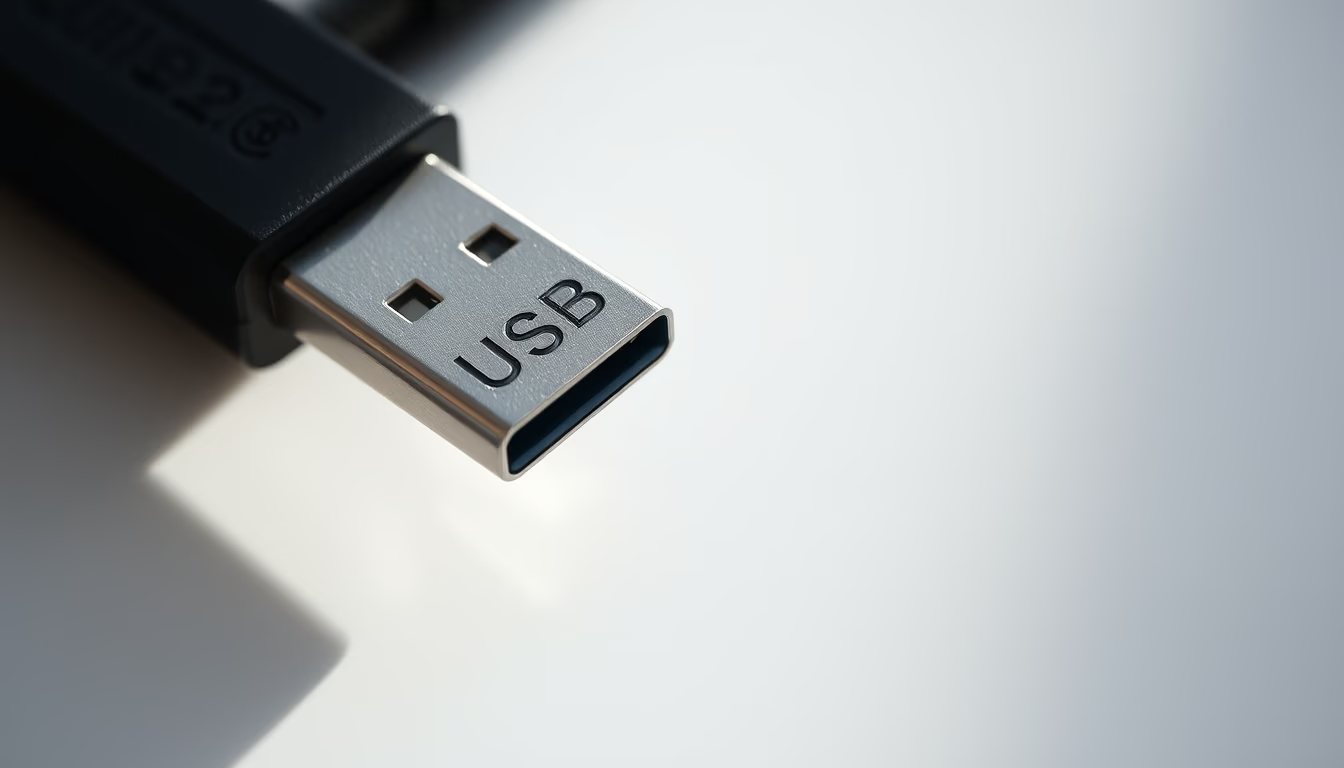
The USB-C connector is a reversible 24-pin standard offering high-speed data transfer, fast charging, and video support, adopted globally in modern devices.
About this subject
The USB-C connector, standardized by the USB Implementers Forum (USB-IF), was introduced in 2014 to unify connections in electronic devices. Unlike USB-A and USB-B connectors, USB-C is symmetrical and reversible, eliminating the frustration of plug orientation. It supports USB 3.1 Gen 2 with transfer rates up to 10 Gbps, and later versions like USB 3.2 (20 Gbps) and USB4 (40 Gbps). Beyond data, the connector can deliver up to 240 W of power via USB Power Delivery (PD) and transmit video using DisplayPort and HDMI protocols, replacing multiple cables.
Adoption of USB-C was accelerated by Apple's 2015 MacBook, followed by manufacturers of laptops, smartphones, and tablets. Today it is mandatory in the European Union by law from 2024 for devices such as smartphones, cameras, and headphones. Its versatility enables docks and hubs that extend ports for monitors, networking, and storage. Technically, USB-C uses 24 pins for data channels, configuration, and power, supporting alternative modes like Thunderbolt 3/4.
Despite advantages, confusion in naming (USB 3.2 Gen 1 vs Gen 2) and low-quality cables can limit performance. The connector is backward-compatible via adapters, but legacy devices require specific cables. Durability is estimated at 10,000 insertion cycles, and shielding reduces interference. The minimalist design, without latches or exposed pins, contributes to its clean aesthetic, reflecting a trend toward hardware simplification.
Frequently Asked Questions
What is the USB-C connector?
USB-C is a reversible 24-pin connector that transmits data, power, and video. It was introduced in 2014 by the USB-IF and has become the universal standard for modern devices.
What are the main advantages of USB-C?
Advantages include reversibility, high transfer rates (up to 40 Gbps with USB4), fast charging up to 240 W, and support for 4K/8K video, replacing multiple cables.
Is USB-C backward compatible with USB-A and micro-USB?
Yes, with appropriate adapters or cables. However, speed and charging capacity may be limited by the older device's supported standard version.
Direct URL
https://pub-c7d6a6ea828543ac903a74a341ccb2e1.r2.dev/imagens/usb-c-connector-macro-minimalist-composition-p3.avifHow to credit
Include a visible link back to UtilizAí. Copy one of the snippets below:
<a href="https://xn--utiliza-eza.com/en/midia/imagens/usb-c-connector-macro-minimalist-composition-p3">Usb-c connector macro</a> by <a href="https://xn--utiliza-eza.com">UtilizAí</a>, licensed under <a href="https://creativecommons.org/licenses/by/4.0/">CC BY 4.0</a>.
[Usb-c connector macro](https://xn--utiliza-eza.com/en/midia/imagens/usb-c-connector-macro-minimalist-composition-p3) by [UtilizAí](https://xn--utiliza-eza.com), CC BY 4.0
License: CC-BY-4.0