Thai script ornate
1344×768 · AVIF · CC BY 4.0
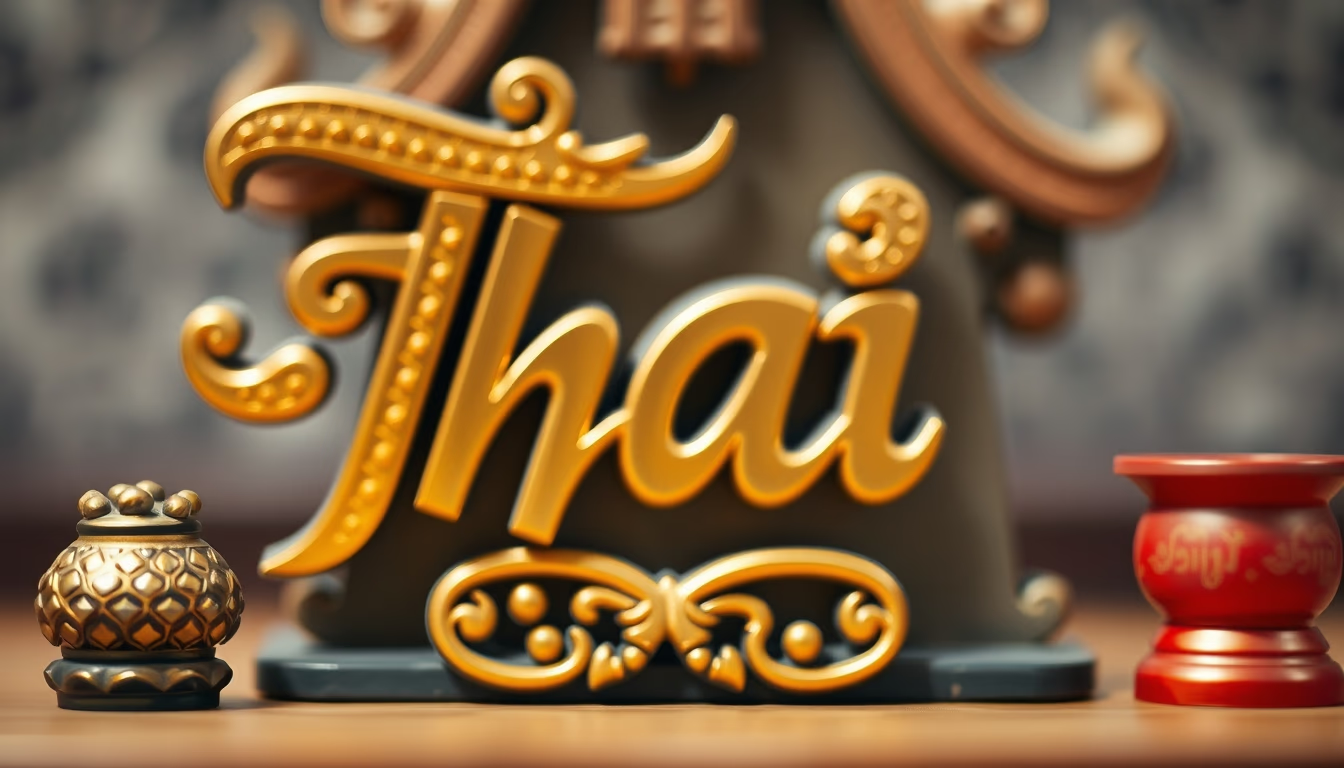
The ornate Thai script is a calligraphic style rich in curves, used in ceremonial, religious and artistic contexts in Thailand, derived from the Khmer alphabet.
About this subject
The ornate Thai script, locally known as "อักษรไทย" (Akson Thai), is a calligraphic form dating back to the 13th century, when King Ramkhamhaeng of the Sukhothai Kingdom created the Thai alphabet inspired by Khmer and Mon scripts. The ornate style is characterized by elaborate curves, elongated tails, and flourished endings, frequently used in Buddhist sacred texts, royal documents, and artworks. Unlike the standard Thai script used in daily life, the ornamental version requires manual skill and knowledge of traditional proportions, taught in art schools and practiced by monk calligraphers.
In Thailand, ornamental calligraphy is not merely a writing technique but an expression of respect and devotion. It is common to find ornamental inscriptions in temples (wats), such as murals at Wat Phra Kaew in Bangkok, or on amulets and palm-leaf manuscripts. The art is influenced by Theravada Buddhism, where reproducing scriptures is a meritorious act. The style varies by region: northern Thai Lanna script has more angular strokes, while central Thai script features softer curves.
A fascinating aspect of ornate Thai script is the use of special characters like "fong thong" (decorative dots) and "yong" (loops), which embellish the text without altering its phonetic meaning. Additionally, the writing direction is horizontal left-to-right without spaces between words, making ornamental calligraphy a challenge of both readability and aesthetics. Today, the art is preserved by master calligraphers, such as those at the Bangkok Calligraphy Art Center, and has also entered contemporary design, including logos and digital typography.
Interestingly, the Thai alphabet has 44 consonants and 32 vowels, but in ornamental form, many letters are stylized to resemble mythological creatures or natural elements. For example, the letter "ก" (ko kai) can be drawn with a crest resembling a chicken, the animal it represents. This fusion of writing and iconography makes ornate Thai script a unique art form worldwide.
Frequently Asked Questions
What is the origin of ornate Thai script?
Ornate Thai script derives from the alphabet created by King Ramkhamhaeng in the 13th century, based on Khmer and Mon scripts. The ornamental style developed later for ceremonial and religious use.
Where is ornate Thai calligraphy used today?
It is used in Buddhist temples, sacred manuscripts, royal documents, and contemporary art. It also appears in logos and typographic design, and is taught in art schools.
What are the differences between standard Thai script and ornate script?
Ornate script features more elaborate curves, elongated tails, and decorative elements like loops and dots. It requires greater manual skill and is less used in daily life, focusing on aesthetics and tradition.
Direct URL
https://pub-c7d6a6ea828543ac903a74a341ccb2e1.r2.dev/imagens/thai-script-ornate-tilt-shift-miniature-fresh17.avifHow to credit
Include a visible link back to UtilizAí. Copy one of the snippets below:
<a href="https://xn--utiliza-eza.com/en/midia/imagens/thai-script-ornate-tilt-shift-miniature-fresh17">Thai script ornate</a> by <a href="https://xn--utiliza-eza.com">UtilizAí</a>, licensed under <a href="https://creativecommons.org/licenses/by/4.0/">CC BY 4.0</a>.
[Thai script ornate](https://xn--utiliza-eza.com/en/midia/imagens/thai-script-ornate-tilt-shift-miniature-fresh17) by [UtilizAí](https://xn--utiliza-eza.com), CC BY 4.0
License: CC-BY-4.0