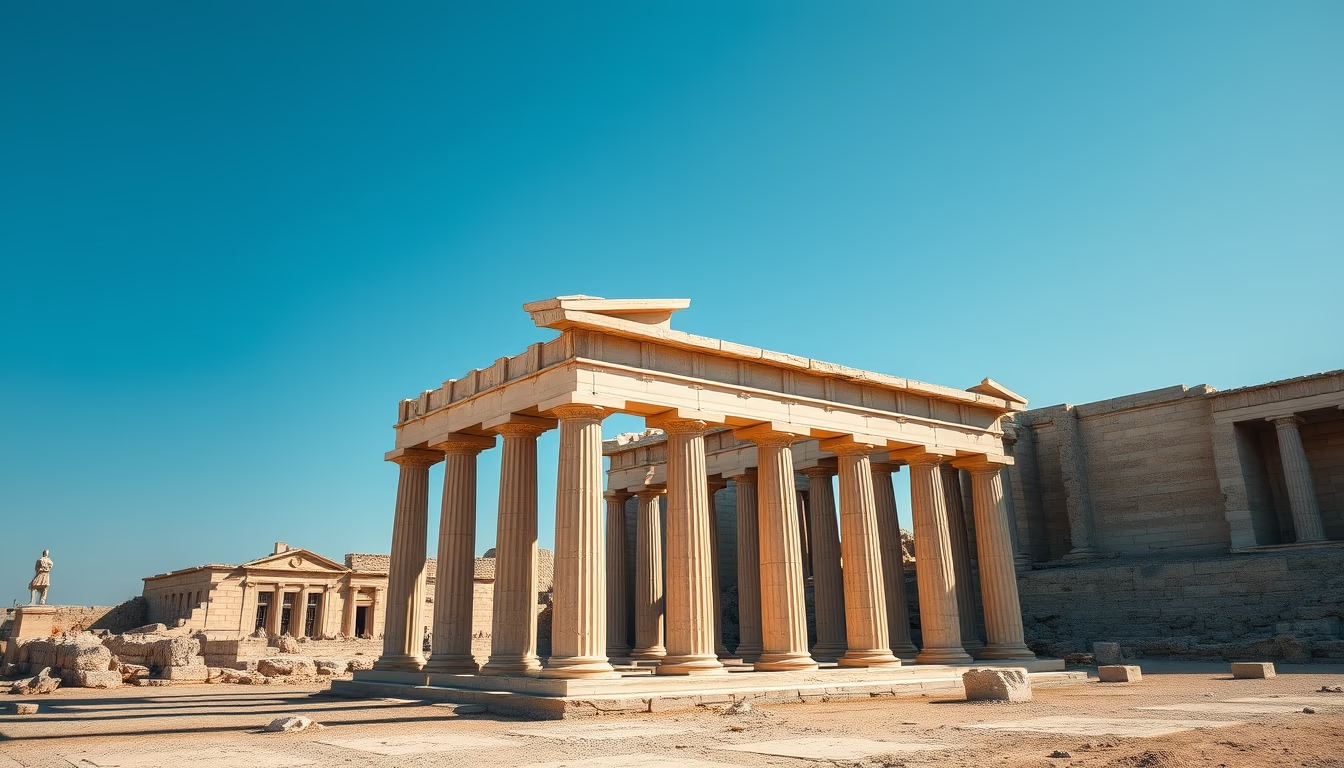
Temple columns ancient
1344×768 · AVIF · CC BY 4.0

Ancient temple columns, such as Doric, Ionic, and Corinthian, are hallmarks of classical architecture that continue to influence modern structures.
About this subject
Ancient temple columns represent one of the most enduring legacies of classical architecture. Originating in ancient Greece around the 7th century BCE, these structural elements not only supported pediments and roofs but also embodied proportion, order, and beauty. The three main styles, Doric, Ionic, and Corinthian, are distinguished by their proportions and decorative details. Doric, the simplest and most robust, was common in mainland Greek temples such as the Parthenon in Athens. Ionic, more slender with volutes on the capital, arose in Ionia (modern-day Turkish coast) and appears in the Erechtheion. Corinthian, with capitals adorned by acanthus leaves, became popular in the Roman period, as seen in the Pantheon in Rome.
The Romans adopted and adapted these orders, spreading them throughout the empire. Monumental columns like those of the Temple of Jupiter in Baalbek, Lebanon, or the Roman Forum demonstrate imperial scale and ambition. Beyond structural function, columns often bore inscriptions and reliefs recounting historical deeds or honoring deities. Construction techniques, such as stacking stone drums without mortar, highlight the ingenuity of ancient builders.
The influence of ancient columns extends far beyond antiquity. During the Renaissance, architects like Andrea Palladio rediscovered Vitruvius's treatises and incorporated classical orders into villas and churches. The Neoclassicism of the 18th and 19th centuries, exemplified by the U.S. Capitol and the British Museum, revived these forms. Today, many government buildings, banks, and universities still use columns to evoke solidity and tradition. Interestingly, the diameter of Doric columns often followed a 1:6 ratio to height, while Ionic used 1:9, mathematical relationships the Greeks believed reflected universal harmony.
Frequently Asked Questions
What are the differences between the Doric, Ionic, and Corinthian orders?
The Doric order is the simplest, with sturdy columns without bases and plain capitals. The Ionic is more slender, with bases and capitals featuring volutes (scrolls). The Corinthian is the most ornate, with capitals carved with acanthus leaves and often used in Roman buildings.
Were ancient temple columns functional or purely decorative?
They were primarily functional: they supported the weight of the roof and pediment. However, they also had decorative and symbolic roles, representing power, divinity, and order. Many columns, such as those in the Pantheon, are monolithic and structural, while others on facades were purely decorative.
How did ancient builders construct such large stone columns without modern technology?
They used stone drums cut from quarries, transported via rollers and ramps, and fitted precisely without mortar. Cranes powered by human or animal labor hoisted the drums. The Greeks also used metal dowels to fix blocks, protected by lead against corrosion.
Direct URL
https://pub-c7d6a6ea828543ac903a74a341ccb2e1.r2.dev/imagens/temple-columns-ancient-documentary-photography-p3.avifHow to credit
Include a visible link back to UtilizAí. Copy one of the snippets below:
<a href="https://xn--utiliza-eza.com/en/midia/imagens/temple-columns-ancient-documentary-photography-p3">Temple columns ancient</a> by <a href="https://xn--utiliza-eza.com">UtilizAí</a>, licensed under <a href="https://creativecommons.org/licenses/by/4.0/">CC BY 4.0</a>.
[Temple columns ancient](https://xn--utiliza-eza.com/en/midia/imagens/temple-columns-ancient-documentary-photography-p3) by [UtilizAí](https://xn--utiliza-eza.com), CC BY 4.0
License: CC-BY-4.0