Telescope observatory dome
1344×768 · AVIF · CC BY 4.0
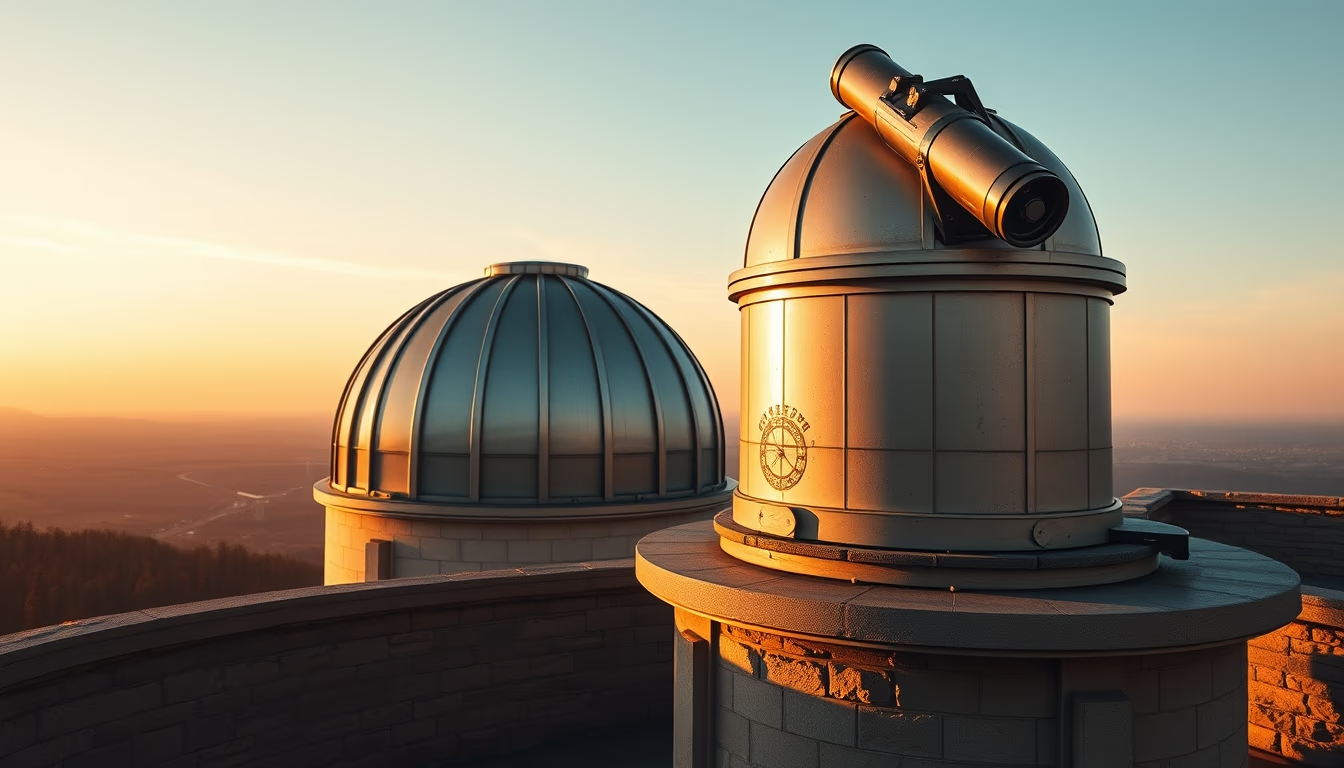
Astronomical observatory domes protect telescopes and house centuries of discoveries about the cosmos, blending precise engineering with iconic architecture.
About this subject
Astronomical observatory domes are structures designed to house telescopes and sensitive instruments, offering protection from weather and light pollution. Usually made of steel, aluminum, or fiberglass, their hemispherical shapes allow a rotating slit to open as the telescope tracks celestial objects. This design, dating back to early 19th-century observatories like the Royal Observatory in Greenwich, has been refined to minimize thermal turbulence and vibrations, ensuring sharp images.
Famous examples include the 5-meter Hale Telescope dome at Palomar Observatory in California and the twin domes of the Very Large Telescope (VLT) in Chile. In Brazil, the National Observatory (ON) in Rio de Janeiro and the Pico dos Dias Observatory (LNA) in Minas Gerais feature traditional domes. Modern observatories like Gemini and Keck in Hawaii use domes adapted to adaptive optics, which correct atmospheric distortions in real time.
Domes are not mere covers; their engineering involves cooling systems to avoid hot air currents, special coatings to reflect sunlight, and ultra-fast rotation mechanisms to track celestial targets. In remote sites like the Atacama Desert or Mauna Kea's summit, domes are precision machines weighing hundreds of tons, moving with millimeter accuracy. Besides optical telescopes, radio and gamma-ray observatories use similar structures, like the Arecibo Radio Telescope (now decommissioned) and the IceCube Neutrino Observatory (which does not use a conventional dome).
Domes also have strong cultural and tourist appeal. Many are open to the public, such as Griffith Observatory in Los Angeles, offering panoramic views and nightly observation sessions. In astronomy festivals, the image of a white dome against a starry sky has become a global icon of scientific exploration. Future projects like the James Webb Space Telescope (in orbit) do not use a dome, but ground-based observatories will continue to rely on these structures to house ever-larger instruments, such as the Extremely Large Telescope (ELT) under construction in Chile, whose dome will be 80 meters in diameter.
Frequently Asked Questions
Why are observatory domes hemispherical?
The hemispherical shape allows a rotating slit to track the telescope in any direction, minimizing wind resistance and thermal turbulence, crucial for precise observations.
What is the largest telescope dome ever built?
The largest dome is that of the Extremely Large Telescope (ELT) in Chile, 80 meters in diameter and 5,000 tons, protecting a 39-meter mirror.
Are observatory domes open to the public in Brazil?
Yes. The National Observatory (RJ) and Pico dos Dias Observatory (MG) offer guided tours and night observation events, subject to scheduling and weather conditions.
Direct URL
https://pub-c7d6a6ea828543ac903a74a341ccb2e1.r2.dev/imagens/telescope-observatory-dome-cinematic-wide-shot-p0.avifHow to credit
Include a visible link back to UtilizAí. Copy one of the snippets below:
<a href="https://xn--utiliza-eza.com/en/midia/imagens/telescope-observatory-dome-cinematic-wide-shot-p0">Telescope observatory dome</a> by <a href="https://xn--utiliza-eza.com">UtilizAí</a>, licensed under <a href="https://creativecommons.org/licenses/by/4.0/">CC BY 4.0</a>.
[Telescope observatory dome](https://xn--utiliza-eza.com/en/midia/imagens/telescope-observatory-dome-cinematic-wide-shot-p0) by [UtilizAí](https://xn--utiliza-eza.com), CC BY 4.0
License: CC-BY-4.0