Supercomputer hall
1344×768 · AVIF · CC BY 4.0
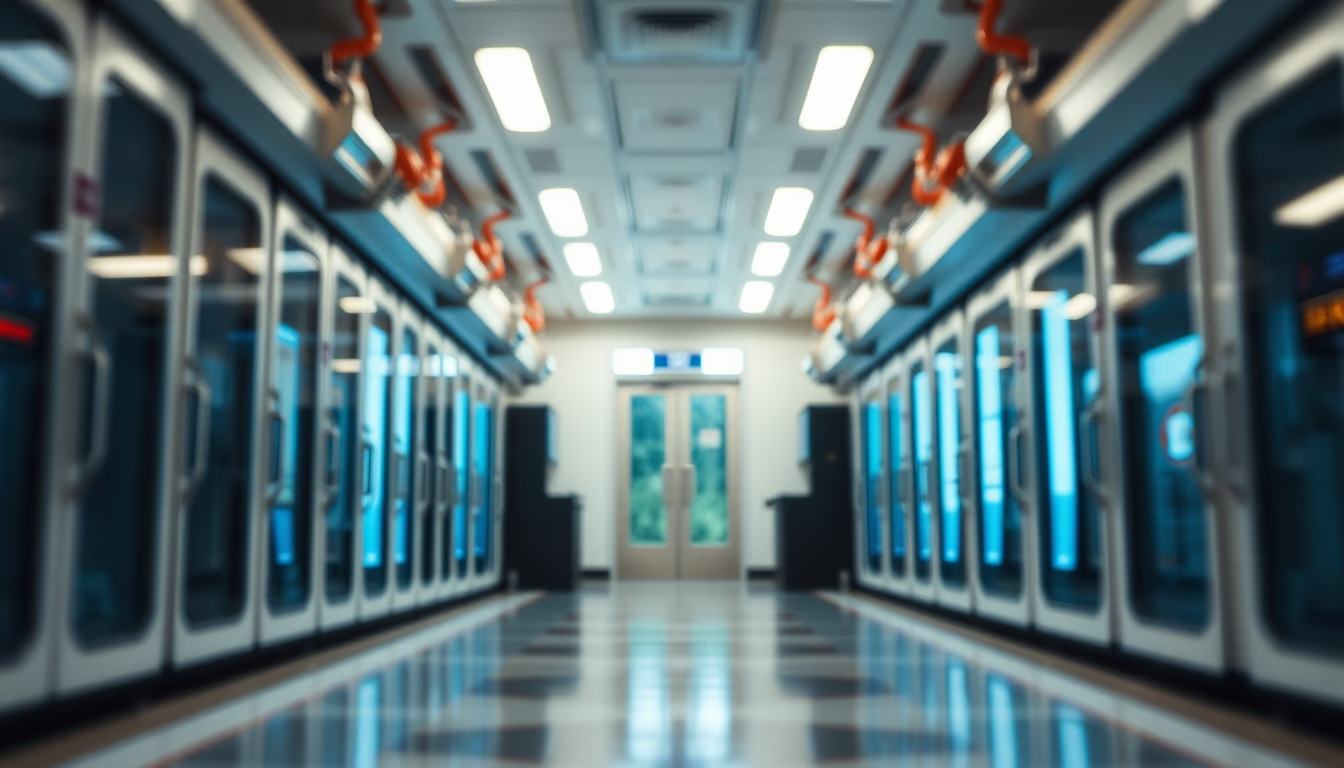
Supercomputer halls house high-performance machines that process petabytes of data per second, crucial for scientific research and artificial intelligence.
About this subject
A supercomputer hall is a specialized facility designed to house high-performance computing clusters that can perform quadrillions of operations per second. These rooms are engineered to accommodate dozens to thousands of racks containing processors, memory, and interconnects. Advanced cooling systems are essential due to the massive heat generated; techniques like direct-to-chip liquid cooling or immersion in dielectric fluid are used in machines such as Fugaku (Japan) or Summit (USA).
Electrical infrastructure is equally critical. Each rack may consume tens of kilowatts, requiring redundant power sources and backup generators. Rack arrangement follows hot and cold aisle containment to optimize cooling efficiency. Sensors monitor temperature, humidity, and vibration around the clock to maintain optimal operating conditions.
Supercomputers enable simulations in climate science, molecular dynamics, nuclear fusion research, and AI model training. The TOP500 list, updated biannually, ranks the world's most powerful systems. Frontier (USA) currently leads with over 1 exaflop of performance. Building a supercomputer hall can cost hundreds of millions of dollars and consume enough electricity to power a small town.
Physical security is paramount: biometric access, CCTV, and inert gas fire suppression systems (e.g., FM200) protect the equipment. Halls are sited in seismically stable areas away from electromagnetic interference. Recent trends include prefabricated modules to speed deployment and reduce construction costs.
Frequently Asked Questions
What is a supercomputer hall?
It is a specially designed room to house supercomputers, with cooling, power, and security infrastructure tailored to their high performance and energy consumption.
How are supercomputers cooled?
They use direct-to-chip liquid cooling, immersion in dielectric fluid, or hot/cold aisle containment with precision air conditioning, depending on power density.
What are the fastest supercomputers in the world today?
Frontier (USA) leads with exaflop performance, followed by Fugaku (Japan) and LUMI (Finland). The TOP500 list is updated every six months.
Direct URL
https://pub-c7d6a6ea828543ac903a74a341ccb2e1.r2.dev/imagens/supercomputer-hall-tilt-shift-miniature-p4.avifHow to credit
Include a visible link back to UtilizAí. Copy one of the snippets below:
<a href="https://xn--utiliza-eza.com/en/midia/imagens/supercomputer-hall-tilt-shift-miniature-p4">Supercomputer hall</a> by <a href="https://xn--utiliza-eza.com">UtilizAí</a>, licensed under <a href="https://creativecommons.org/licenses/by/4.0/">CC BY 4.0</a>.
[Supercomputer hall](https://xn--utiliza-eza.com/en/midia/imagens/supercomputer-hall-tilt-shift-miniature-p4) by [UtilizAí](https://xn--utiliza-eza.com), CC BY 4.0
License: CC-BY-4.0