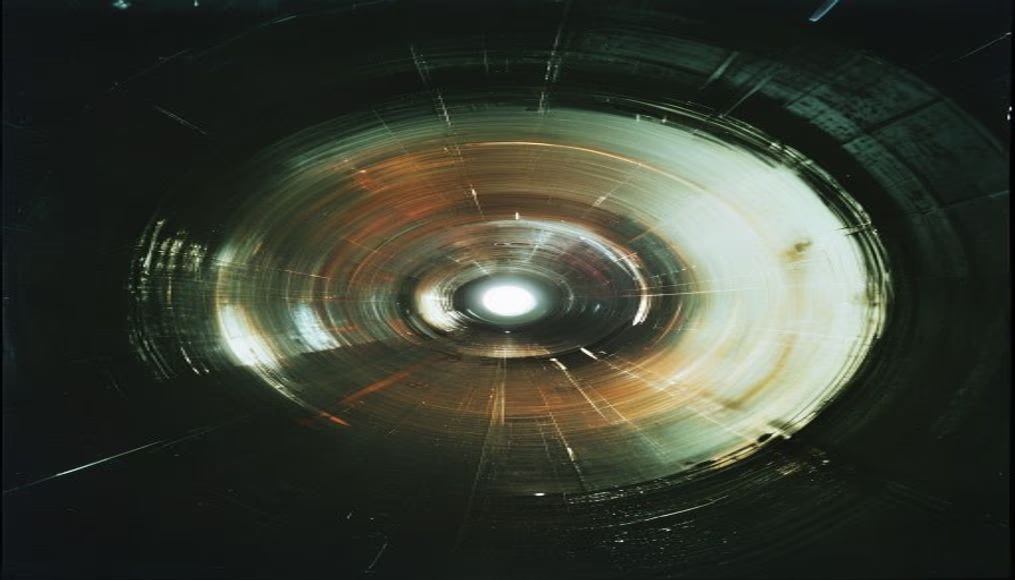
Sun corona solar flare
1344×768 · AVIF · CC BY 4.0

The solar corona, the Sun's outer atmosphere, becomes visible during total eclipses and hosts solar flares that impact Earth's space weather.
About this subject
The solar corona is the Sun's outermost atmospheric layer, extending millions of kilometers into space. Composed of extremely rarefied plasma heated to over 1 million degrees Celsius, it is paradoxically much hotter than the Sun's surface (about 5,500 °C). This coronal heating problem remains a major puzzle in solar physics, possibly solved by Alfvén waves or nanoflares caused by magnetic reconnection.
Solar flares are violent eruptions in the corona that release vast amounts of energy, equivalent to billions of hydrogen bombs. They occur when magnetic field lines snap and reconnect, accelerating charged particles to near light speed. These explosions emit radiation across the electromagnetic spectrum, from X-rays to radio waves, and last from minutes to hours. Flare frequency follows the Sun's 11-year cycle, peaking at solar maximum.
Studying the corona and flares is essential for space weather forecasting. Coronal mass ejections (CMEs) often associated with flares can reach Earth, triggering geomagnetic storms that disrupt satellites, communications, and power grids. Beautiful auroras are a spectacular side effect. Missions like the Parker Solar Probe and Solar Orbiter are revolutionizing our understanding by directly sampling the corona.
Culturally, the solar corona has fascinated humanity for centuries. During total eclipses, its sudden appearance inspired myths and scientific discoveries, such as the element helium, first identified in the solar spectrum in 1868. Today, photographers and scientists capture its image to document solar activity and share its beauty.
Frequently Asked Questions
Why is the solar corona hotter than the Sun's surface?
This coronal heating paradox is not fully understood. Leading theories involve Alfvén waves transferring energy from the surface or nanoflares caused by magnetic reconnection.
What causes solar flares?
Solar flares occur when magnetic field lines reconnect in the corona, releasing stored energy. This process accelerates charged particles and produces intense radiation.
How do solar flares affect Earth?
Flares can trigger geomagnetic storms upon reaching Earth, disrupting radio communications, damaging satellites, and creating auroras. Associated coronal mass ejections pose greater risks to power grids.
Direct URL
https://pub-c7d6a6ea828543ac903a74a341ccb2e1.r2.dev/imagens/sun-corona-solar-flare-travel-photography-p3.avifHow to credit
Include a visible link back to UtilizAí. Copy one of the snippets below:
<a href="https://xn--utiliza-eza.com/en/midia/imagens/sun-corona-solar-flare-travel-photography-p3">Sun corona solar flare</a> by <a href="https://xn--utiliza-eza.com">UtilizAí</a>, licensed under <a href="https://creativecommons.org/licenses/by/4.0/">CC BY 4.0</a>.
[Sun corona solar flare](https://xn--utiliza-eza.com/en/midia/imagens/sun-corona-solar-flare-travel-photography-p3) by [UtilizAí](https://xn--utiliza-eza.com), CC BY 4.0
License: CC-BY-4.0