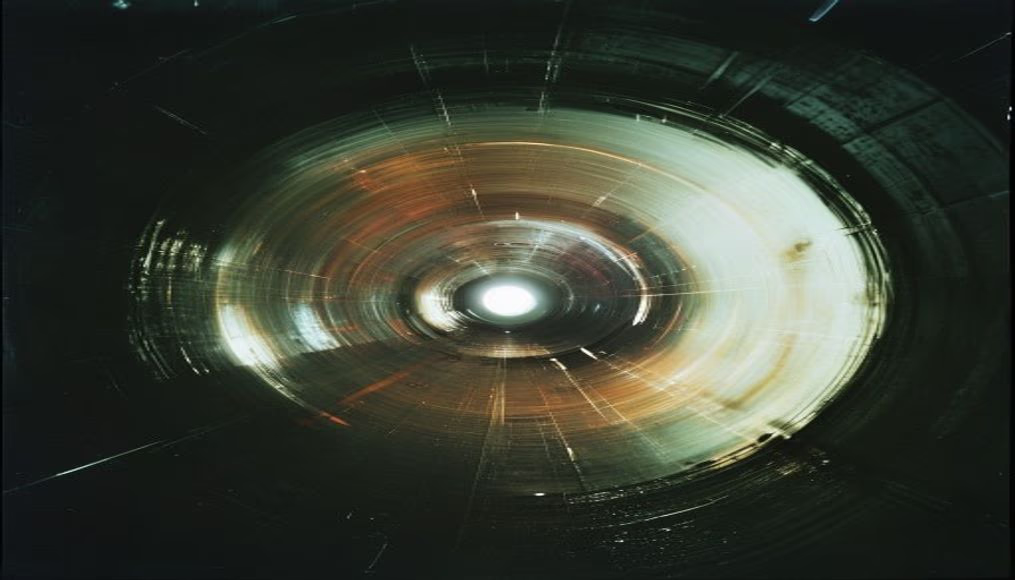
Sun corona solar flare
1344×768 · AVIF · CC BY 4.0

Solar flares are intense explosions on the Sun's surface that release huge amounts of energy, affecting space weather and communications on Earth.
About this subject
Solar flares, also known as solar flares, are sudden explosions of electromagnetic radiation that occur in the Sun's atmosphere, especially in the solar corona which is the outermost layer. These events are caused by the sudden release and rearrangement of solar magnetic fields, releasing energy equivalent to millions of hydrogen bombs. The emitted radiation spans the entire electromagnetic spectrum, from radio waves to gamma rays, and can reach Earth in about eight minutes.
The classification of solar flares is based on their X-ray flux: C-class (minor), M-class (moderate), and X-class (major). Each category has a scale from 1 to 9, with X9 being extremely strong. The largest recorded flare was an X28 in 2003, which overloaded sensors. These events are linked to the approximately 11-year solar cycle, which regulates the Sun's magnetic activity. During solar maximum, the number of sunspots and flares increases significantly.
The consequences of solar flares on Earth are varied. In communications, they can cause high-frequency radio blackouts, especially in polar regions. For satellites and astronauts, increased energetic particles pose radiation risks. Additionally, they trigger geomagnetic storms that can create stunning auroras borealis and australis, but also damage power grids. Forecasting and monitoring are done by agencies like NOAA and NASA, using space telescopes such as the SDO (Solar Dynamics Observatory).
Interestingly, the solar corona is millions of degrees hotter than the Sun's surface, a paradox called coronal heating. Solar flares help understand this phenomenon as they release energy that heats the plasma. Studies show that the frequency and intensity of flares vary over the solar cycle, and the next solar maximum is forecast for 2025.
Frequently Asked Questions
What causes a solar flare?
Solar flares are caused by the sudden breaking and reconnection of complex magnetic fields on the Sun's surface, especially near sunspots. This process releases stored magnetic energy in the form of radiation and particles.
Are solar flares dangerous to humans on Earth?
Earth's atmosphere and magnetic field protect us from direct radiation from solar flares. However, very strong flares can disrupt radio communications and navigation systems, and pose risks to astronauts and satellites in orbit.
What was the largest solar flare ever recorded?
The largest recorded solar flare occurred on November 4, 2003, classified as X28 (initially measured as X45). It overwhelmed X-ray sensors and caused radio blackouts worldwide.
Direct URL
https://pub-c7d6a6ea828543ac903a74a341ccb2e1.r2.dev/imagens/sun-corona-solar-flare-lo-fi-disposable-camera-p8.avifHow to credit
Include a visible link back to UtilizAí. Copy one of the snippets below:
<a href="https://xn--utiliza-eza.com/en/midia/imagens/sun-corona-solar-flare-lo-fi-disposable-camera-p8">Sun corona solar flare</a> by <a href="https://xn--utiliza-eza.com">UtilizAí</a>, licensed under <a href="https://creativecommons.org/licenses/by/4.0/">CC BY 4.0</a>.
[Sun corona solar flare](https://xn--utiliza-eza.com/en/midia/imagens/sun-corona-solar-flare-lo-fi-disposable-camera-p8) by [UtilizAí](https://xn--utiliza-eza.com), CC BY 4.0
License: CC-BY-4.0