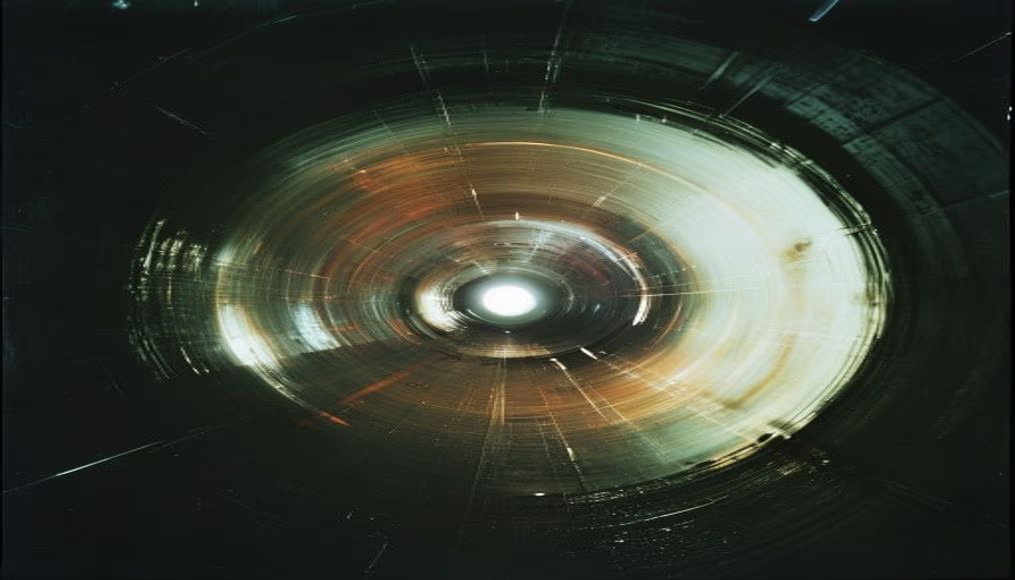
Sun corona solar flare
1344×768 · AVIF · CC BY 4.0

The solar corona, the Sun's outer atmosphere, hosts powerful magnetic explosions called solar flares, releasing energy equal to billions of nuclear bombs.
About this subject
The solar corona is the outermost layer of the Sun's atmosphere, extending millions of kilometers into space. Despite being farther from the solar core, its temperature paradoxically exceeds 1 million degrees Celsius, while the visible surface (photosphere) is about 5,500°C. This puzzle, known as the coronal heating problem, remains an active area of research. The corona is only visible to the naked eye during total solar eclipses, appearing as a pearly white halo around the Moon.
Solar flares are sudden explosions of energy in the corona, caused by the violent rearrangement of the Sun's magnetic fields. This process, magnetic reconnection, accelerates charged particles and releases radiation across the electromagnetic spectrum, from radio waves to gamma rays. Flares are classified on a scale from A (weakest) to X (strongest). The most powerful ever recorded, in 2003, reached X28, causing radio blackouts worldwide.
Their effects on Earth are significant: M- and X-class flares can disrupt high-frequency radio communications, affect satellite navigation systems, and pose radiation hazards to astronauts and airline crews on polar routes. One of the most notable historical events was the Carrington Event of 1859, when an extremely intense flare produced auroras visible as far south as the Caribbean and caused telegraph systems to catch fire. Today, satellites like the Solar Dynamics Observatory (SDO) continuously monitor the corona to forecast space weather.
Observing the corona and solar flares became possible with coronagraphs, which block the Sun's direct light, and space telescopes such as SOHO. Historical film-based images, with their characteristic grain, recorded many of these events before the digital era, helping build a long timeline of solar activity.
Frequently Asked Questions
What causes solar flares?
Solar flares are caused by magnetic reconnection, a process in which magnetic field lines in the corona abruptly break and reconfigure, releasing vast amounts of energy.
Is the solar corona hotter than the Sun's surface?
Yes, the corona reaches over 1 million degrees Celsius, while the visible surface (photosphere) is about 5,500°C. This coronal heating problem remains a key mystery in solar physics.
How do solar flares affect Earth?
Intense flares (M and X classes) can cause radio blackouts, disrupt GPS signals, damage satellites, and increase radiation at high altitudes, posing risks to astronauts and polar flight passengers.
Direct URL
https://pub-c7d6a6ea828543ac903a74a341ccb2e1.r2.dev/imagens/sun-corona-solar-flare-film-grain-authentic-p7.avifHow to credit
Include a visible link back to UtilizAí. Copy one of the snippets below:
<a href="https://xn--utiliza-eza.com/en/midia/imagens/sun-corona-solar-flare-film-grain-authentic-p7">Sun corona solar flare</a> by <a href="https://xn--utiliza-eza.com">UtilizAí</a>, licensed under <a href="https://creativecommons.org/licenses/by/4.0/">CC BY 4.0</a>.
[Sun corona solar flare](https://xn--utiliza-eza.com/en/midia/imagens/sun-corona-solar-flare-film-grain-authentic-p7) by [UtilizAí](https://xn--utiliza-eza.com), CC BY 4.0
License: CC-BY-4.0