Sun corona solar flare
1344×768 · AVIF · CC BY 4.0

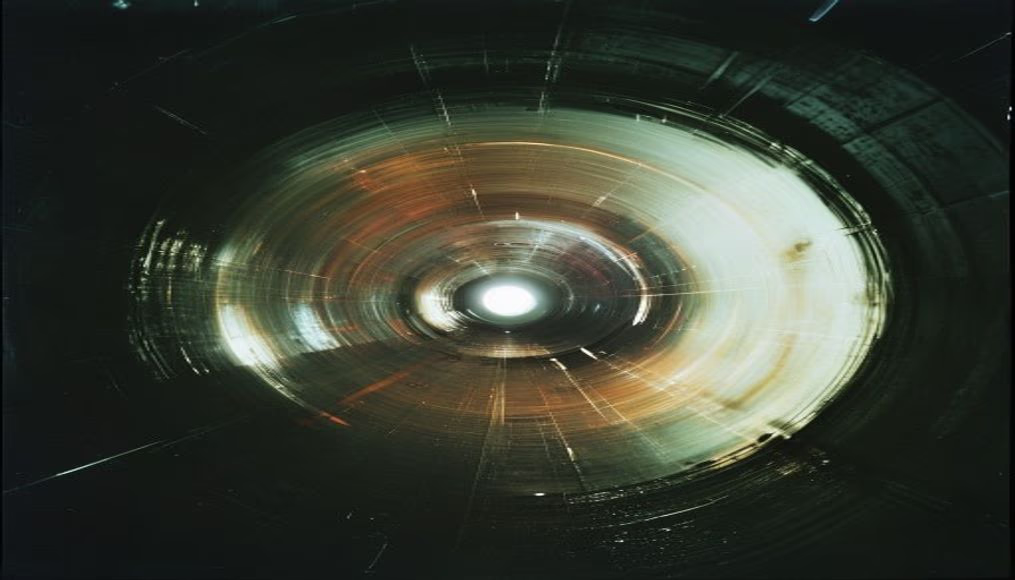
Solar flares and the Sun's corona: high-energy phenomena that impact space weather and communications on Earth.
About this subject
Solar flares are sudden explosions of energy in the Sun's atmosphere, releasing radiation across the electromagnetic spectrum. They occur when magnetic energy stored in intense fields, usually above sunspots, is converted into heat and accelerated particles. The solar corona, the outermost layer of the Sun's atmosphere, is visible during total eclipses and reaches temperatures of millions of degrees Celsius, much hotter than the solar surface. This temperature difference remains a mystery for astrophysicists.
Solar flares are classified by X-ray intensity: A, B, C, M, and X, with X being the most powerful. Each class is ten times more energetic than the previous. X-class flares can cause radiation storms that disrupt satellites, radio communications, and power grids on Earth. In 1859, the Carrington Event, a massive solar flare, induced sparks in telegraph lines and auroras visible as far south as the Caribbean. Today, agencies like NOAA constantly monitor solar activity to issue warnings.
The corona also produces the solar wind, a continuous flow of charged particles that shapes the heliosphere. When flares or coronal mass ejections (CMEs) hit Earth's magnetosphere, they trigger geomagnetic storms and auroras. NASA's Parker Solar Probe, launched in 2018, is studying the corona up close, approaching the Sun closer than any previous mission. Its data help predict space weather and protect critical technologies.
Frequently Asked Questions
What causes a solar flare?
Solar flares are caused by the sudden release of magnetic energy accumulated in the Sun's atmosphere, typically in sunspot regions. Magnetic reconnection accelerates particles and emits radiation.
Are solar flares dangerous for humans on Earth?
Earth's atmosphere and magnetic field protect us from direct radiation. However, intense solar storms can disrupt satellites, communications, and power grids, posing risks to astronauts and technology.
Why is the solar corona hotter than the Sun's surface?
This is a major puzzle in solar physics. It is thought that plasma waves and nanoflares transfer energy to the corona, heating it to millions of degrees, while the surface is about 5,500°C.
Direct URL
https://pub-c7d6a6ea828543ac903a74a341ccb2e1.r2.dev/imagens/sun-corona-solar-flare-commercial-product-photography-p2.avifHow to credit
Include a visible link back to UtilizAí. Copy one of the snippets below:
<a href="https://xn--utiliza-eza.com/en/midia/imagens/sun-corona-solar-flare-commercial-product-photography-p2">Sun corona solar flare</a> by <a href="https://xn--utiliza-eza.com">UtilizAí</a>, licensed under <a href="https://creativecommons.org/licenses/by/4.0/">CC BY 4.0</a>.
[Sun corona solar flare](https://xn--utiliza-eza.com/en/midia/imagens/sun-corona-solar-flare-commercial-product-photography-p2) by [UtilizAí](https://xn--utiliza-eza.com), CC BY 4.0
License: CC-BY-4.0