Sun corona eclipse
1344×768 · AVIF · CC BY 4.0
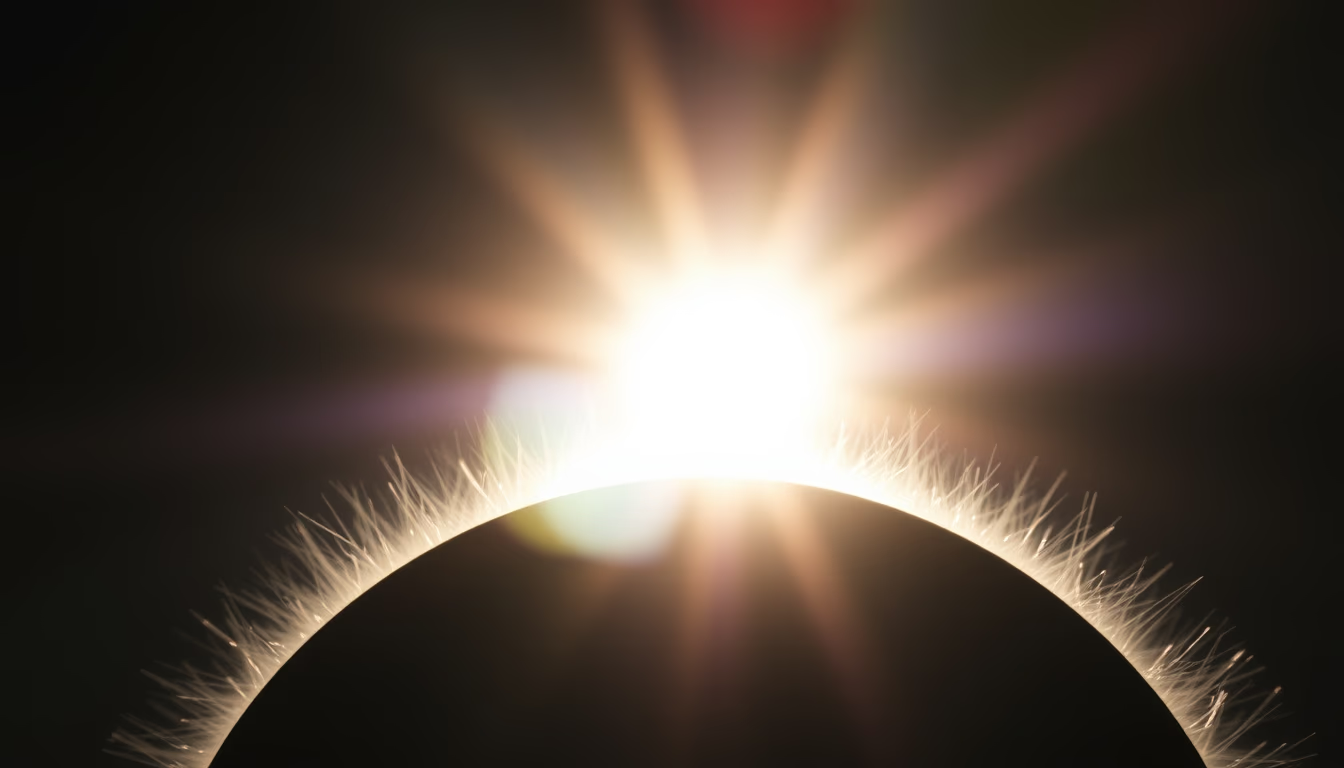
The solar corona, the Sun's outer and tenuous structure, becomes visible during total eclipses, revealing plasma at millions of degrees Celsius.
About this subject
The solar corona is the outermost layer of the Sun's atmosphere, extending millions of kilometers into space. During a total solar eclipse, the Moon blocks the intense light from the solar disk, allowing the corona to be seen with the naked eye. This rare event provides one of the few opportunities to study the corona, which is normally hidden by the Sun's surface brightness.
One of the biggest mysteries in solar physics is why the corona is much hotter than the Sun's surface. While the photosphere reaches about 5,500°C, the corona can reach temperatures of 1 to 3 million degrees Celsius. Scientists believe that plasma waves and magnetic reconnections transfer energy to the corona, but the exact mechanism is still debated.
Historically, observations of the corona during eclipses led to important discoveries. In 1868, astronomer Pierre Janssen detected a spectral line that led to the discovery of helium. Later, in 1930, Bernard Lyot invented the coronagraph, allowing the study of the corona without an eclipse. Today, missions like the Parker Solar Probe and Solar Orbiter collect data in situ, revolutionizing our understanding of the corona and the solar wind.
Frequently Asked Questions
Why is the solar corona hotter than the Sun's surface?
Although the physics of energy transport is not fully understood, plasma waves and magnetic reconnection are believed to heat the corona to millions of degrees, far above the photosphere's 5,500°C.
How long does a total solar eclipse last?
Totality, the phase when the Moon completely covers the solar disk, can last from a few seconds up to a maximum of 7 minutes and 32 seconds, depending on the positions of Earth and the Moon.
How do scientists study the corona outside of eclipses?
They use coronagraphs, instruments that block the direct light of the Sun, creating an artificial eclipse. Additionally, space probes like the Parker Solar Probe fly through the corona to measure its properties in situ.
Direct URL
https://pub-c7d6a6ea828543ac903a74a341ccb2e1.r2.dev/imagens/sun-corona-eclipse-macro-closeup-p4.avifHow to credit
Include a visible link back to UtilizAí. Copy one of the snippets below:
<a href="https://xn--utiliza-eza.com/en/midia/imagens/sun-corona-eclipse-macro-closeup-p4">Sun corona eclipse</a> by <a href="https://xn--utiliza-eza.com">UtilizAí</a>, licensed under <a href="https://creativecommons.org/licenses/by/4.0/">CC BY 4.0</a>.
[Sun corona eclipse](https://xn--utiliza-eza.com/en/midia/imagens/sun-corona-eclipse-macro-closeup-p4) by [UtilizAí](https://xn--utiliza-eza.com), CC BY 4.0
License: CC-BY-4.0