Submarine deep ocean
1344×768 · AVIF · CC BY 4.0
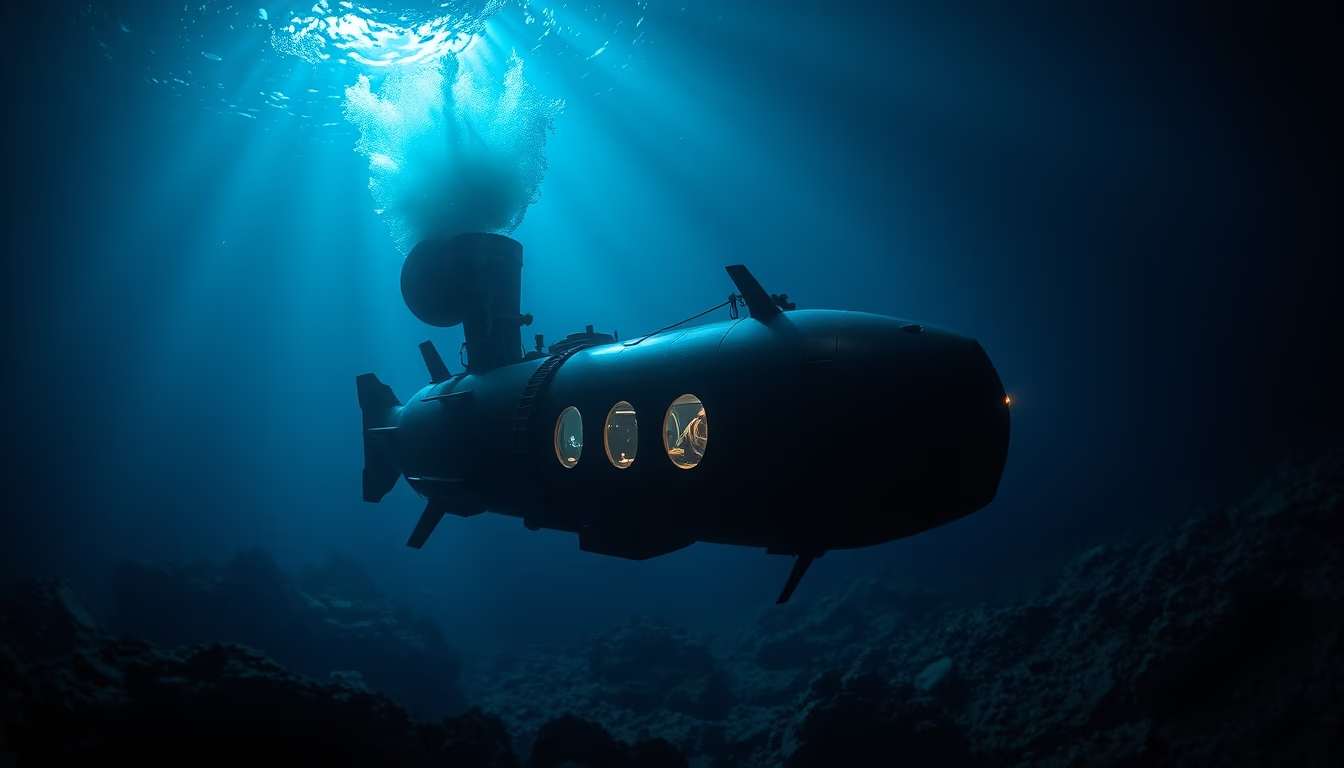
Submarines are vessels designed to operate underwater, exploring the deep ocean for military, scientific, or commercial missions.
About this subject
Submarines have revolutionized deep ocean exploration, allowing humans to reach regions previously inaccessible. The first operational military submarine was the USS Holland, launched in 1900, but the concept of underwater navigation dates back to Leonardo da Vinci. Modern nuclear submarines, such as the U.S. Ohio class, can remain submerged for months thanks to nuclear propulsion that eliminates the need for oxygen for combustion.
Military submarines typically have maximum operational depths between 300 and 600 meters, but research submersibles like the DSV Limiting Factor have reached the deepest point of the oceans, the Challenger Deep in the Mariana Trench, nearly 11,000 meters down. These manned vehicles require hulls made of titanium or special steel to withstand extreme pressures.
Beyond military use, submarines play a crucial role in ocean science. They help map the seafloor, study hydrothermal vent ecosystems, and collect sediment samples. The historic dive of the bathyscaphe Trieste in 1960 with Jacques Piccard and Don Walsh was a milestone. Today, autonomous underwater vehicles (AUVs) like Nereus carry out similarly deep missions.
Interestingly, the pressure at the ocean floor is equivalent to having an elephant on every square centimeter of the hull. To ensure safety, modern submarines have redundant life support systems, oxygen generators via water electrolysis, and carbon dioxide scrubbers. Life on board is highly organized, with crews trained to operate in confinement for long periods.
Frequently Asked Questions
What is the maximum depth a military submarine can reach?
Conventional military submarines operate between 300 and 600 meters deep, while some nuclear models may exceed 600 meters. However, exact depths are classified for security reasons.
How do submarines generate oxygen for the crew?
Modern submarines produce oxygen by electrolysis of seawater, splitting hydrogen and oxygen. The hydrogen is expelled or combined with carbon dioxide to produce methane, maintaining breathable air.
What was the first submarine to reach the deepest part of the ocean?
The bathyscaphe Trieste in 1960 was the first manned vehicle to reach the Challenger Deep in the Mariana Trench, at approximately 11 km depth, with Jacques Piccard and Don Walsh on board.
Direct URL
https://pub-c7d6a6ea828543ac903a74a341ccb2e1.r2.dev/imagens/submarine-deep-ocean-fine-art-photography-p3.avifHow to credit
Include a visible link back to UtilizAí. Copy one of the snippets below:
<a href="https://xn--utiliza-eza.com/en/midia/imagens/submarine-deep-ocean-fine-art-photography-p3">Submarine deep ocean</a> by <a href="https://xn--utiliza-eza.com">UtilizAí</a>, licensed under <a href="https://creativecommons.org/licenses/by/4.0/">CC BY 4.0</a>.
[Submarine deep ocean](https://xn--utiliza-eza.com/en/midia/imagens/submarine-deep-ocean-fine-art-photography-p3) by [UtilizAí](https://xn--utiliza-eza.com), CC BY 4.0
License: CC-BY-4.0