Stone tools paleolithic
1344×768 · AVIF · CC BY 4.0

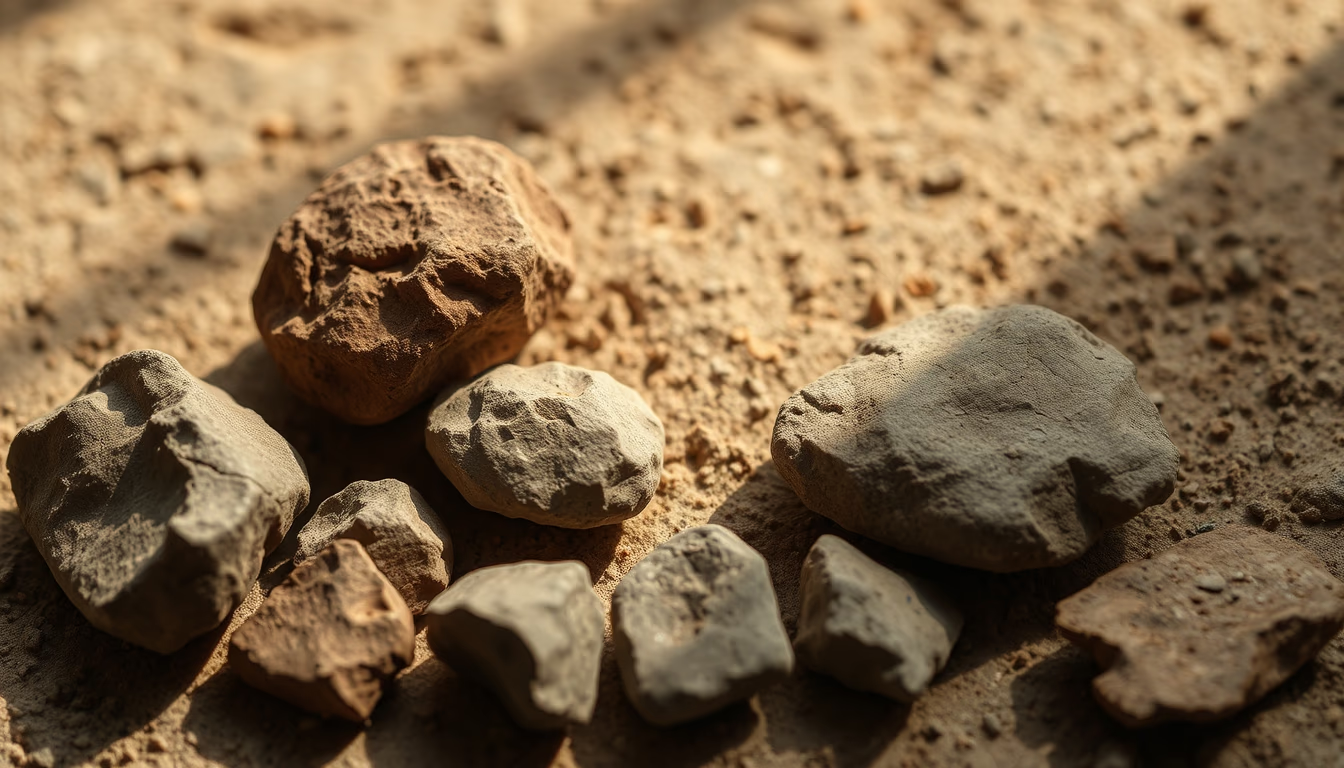
Paleolithic stone tools represent the earliest human technologies, crucial for survival and cognitive evolution of hominids.
About this subject
Paleolithic stone tools are the oldest human-made artifacts, dating back to approximately 2.6 million years ago. They mark the beginning of human technology and are classified into stone industries such as the Oldowan, characterized by simple flakes and choppers, and the Acheulean, which introduced symmetrical handaxes. These tools have been found at archaeological sites across Africa, Europe, Asia, and the Americas, with notable examples at Olduvai Gorge (Tanzania) and Atapuerca (Spain).
Manufacturing required precise knowledge of rock fracture, using materials like flint, chert, quartzite, and obsidian. Techniques such as direct and indirect percussion, and later the Levallois method in the Middle Paleolithic, allowed control over shape and edge. Tool types included scrapers for hide preparation, points for hunting, burins for woodworking, and knives for cutting meat. This diversity reflects adaptations to different environments and needs.
Culturally, stone tool production is linked to hominid brain development and social learning. The intergenerational transmission of knapping skills demonstrates teaching and tradition. The widespread distribution of techniques like the Acheulean across vast regions suggests migration and contact between groups. Studying these artifacts reveals not only subsistence but also symbolic aspects, such as the use of exotic raw materials indicating exchange or status.
Interestingly, some Paleolithic tool types persisted for hundreds of thousands of years, showing technological stability. Sites like Schöningen (Germany) preserved wooden spears associated with stone tools, offering a glimpse into daily life. Today, experimental archaeologists replicate these techniques to better understand our ancestors' capabilities.
Frequently Asked Questions
How did prehistoric people make stone tools?
They used knapping techniques, striking one stone against another (percussion) to remove flakes and shape the tool. In the Lower Paleolithic, direct percussion was common; in the Middle Paleolithic, the Levallois method allowed greater control.
What is the difference between Lower and Upper Paleolithic tools?
Lower Paleolithic tools were larger and cruder, like Acheulean handaxes. Upper Paleolithic tools were more refined, featuring blades, points, and burins, and often used bone and ivory.
Where were the oldest stone tools in the world found?
The oldest artifacts come from sites in Ethiopia, such as Gona, dated to 2.6 million years ago. Important records also come from Olduvai Gorge in Tanzania, with 1.8 million years.
Direct URL
https://pub-c7d6a6ea828543ac903a74a341ccb2e1.r2.dev/imagens/stone-tools-paleolithic-tilt-shift-miniature-p3.avifHow to credit
Include a visible link back to UtilizAí. Copy one of the snippets below:
<a href="https://xn--utiliza-eza.com/en/midia/imagens/stone-tools-paleolithic-tilt-shift-miniature-p3">Stone tools paleolithic</a> by <a href="https://xn--utiliza-eza.com">UtilizAí</a>, licensed under <a href="https://creativecommons.org/licenses/by/4.0/">CC BY 4.0</a>.
[Stone tools paleolithic](https://xn--utiliza-eza.com/en/midia/imagens/stone-tools-paleolithic-tilt-shift-miniature-p3) by [UtilizAí](https://xn--utiliza-eza.com), CC BY 4.0
License: CC-BY-4.0