Stone tools paleolithic
1344×768 · AVIF · CC BY 4.0

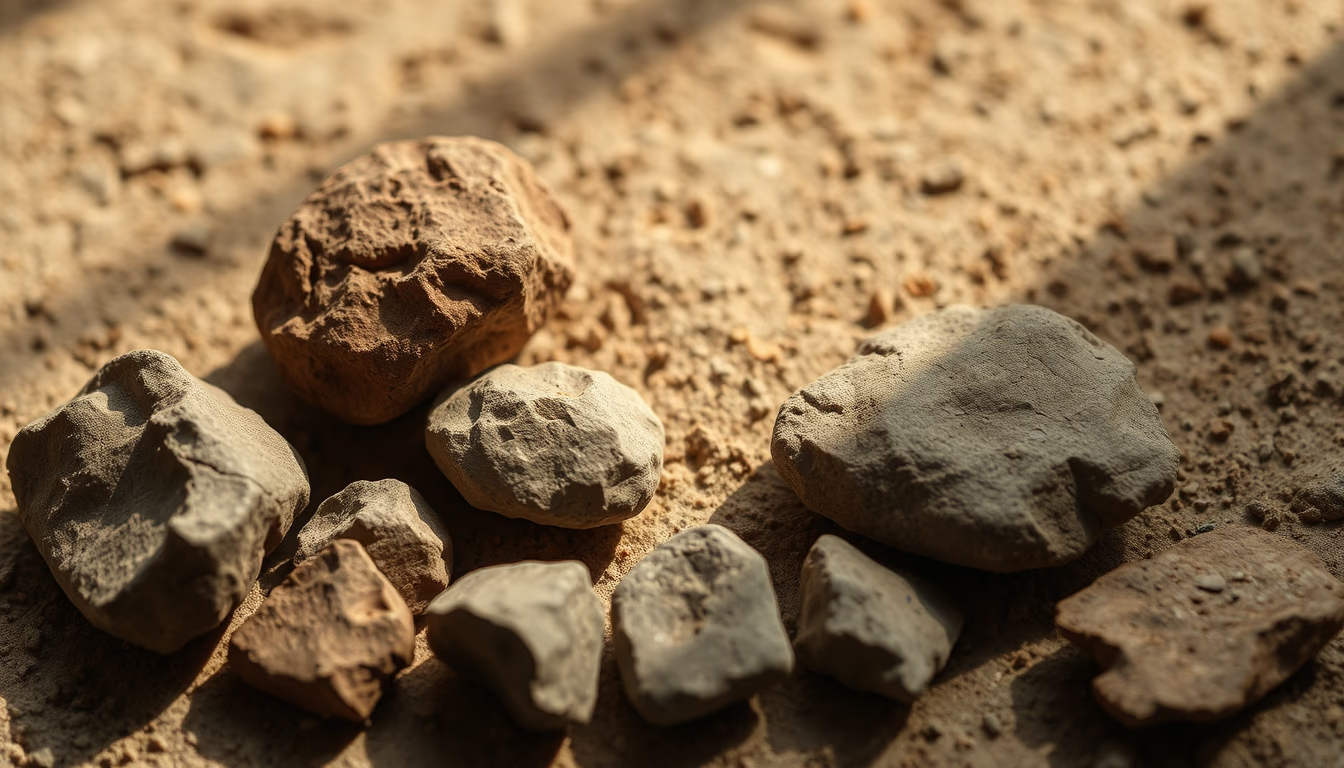
Stone tools from the Paleolithic reveal early human technological advances, dating back up to 2.6 million years.
About this subject
Paleolithic stone tools represent the earliest evidence of human technology, marking the beginning of material culture. These artifacts, known as lithic industries, include hand axes, flakes, and spear points crafted by hominins such as Homo habilis and Homo erectus. The Paleolithic period, spanning from roughly 2.6 million years ago to 10,000 BCE, is divided into Lower, Middle, and Upper stages, each with specific advancements in knapping techniques.
The most iconic technique is flintknapping, where a stone core was struck to produce sharp flakes. In the Lower Paleolithic, the Oldowan industry in Africa produced simple tools. During the Middle Paleolithic, the Levallois technique, associated with Neanderthals, allowed greater control and efficiency. In the Upper Paleolithic, modern humans created more specialized tools like bone needles and projectile points, indicating social and cognitive complexity.
The importance of stone tools extends beyond survival: they are key to understanding human evolution. Archaeological sites such as Olduvai (Tanzania) and Lascaux (France) preserve these pieces, helping to date occupations and reconstruct diets, migrations, and social interactions. Use-wear and micro-residue analysis identifies their application in cutting meat, wood, or plants.
Interestingly, stone tool production required specific knowledge of rock fracture, passed down through generations. Obsidian, for example, was prized for its extremely sharp edge, and its trade over hundreds of kilometers evidences exchange networks as early as the Paleolithic. These objects are not mere relics; they are testimonies to the human capacity for innovation and adaptation to the environment.
Frequently Asked Questions
How do archaeologists determine the age of Paleolithic stone tools?
Age is determined by methods such as potassium-argon dating for associated volcanic rocks, radiocarbon dating of nearby organic materials, and stratigraphic analysis of the sediment.
What is the difference between Oldowan and Levallois techniques?
The Oldowan is the earliest technique, producing simple flakes by direct percussion. The Levallois, from the Middle Paleolithic, involves preparing the core to obtain flakes of controlled shape and size, being more efficient.
Were Paleolithic stone tools used only for hunting?
No. They served multiple functions: cutting meat and plants, scraping hides, working wood or bone, and even processing plant materials. Residue analysis reveals varied use.
Direct URL
https://pub-c7d6a6ea828543ac903a74a341ccb2e1.r2.dev/imagens/stone-tools-paleolithic-aerial-drone-shot-p7.avifHow to credit
Include a visible link back to UtilizAí. Copy one of the snippets below:
<a href="https://xn--utiliza-eza.com/en/midia/imagens/stone-tools-paleolithic-aerial-drone-shot-p7">Stone tools paleolithic</a> by <a href="https://xn--utiliza-eza.com">UtilizAí</a>, licensed under <a href="https://creativecommons.org/licenses/by/4.0/">CC BY 4.0</a>.
[Stone tools paleolithic](https://xn--utiliza-eza.com/en/midia/imagens/stone-tools-paleolithic-aerial-drone-shot-p7) by [UtilizAí](https://xn--utiliza-eza.com), CC BY 4.0
License: CC-BY-4.0