Ssd nvme stick
1344×768 · AVIF · CC BY 4.0
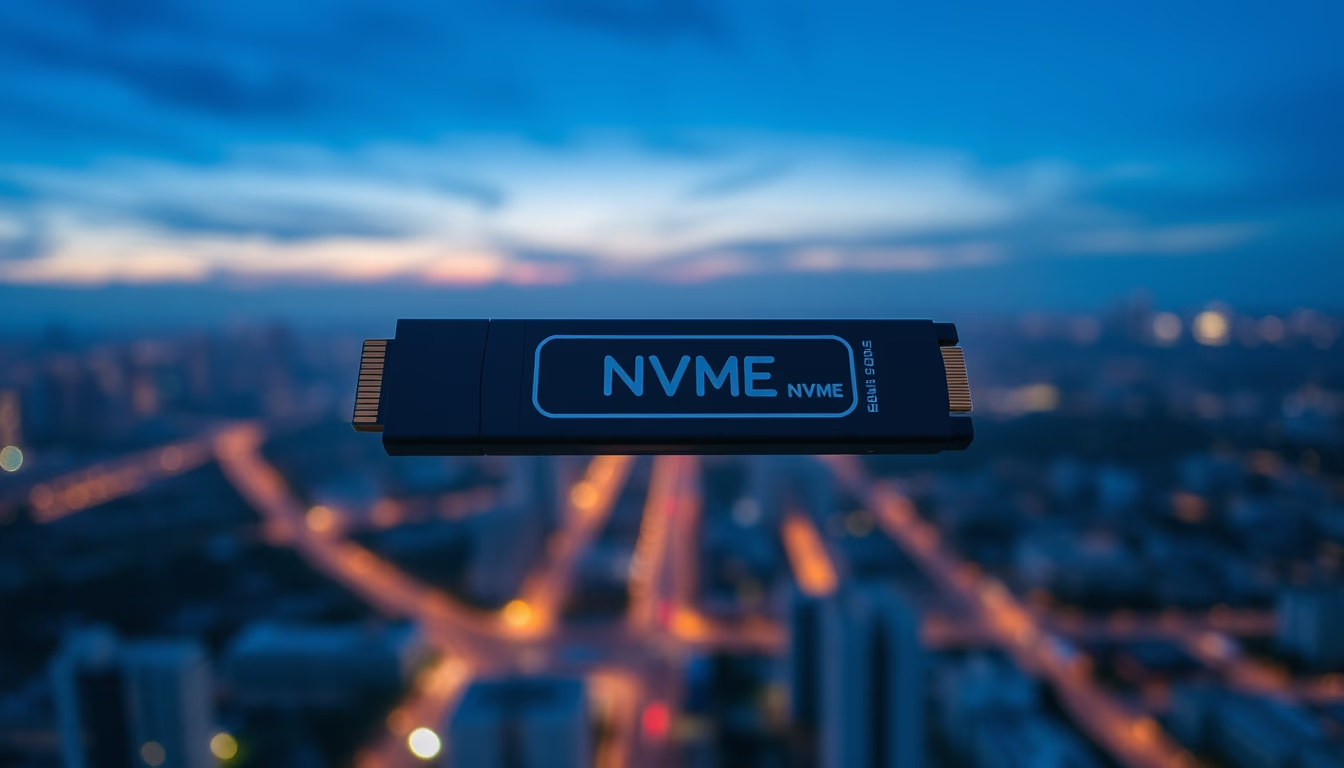
NVMe SSD sticks are ultra-fast storage devices that use the NVMe protocol for direct CPU access, surpassing speed limits of older interfaces.
About this subject
NVMe SSDs represent the latest evolution in solid-state storage, gradually replacing traditional SATA drives. Unlike conventional SSDs that use the AHCI protocol designed for mechanical disks, NVMe drives communicate directly with the CPU via PCI Express lanes, eliminating latency bottlenecks. This allows sequential transfer rates exceeding 7,000 MB/s in the fastest models, compared to about 550 MB/s for SATA SSDs.
The stick form factor, usually M.2, is the most common for NVMe. These small rectangular boards feature an M-key or B+M interface, with lengths ranging from 30 mm to 110 mm (standards 2230, 2242, 2260, and 2280). The lack of cables and enclosures allows direct installation on the motherboard, ideal for laptops and compact desktops. NVMe technology was standardized in 2011 by the NVM Express consortium and has since become the dominant standard in high-performance computers.
Culturally, Brazil quickly adopted NVMe SSDs for gaming and video editing, where load times and large file transfers are critical. Manufacturers like Samsung, Kingston, and WD offer models with capacities up to 4 TB. A technical curiosity: NVMe supports parallel command queues (up to 65,535), while AHCI handles only one queue. This makes a huge difference in random operations, such as loading multiple applications simultaneously.
Despite being relatively recent, NVMe SSDs face thermal challenges, in high-speed drives, a heatsink is essential to avoid throttling. Some models include integrated heat sinks or require active cooling solutions. The price per gigabyte is still higher than SATA SSDs, but the gap has narrowed sharply in recent years, making them affordable for the consumer market.
Frequently Asked Questions
What is the difference between NVMe SSD and SATA SSD?
NVMe uses the NVM Express protocol over PCI Express, offering much higher speeds (up to 7,000 MB/s sequential read) and parallel command queues, while SATA is limited to about 550 MB/s and has a single command queue.
Can I use an NVMe SSD on any motherboard?
No. The motherboard must have an M.2 slot supporting NVMe (usually M-key) and the chipset must provide enough PCIe lanes. Older boards may only support SATA M.2.
Why do NVMe SSDs get so hot?
Because high transfer rates generate concentrated heat in components like the controller. Heatsinks or adequate ventilation are recommended to avoid performance throttling.
Direct URL
https://pub-c7d6a6ea828543ac903a74a341ccb2e1.r2.dev/imagens/ssd-nvme-stick-aerial-drone-shot-p11.avifHow to credit
Include a visible link back to UtilizAí. Copy one of the snippets below:
<a href="https://xn--utiliza-eza.com/en/midia/imagens/ssd-nvme-stick-aerial-drone-shot-p11">Ssd nvme stick</a> by <a href="https://xn--utiliza-eza.com">UtilizAí</a>, licensed under <a href="https://creativecommons.org/licenses/by/4.0/">CC BY 4.0</a>.
[Ssd nvme stick](https://xn--utiliza-eza.com/en/midia/imagens/ssd-nvme-stick-aerial-drone-shot-p11) by [UtilizAí](https://xn--utiliza-eza.com), CC BY 4.0
License: CC-BY-4.0