Space telescope hubble photograph
1344×768 · AVIF · CC BY 4.0
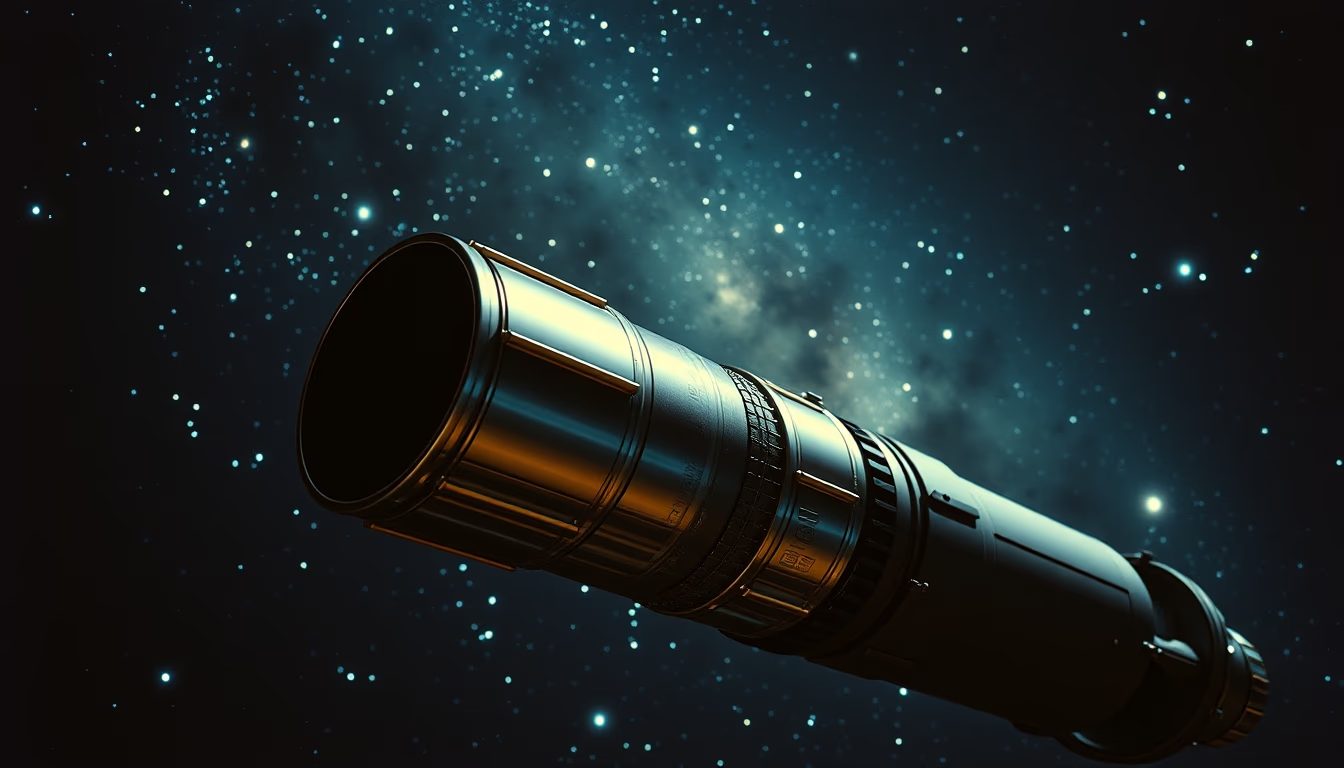
The Hubble Space Telescope has revolutionized astronomy since 1990, capturing cosmic images that transformed our understanding of the universe.
About this subject
Launched in April 1990 aboard the Space Shuttle Discovery, the Hubble Space Telescope (HST) is one of the most productive scientific instruments in history. Orbiting Earth at about 547 km altitude, it avoids atmospheric distortion, delivering ultra-high-resolution images of deep space. Its name honors astronomer Edwin Hubble, who discovered the universe's expansion in the 1920s.
Over three decades, Hubble has achieved remarkable feats. It helped determine the universe's expansion rate (Hubble constant), confirmed supermassive black holes at galaxy centers, recorded Comet Shoemaker-Levy 9's impact on Jupiter in 1994, and produced the iconic Hubble Deep Fields, revealing thousands of galaxies billions of light-years away. More than 1.5 million observations have been made, spawning thousands of scientific papers.
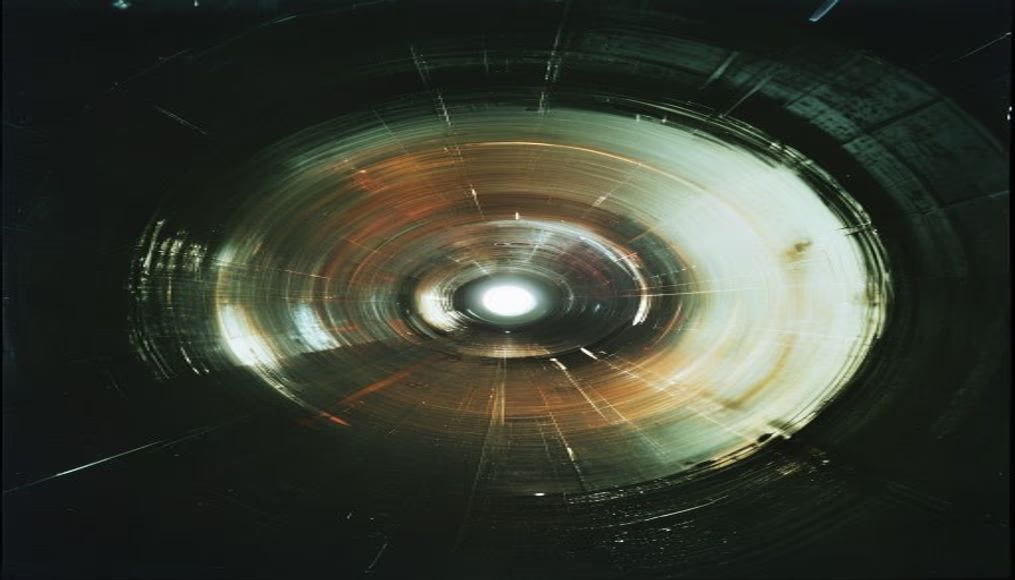
The lo-fi disposable camera style applied to Hubble's photograph creates an intentional contrast: the telescope's high-tech precision is reinterpreted through a grainy, imperfect analog aesthetic common in 1990s everyday snapshots. This artistic approach evokes nostalgia and ephemerality, reminding that despite scientific rigor, Hubble is also a cultural icon that inspired generations with its cosmic images. The filter choice suggests an alternative view, as if the grandeur of space were captured by an ordinary camera, making the unreachable feel closer and more human.
Frequently Asked Questions
What was Hubble's biggest challenge after launch?
Shortly after launch, Hubble's main mirror was found to have spherical aberration, causing blurred images. In 1993, Servicing Mission STS-61 installed a corrective system (COSTAR), restoring expected sharpness.
How many servicing missions did Hubble receive?
Five crewed servicing missions were carried out by space shuttles between 1993 and 2009. They replaced instruments, gyroscopes, batteries, and other components, keeping the telescope fully operational.
Will Hubble be replaced by the James Webb Space Telescope?
Not exactly. James Webb (launched in 2021) observes in infrared and has complementary goals. Hubble still operates in visible and ultraviolet light, and both are expected to work simultaneously for several years.
Direct URL
https://pub-c7d6a6ea828543ac903a74a341ccb2e1.r2.dev/imagens/space-telescope-hubble-photograph-lo-fi-disposable-camera-p4.avifHow to credit
Include a visible link back to UtilizAí. Copy one of the snippets below:
<a href="https://xn--utiliza-eza.com/en/midia/imagens/space-telescope-hubble-photograph-lo-fi-disposable-camera-p4">Space telescope hubble photograph</a> by <a href="https://xn--utiliza-eza.com">UtilizAí</a>, licensed under <a href="https://creativecommons.org/licenses/by/4.0/">CC BY 4.0</a>.
[Space telescope hubble photograph](https://xn--utiliza-eza.com/en/midia/imagens/space-telescope-hubble-photograph-lo-fi-disposable-camera-p4) by [UtilizAí](https://xn--utiliza-eza.com), CC BY 4.0
License: CC-BY-4.0