Space telescope hubble photograph
1344×768 · AVIF · CC BY 4.0
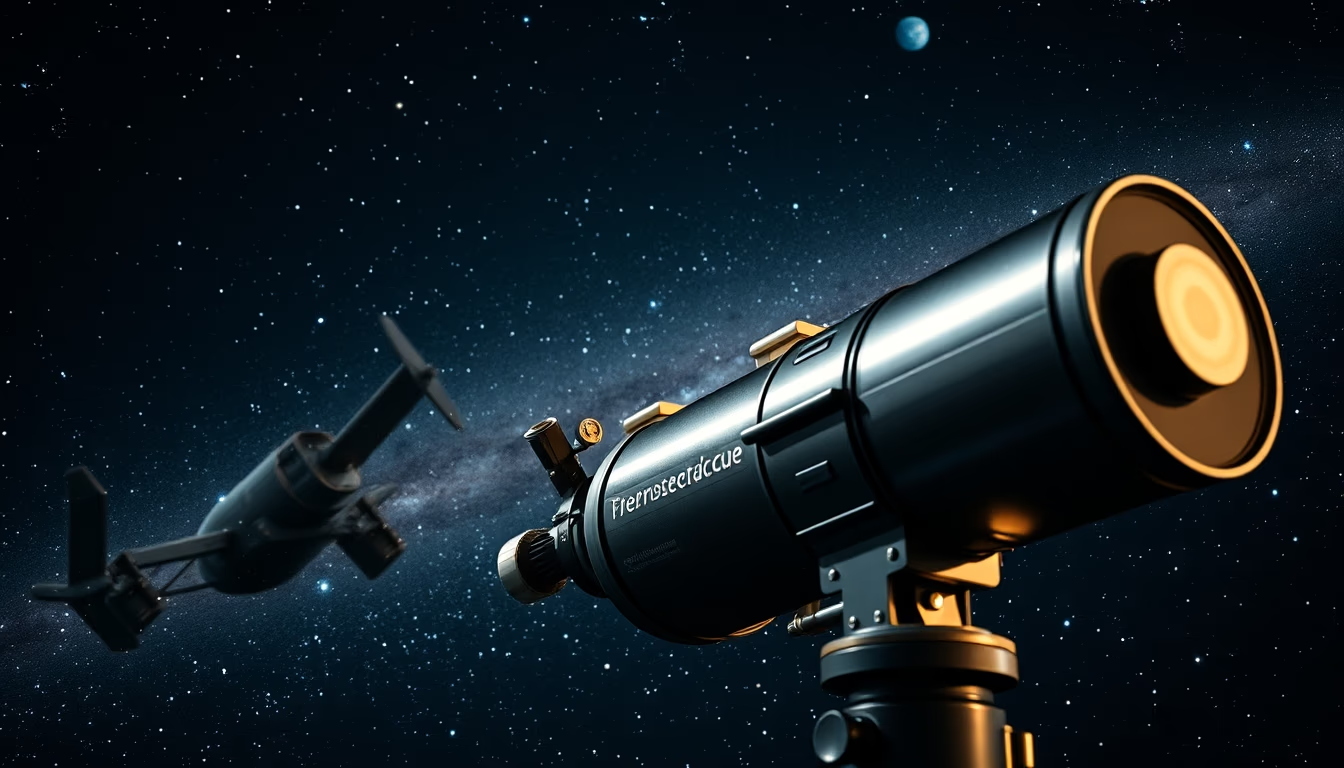
Launched in 1990, the Hubble Space Telescope revolutionized astronomy with crisp images of the cosmos, enabling discoveries about the universe's age, black holes, and the accelerated expansion driven by dark energy.
About this subject
The Hubble Space Telescope, a joint project of NASA and ESA, was launched on April 24, 1990, aboard the Space Shuttle Discovery. Orbiting Earth at about 547 kilometers altitude, it avoids atmospheric distortion, capturing images with far higher resolution than ground-based telescopes. Among its most notable contributions is the determination of the universe's expansion rate, known as the Hubble constant, which helped set the age of the cosmos at about 13.8 billion years. The telescope also provided direct evidence of supermassive black holes at the centers of galaxies, such as in M87, and captured iconic images of the Pillars of Creation in the Eagle Nebula.
Over more than three decades, Hubble underwent five servicing and upgrade missions performed by astronauts, replacing instruments like the Advanced Camera for Surveys and the Space Telescope Imaging Spectrograph. These upgrades allowed the telescope to continue producing cutting-edge scientific data, such as the discovery of exoplanets and observations of distant supernovae. One of its greatest achievements is the Hubble Ultra Deep Field, a long-exposure survey of a tiny patch of sky that revealed thousands of distant galaxies, some over 13 billion light-years away, providing a window into the early universe.
Hubble's legacy extends beyond science: its colorful, detailed images have inspired the public and educated generations about the beauty and complexity of space. It also served as a precursor to the James Webb Space Telescope, launched in 2021, which complements Hubble's observations by focusing on infrared to see through cosmic dust and study the first stars and galaxies. Despite technical challenges over the years, such as failing gyroscopes and data leaks, Hubble remains operational and continues to contribute to astronomy, with an expected lifespan into the 2030s.
Frequently Asked Questions
What was the major problem Hubble faced shortly after launch?
After launch, Hubble's primary mirror was found to have a manufacturing defect causing spherical aberration, resulting in blurry images. Fortunately, the STS-61 servicing mission (1993) installed corrective optics, restoring the expected sharpness.
How many images has Hubble captured so far?
As of October 2024, Hubble has conducted over 1.5 million observations and generated about 150 terabytes of data. Its scientific gallery has led to more than 10,000 peer-reviewed papers based on its data.
Is Hubble still operational? How much longer will it last?
Yes, Hubble remains operational, though relying on backup systems. Current estimates suggest it could continue working into the mid-2030s, depending on the degradation of its solar panels and gyroscopes.
Direct URL
https://pub-c7d6a6ea828543ac903a74a341ccb2e1.r2.dev/imagens/space-telescope-hubble-photograph-documentary-photography-p5.avifHow to credit
Include a visible link back to UtilizAí. Copy one of the snippets below:
<a href="https://xn--utiliza-eza.com/en/midia/imagens/space-telescope-hubble-photograph-documentary-photography-p5">Space telescope hubble photograph</a> by <a href="https://xn--utiliza-eza.com">UtilizAí</a>, licensed under <a href="https://creativecommons.org/licenses/by/4.0/">CC BY 4.0</a>.
[Space telescope hubble photograph](https://xn--utiliza-eza.com/en/midia/imagens/space-telescope-hubble-photograph-documentary-photography-p5) by [UtilizAí](https://xn--utiliza-eza.com), CC BY 4.0
License: CC-BY-4.0