Space telescope hubble photograph
1344×768 · AVIF · CC BY 4.0
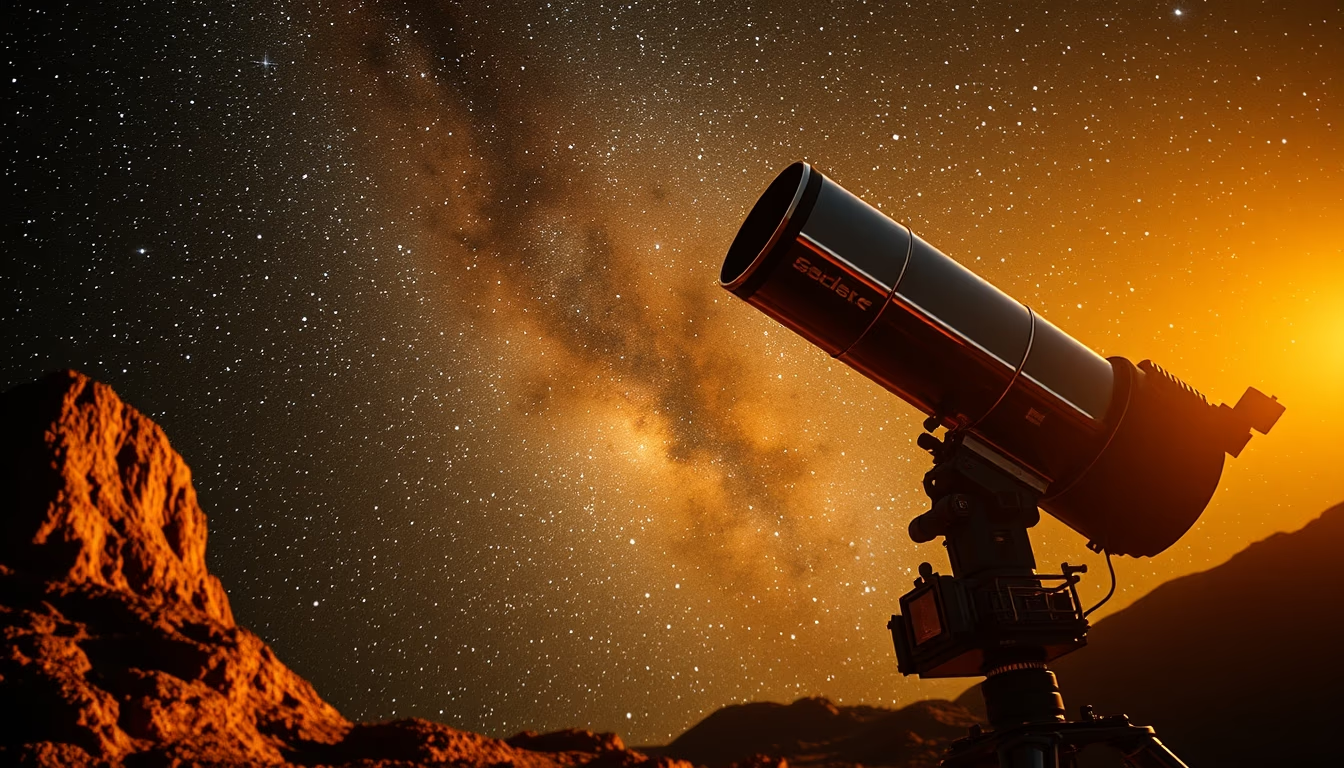
The Hubble Space Telescope, launched in 1990, revolutionized astronomy with deep universe images and discoveries about cosmic expansion.
About this subject
The Hubble Space Telescope, a joint project of NASA and ESA, was launched into orbit on April 24, 1990, aboard the Space Shuttle Discovery. Measuring 13.2 meters in length with a primary mirror of 2.4 meters, it orbits at approximately 540 km altitude, free from atmospheric distortion. Its advanced cameras and spectrographs observe from ultraviolet to near-infrared light, capturing objects billions of light-years away.
Among its most striking contributions is the discovery that the universe's expansion is accelerating, evidenced by Type Ia supernovae, which led to the 2011 Nobel Prize in Physics. Hubble also produced the Hubble Deep Field, an image of a tiny patch of sky revealing thousands of distant galaxies, helping estimate the universe's age at 13.8 billion years. It detected atmospheres of exoplanets, such as water vapor on HD 209458b, and monitored changes on Jupiter's and Saturn's moons.
The telescope underwent five servicing missions by astronauts between 1993 and 2009, fixing its flawed mirror and installing new instruments like the Wide Field Camera 3. Despite its successor, the James Webb Space Telescope, Hubble remains operational, providing complementary data especially in ultraviolet wavelengths that Webb cannot cover. Its longevity and productivity make it one of the most important scientific instruments in history.
Frequently Asked Questions
Why is the Hubble Space Telescope important for astronomy?
Hubble revolutionized astronomy by providing high-resolution images of the universe, enabling discoveries such as the acceleration of cosmic expansion, determining the universe's age, and detecting exoplanet atmospheres.
How many images has Hubble captured?
By 2024, the telescope has conducted over 1.5 million observations and generated an archive of about 200 terabytes of data, including images from solar system planets to distant galaxies.
What is the Hubble Deep Field?
It is a series of images of a tiny patch of sky in the constellation Ursa Major, exposed over several days, revealing thousands of extremely distant galaxies and helping study the early universe.
Direct URL
https://pub-c7d6a6ea828543ac903a74a341ccb2e1.r2.dev/imagens/space-telescope-hubble-photograph-cinematic-wide-shot-p6.avifHow to credit
Include a visible link back to UtilizAí. Copy one of the snippets below:
<a href="https://xn--utiliza-eza.com/en/midia/imagens/space-telescope-hubble-photograph-cinematic-wide-shot-p6">Space telescope hubble photograph</a> by <a href="https://xn--utiliza-eza.com">UtilizAí</a>, licensed under <a href="https://creativecommons.org/licenses/by/4.0/">CC BY 4.0</a>.
[Space telescope hubble photograph](https://xn--utiliza-eza.com/en/midia/imagens/space-telescope-hubble-photograph-cinematic-wide-shot-p6) by [UtilizAí](https://xn--utiliza-eza.com), CC BY 4.0
License: CC-BY-4.0