Solar wind cme
1344×768 · AVIF · CC BY 4.0
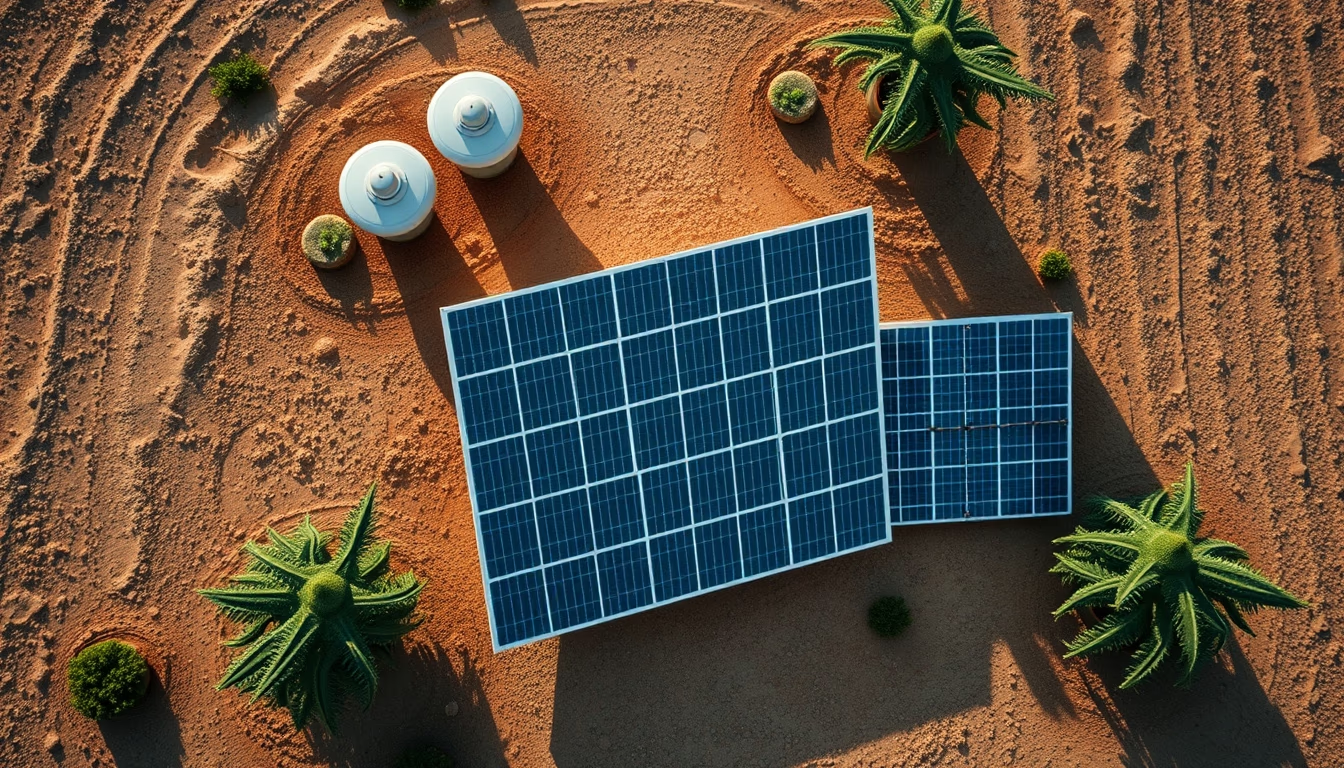
Solar wind and coronal mass ejections (CMEs) are phenomena that shape space weather and affect satellites, communications, and auroras on Earth.
About this subject
The solar wind is a continuous stream of charged particles (mostly protons and electrons) ejected from the Sun's corona at speeds ranging from 300 to 800 km/s. This flow travels throughout the solar system, creating the heliosphere, a magnetic bubble that shields planets from galactic cosmic rays. The intensity of the solar wind varies with the 11-year solar cycle, being strongest during solar maximum. Coronal mass ejections (CMEs), on the other hand, are violent explosions of plasma and magnetic fields from the solar corona, capable of releasing up to 10 billion tons of material in just hours.
CMEs are often associated with active regions on the Sun, such as sunspots and filaments. When a CME is directed toward Earth, it can reach the planet in one to three days, interacting with Earth's magnetosphere. This interaction generates geomagnetic storms, which can cause intense auroras at lower latitudes than usual, such as in southern Brazil. However, they also pose risks: they can induce electrical currents in power grids, damage satellites, and disrupt radio communications and GPS.
The difference between solar wind and CME lies in scale and origin. Solar wind is constant and diffuse, while CMEs are localized eruptive events. CMEs can travel at speeds exceeding 2,000 km/s, generating shock waves that accelerate particles, creating solar radiation storms. Instruments such as SOHO and DSCOVR continuously monitor the Sun to forecast these events, allowing satellite operators and power companies to take precautions.
Remarkably, the energy released in a large CME is equivalent to billions of atomic bombs. Beyond technological impacts, these phenomena provide valuable insights into plasma physics and stellar magnetic fields. Studying solar wind and CMEs is essential for space exploration, especially for crewed missions to Mars, where solar radiation is a constant concern.
Frequently Asked Questions
What is the difference between solar wind and a coronal mass ejection?
Solar wind is a continuous flow of particles from the Sun, while a coronal mass ejection (CME) is a violent, localized explosion of plasma and magnetic fields, much more intense and faster.
How do CMEs affect Earth?
When a CME hits Earth, it interacts with the planet's magnetic field, causing geomagnetic storms. This can produce auroras but also interfere with satellites, power grids, and communication systems.
Are CMEs dangerous for astronauts?
Yes, CMEs release energetic particle radiation that can be harmful to astronauts in space, especially on missions outside Earth's magnetosphere, such as future trips to Mars.
Direct URL
https://pub-c7d6a6ea828543ac903a74a341ccb2e1.r2.dev/imagens/solar-wind-cme-isometric-flat-lay-p9.avifHow to credit
Include a visible link back to UtilizAí. Copy one of the snippets below:
<a href="https://xn--utiliza-eza.com/en/midia/imagens/solar-wind-cme-isometric-flat-lay-p9">Solar wind cme</a> by <a href="https://xn--utiliza-eza.com">UtilizAí</a>, licensed under <a href="https://creativecommons.org/licenses/by/4.0/">CC BY 4.0</a>.
[Solar wind cme](https://xn--utiliza-eza.com/en/midia/imagens/solar-wind-cme-isometric-flat-lay-p9) by [UtilizAí](https://xn--utiliza-eza.com), CC BY 4.0
License: CC-BY-4.0