Solar prominence eruption
1344×768 · AVIF · CC BY 4.0
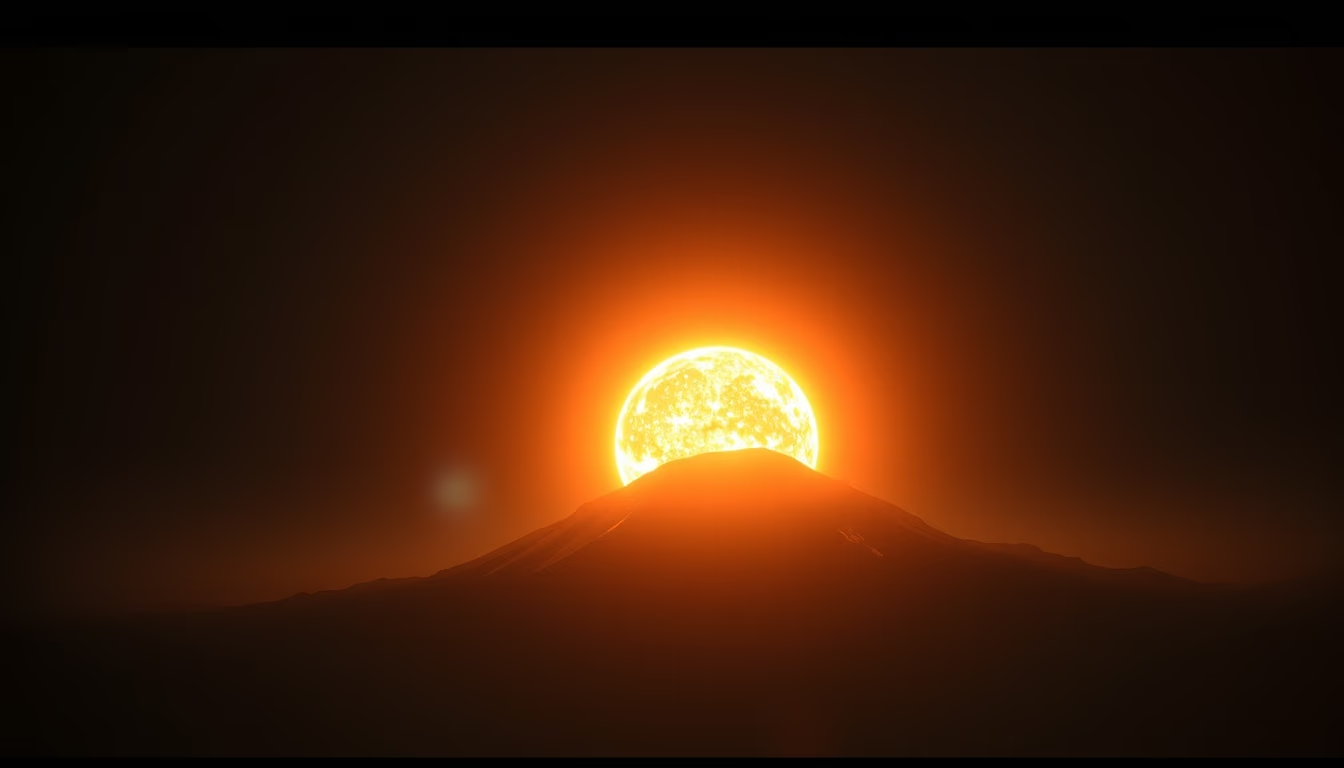
Solar prominence eruptions are explosions of magnetized plasma that can eject billions of tons of material into space.
About this subject
Solar prominences are large structures of dense, cooler plasma that form in the chromosphere and extend into the solar corona, supported by complex magnetic fields. When these structures become unstable, they can violently erupt, releasing enormous amounts of energy. This phenomenon, known as a prominence eruption, is often associated with solar flares and coronal mass ejections (CMEs). A typical prominence can reach hundreds of thousands of kilometers in height, dwarfing Earth's diameter many times. The approximately 11-year solar cycle influences the frequency and intensity of these eruptions, peaking during solar maximum.
The mechanism behind eruptions involves magnetic reconnection, where magnetic field lines abruptly rearrange, converting magnetic energy into kinetic and thermal energy. During an eruption, plasma accelerates to hundreds of kilometers per second. When directed towards Earth, resulting CMEs can cause geomagnetic storms, affecting satellites, communications, and power grids. Notable events include the 1859 Carrington Event and a near-miss eruption in 2012. Observatories like the Solar Dynamics Observatory (SDO) constantly monitor the Sun to predict such events.
Besides potential hazards, prominences offer a stunning visual display during total solar eclipses, appearing as reddish loops on the Sun's edge. Recent studies show prominence temperatures around 10,000 K, much cooler than the surrounding corona (1-2 million K), making them visible in specific wavelengths like H-alpha. Understanding these phenomena is crucial for space weather, helping protect modern technology and astronauts on future missions, such as voyages to Mars.
Frequently Asked Questions
What is the difference between a solar prominence and a solar flare?
Prominences are cooler, denser plasma structures suspended in the corona, while solar flares are sudden bursts of electromagnetic radiation. A prominence eruption can release energy equivalent to billions of hydrogen bombs, but flares are more intense in X-rays and ultraviolet.
Do prominence eruptions affect Earth?
Yes, when the eruption is associated with a coronal mass ejection (CME) directed at Earth, it can cause geomagnetic storms. This can disrupt satellite communications, GPS systems, and power grids, as well as generate intense auroras at lower latitudes.
How often do prominence eruptions occur?
Frequency varies with the solar cycle. During solar maximum (every ~11 years), several can occur per day. At solar minimum, weeks may pass without significant eruptions. Major eruptions are rarer but still happen a few times per year.
Direct URL
https://pub-c7d6a6ea828543ac903a74a341ccb2e1.r2.dev/imagens/solar-prominence-eruption-film-grain-authentic-p6.avifHow to credit
Include a visible link back to UtilizAí. Copy one of the snippets below:
<a href="https://xn--utiliza-eza.com/en/midia/imagens/solar-prominence-eruption-film-grain-authentic-p6">Solar prominence eruption</a> by <a href="https://xn--utiliza-eza.com">UtilizAí</a>, licensed under <a href="https://creativecommons.org/licenses/by/4.0/">CC BY 4.0</a>.
[Solar prominence eruption](https://xn--utiliza-eza.com/en/midia/imagens/solar-prominence-eruption-film-grain-authentic-p6) by [UtilizAí](https://xn--utiliza-eza.com), CC BY 4.0
License: CC-BY-4.0